Every investor wants companies that can cope well during economic turbulence.
And while no company is completely immune to shocks, Singapore banks deserve some attention for their resilience across multiple crises.
Their ability to absorb shocks without significantly compromising shareholder returns is precisely why they remain a cornerstone of defensive portfolios.
What Makes Singapore Banks Different?
Monetary Authority of Singapore (MAS)’s rigorous regulatory framework ensures Singapore banks maintain prudent lending practices and strong governance.
The capital adequacy requirements compel banks to hold sufficient capital relative to their risk exposure.
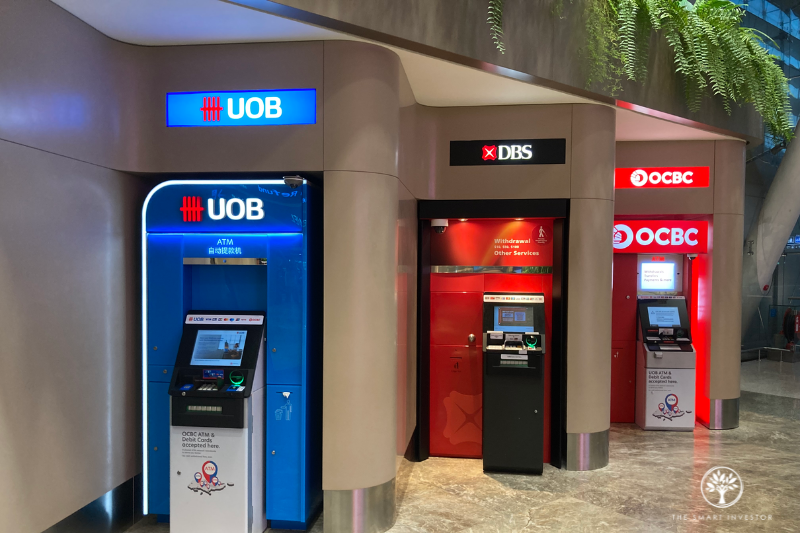
Three major players – DBS Group (SGX: D05), OCBC Bank (SGX: O39), and United Overseas Bank (SGX: U11) – dominate Singapore’s banking scene.
Their scale gives them significant competitive advantages, extensive customer networks, and strong brand recognition.
The industry’s high regulatory hurdles and capital requirements also create almost impenetrable barriers to entry for new players.
Furthermore, Singapore banks generate income from multiple business streams.
While traditional lending remains a major earnings driver through interest income, banks also earn from wealth management services, transaction fees, and commissions from various products.
How Banks Survive Economic Shocks
People and businesses use banking services regardless of economic conditions.
Even during recessions, services such as deposits, payroll, and trade transactions all continue to happen.
The essential nature of banking services creates dependable and recurring revenue for banks.
Singapore banks are also well-known for maintaining conservative balance sheets.
Healthy capital ratios ensure banks have enough financial resources to absorb unexpected losses, while ample liquidity allows them to meet withdrawal demands even during periods of stress.
While loan defaults are an unavoidable part of banking, Singapore banks regularly set aside provisions to cover potential bad debts.
These provisions act as a buffer, allowing banks to recognise losses without severely damaging profitability or capital strength.
Why Singapore Banks Have Become Income Machines
Singapore banks have demonstrated a remarkable ability to generate substantial profits across different economic environments.
For the first quarter of 2026 (1Q2026), DBS and OCBC reported S$5.95 billion and S$3.83 billion in total income, up 1% and 5% year on year (YoY) respectively, while UOB recorded S$3.4 billion.
Strong profitability directly strengthens a bank’s capacity to reinvest in growth, build capital reserves, and return cash to shareholders.
Additionally, Singapore banks’ stable earnings and healthy capital positions allow them to distribute a meaningful portion of profits to shareholders.
In addition to ordinary dividends, banks may also reward shareholders with special dividends during periods of exceptionally strong earnings or surplus capital.
For FY2025, DBS paid S$3.06 per share in total dividends, consisting of S$2.46 in ordinary dividends and S$0.60 in capital return dividends.
Meanwhile, UOB rewarded its shareholders with a total dividend payout of S$1.56 per share for FY2025 (which included a special dividend of S$0.50), and OCBC paid out S$0.99 for the same period.
The Three Key Drivers Investors Should Watch
- Interest rates: Wider net interest margins (NIM) during rate hikes boost profitability because loan returns outpace deposit costs. However, excessively high rates can suppress loan demand and trigger borrower defaults.
- Loan growth: Stronger lending volumes directly expand interest income, serving as a reliable indicator of economic health and future earnings momentum.
- Wealth management growth: The region’s rapidly growing affluent populations drive lucrative, predictable fee income (e.g., advisory and estate planning) that stabilises revenues during low-interest-rate cycles.
Are Singapore Banks Truly “Shock-Proof”?
Even the most resilient banks in Singapore cannot be shielded from adverse economic conditions or financial risks.
Residential home loans, commercial mortgages, and developer lending represent a significant part of revenue sources for banks.
Therefore, any significant changes to the real estate market, including decreased property prices and transaction volume, will negatively influence the banks’ lending and loan quality.
During recessions, weaker business activity and declining consumer spending can also increase credit risk and pressure on profitability.
Fintech companies and digital banks also compete with conventional banks by offering faster, lower-cost, and more convenient services.
Remember, even high-quality banks remain exposed to macroeconomic cycles and unexpected disruptions.
Why Many Long-Term Investors Still Prefer Banks
Bank stocks appeal to long-term investors because they offer the potential for both income and capital appreciation.
Shareholders can benefit from consistent dividend payments while also participating in share price gains as earnings grow over time.
Even in inflationary environments, banks remain appealing as they can maintain earnings power.
Compared with highly technical industries such as semiconductors or biotechnology, banks are often easier for many investors to understand.
Most people interact with banks regularly, making their services familiar and easier to evaluate.
Common Misconceptions About Bank Stocks
Although higher interest rates can boost bank profitability through increased NIMs, they are just one of many factors.
Earnings are also heavily driven by loan growth, non-interest income, and the broader economic environment.
Another misconception is that high dividend payouts stifle growth.
In reality, banks with significant dividends usually have well-established business models, allowing them to easily cover expenses and fund growth out of existing cash flows – the two are not mutually exclusive when a business generates durable earnings.
Finally, while bank stocks are sometimes labelled as boring due to operating in mature, heavily regulated industries, these businesses often deliver highly attractive long-term investment outcomes precisely because they prioritise consistency over hype.
Get Smart: Resilience Makes Banks Special
In a market increasingly defined by volatility, Singapore banks continue to stand out as rare islands of resilience.
Their secret lies in a powerful mix of risk management, pricing power, and diversified income streams, making them some of the market’s most shock-resistant income plays.
The smartest investors know that while Singapore banks are not immune to downturns, they offer a compelling combination of resilience, profitability, and income stability for the long-term.
Imagine receiving steady rent increases for more than two decades. It sounds unusual, but one healthcare REIT already has rental escalations locked in until around 2042. Income visibility like this is hard to find today. We break down how this REIT built such dependable cash flow in our FREE dividend report and how it could strengthen a retirement portfolio. Get the free report here.
Follow us on Facebook, Instagram and Telegram for the latest investing news and analyses!
Disclosure: Wenting A. does not own any of the stocks mentioned.