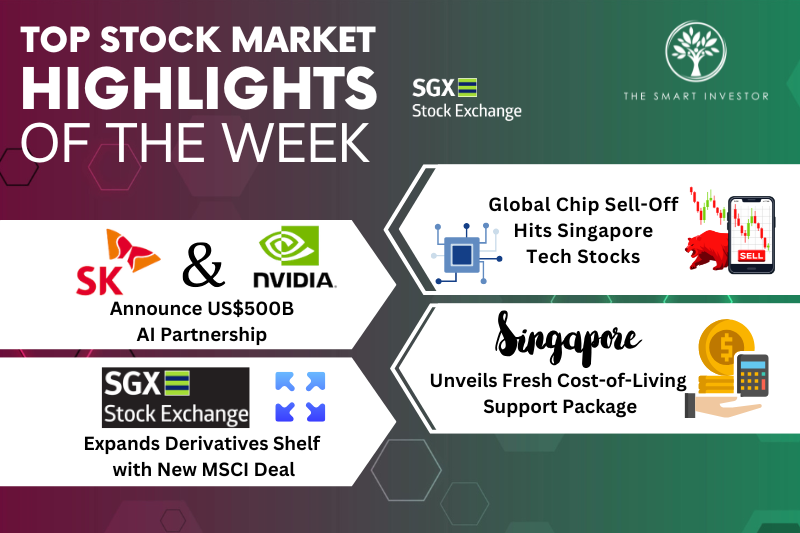
A global chip rout dragged down Singapore’s technology counters this week, even as South Korea’s SK Group and NVIDIA (NASDAQ: NVDA) unveiled one of the largest artificial intelligence (AI) infrastructure commitments to date.
Closer to home, the government rolled out a second round of cost-of-living support for households and businesses, while Singapore Exchange (SGX: S68) struck a licensing deal that materially widened its derivatives shelf.
Here are the four developments we are watching.
Chip sell-off drags Singapore technology counters lower
Singapore’s technology and semiconductor counters were caught in a global memory chip rout on Tuesday, 28 July 2026.
Frencken Group (SGX: E28), a supplier to Applied Materials (NASDAQ: AMAT), took the largest hit and fell 8.9% by the close, while UMS Integration (SGX: 558), also an Applied Materials supplier, declined 8.5%.
AEM Holdings (SGX: AWX) shares dropped 8.5% and CSE Global (SGX: 544) shed 4.9%.
The trigger was a 5.8% slide in ASML (NASDAQ: ASML) after a report that an unnamed state-backed Chinese company can now mass-produce immersive deep ultraviolet lithography machines – tools regarded as a central workhorse of the semiconductor industry and a core revenue stream for ASML, which is estimated to hold as much as 90% of the lithography market.
Japanese equipment makers Nikon (TYO: 7731) and Canon (TYO: 7751) fell as much as 9.2% and 6.3% respectively, while Samsung Electronics (KRX: 005930) and SK Hynix (KRX: 000660) retreated by as much as 9.5% and 10.9%.
Ironically, the weakness came just after Chinese memory maker ChangXin Memory Technologies, or CXMT (SSE: 688825) became the country’s most valuable listed company, its shares surging 466% on their Shanghai trading debut following an initial public offering said to be more than 200 times oversubscribed.
Morningstar equity analyst Jing Jie Yu, however, called the debut close overdone and now views the shares as considerably overvalued.
SK Group and NVIDIA unveil sweeping AI infrastructure pact
SK Group and NVIDIA announced on 24 July 2026 plans for a partnership worth more than US$500 billion to build AI infrastructure, spanning AI factory construction through to AI memory supply, with letters of intent signed to formalise the agreement.
SK Telecom (KRX: 017670) will build a two-gigawatt AI cloud in Korea using NVIDIA’s DSX platform and Vera Rubin accelerated computing powered by SK Hynix HBM4, with the first AI factory planned to come online in 2027.
Separately, SK Hynix is entering a long-term AI memory partnership with NVIDIA that secures the chip designer a stable supply of next-generation memory, including high-bandwidth memory, with both parties codeveloping solutions for workloads ranging from large language model training to agentic and physical AI.
NVIDIA founder and chief executive Jensen Huang said South Korea has the world-class networks, data centres, chip leadership and industrial scale to become a global AI powerhouse, while SK Group chairman Chey Tae-won framed the tie-up as helping Korea move from leading AI adopter to global innovation hub.
Singapore rolls out second cost-of-living support package
Singapore announced a further S$900 million of government support on 29 July 2026 to cushion households and businesses from elevated energy prices tied to Middle East uncertainty, including S$300 more in CDC vouchers for every household and additional rebates in October 2026 and January 2027 to offset higher utility bills.
Two-thirds of the package goes to households, with the remainder directed at businesses.
Businesses will receive cash grants of at least S$500 for every small and medium-sized enterprise (SME) with a local employee, alongside up to S$1,200 in rental support for hawker centre and market stallholders.
Some 160,000 SMEs are expected to benefit, with grants disbursed in November and capped at S$2,500 per business.
The government will also lift its risk-share under the working capital loan and project loan schemes from 50% to 70%.
Together with April’s S$1 billion package, support now totals around S$2 billion on top of Budget 2026 schemes.
The economy grew 6.3% in the first quarter of 2026 (1Q2026), with advance estimates showing 5.7% growth in 2Q 2026.
SGX expands derivatives shelf with new MSCI deal
Singapore Exchange has signed a new licensing agreement with MSCI (NYSE: MSCI) to introduce up to 100 new contracts, which the bourse describes as a material expansion of its derivatives product shelf.
The initial phase will bring some 40 futures and options contracts to market, spanning MSCI’s flagship global developed market benchmarks, key Asia-Pacific single-country indices and emerging market Asia sector indices.
The deal also marks a reversal of ties between the two parties.
Back in 2020, MSCI shifted licensing for the majority of its regional Asian and emerging market derivatives to Hong Kong.
SGX chief executive Loh Boon Chye said the exchange has built a distinct capability in creating markets around the exposures global investors need, adding that a comprehensive MSCI suite gives investors a broader platform to manage global equity risk through one venue.
MSCI chairman and chief executive Henry Fernandez said the agreement extends the two firms’ long-standing partnership.
2008. 2020. 2022. Three of the toughest stretches for Singapore markets in a generation. We found 6 SGX companies that paid a dividend every single year through all three. Our free report reveals the six companies and what allowed them to keep paying when others couldn’t. Click here to download now.
Follow us on Facebook, Instagram and Telegram for the latest investing news and analyses!