Right now, infrastructure is a hot topic.
Governments and private players are pouring cash into cleaner energy, digital networks, and city development.
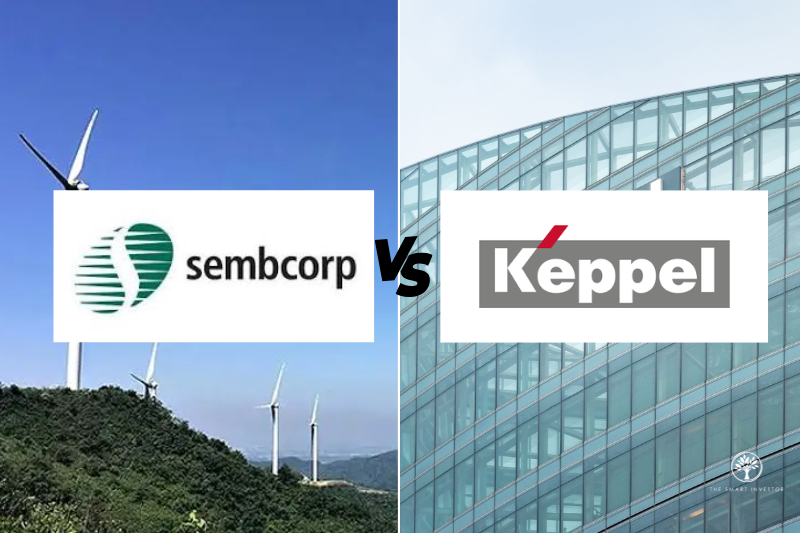
There’s a race to build the future, and Sembcorp Industries Ltd (SGX: U96) and Keppel Ltd (SGX: BN4) are right in the thick of it.
As we explored in our earlier comparison of the two companies, both have moved beyond their legacy businesses and rebuilt themselves around infrastructure-led growth.
So, which company sets up long-term investors for better success?
How Both Companies Have Reinvented Themselves
In the last few years, Sembcorp has completely reworked its identity into an energy and urban solutions group.
The old-school energy side still does the heavy lifting, contributing about 70% of underlying profit.
But the growth capital is going elsewhere: Sembcorp has invested over S$5 billion in renewables globally since 2021, expanding gross renewables capacity more than six-fold from 3.2 GW to 20.4 GW.
Keppel, on the other hand, has made a big shift.
Its left its offshore and marine businesses behind and transformed itself into a global asset manager and infrastructure solutions provider.
Now, Keppel deals in everything from infrastructure and real estate to data centres, subsea cables and fund management.
So, in a nutshell: Sembcorp’s getting greener, and Keppel’s going lighter.
The Energy Transition
Sembcorp offers the more direct clean-energy play.
On top of that, the proposed acquisition of Alinta Energy — expected to complete by mid-2026 — will boost its footprint in Australia, bringing a 10.4 GW renewables and firming development pipeline along with a coal-fired plant that lifts near-term emissions.
Its portfolio spans mainly solar, wind and energy storage, so investors get direct access to the growing appetite for low-carbon power across Asia-Pacific.
Keppel’s role is broader. Its 600 MW hydrogen-compatible Keppel Sakra Cogen Plant is nearing generation readiness.
Its decarbonisation and sustainability business also secured over S$700 million of new long-term contracts in 1Q2026.
These included a second 20-year contract from Singapore’s Housing & Development Board (HDB) to provide centralised cooling to nine Build-to-Order projects in Tengah.
Summing it up, Sembcorp is scaling clean-energy generation. Keppel is building and running the infrastructure that makes the wider energy transition work.
Infrastructure Growth
Sembcorp’s infrastructure growth is anchored by contracted utility earnings.
Around 80% of its Singapore contracted portfolio, excluding Senoko Energy, was locked in for five years or more as of February 2026, giving it strong cash-flow visibility.
Senoko, in which Sembcorp raised its stake to 50% in 2025, runs on shorter contracts, with about half of its contracts up for renewal in 2026.
Beyond power generation, its urban developments now span 16,200 hectares across Asia.
Keppel is pursuing a more asset-light model.
Its funds under management reached S$95 billion at end-2025, up 8% on the year.
More recently, asset management fees rose 13% year on year to S$108 million in 1Q2026.
Net profit for the quarter slipped slightly, as stronger Infrastructure and Connectivity earnings were offset by a weaker Real Estate contribution.
But cash generation moved the right way, with Keppel swinging to a free cash inflow after an outflow a year earlier.
Which Company Has the Better Growth Drivers?
Sembcorp’s growth rests on expanding renewables, rising regional power demand and urban solutions.
Since end-2024, it has secured 3.6 GW of new renewables capacity across key markets.
Keppel has more varied levers.
Beyond growing fee income, as at the end of 1Q2026, it had about S$2 billion of additional limited-partner commitments in advanced documentation, spread across its data centre, education and private credit funds.
Dividend Comparison
Sembcorp has built a clearer dividend-growth record.
Its FY2025 dividend rose 9% to S$0.25 per share, up from S$0.23 in FY2024, supported by underlying net profit of about S$1 billion and improved free cash flow.
Its payout remains measured, leaving room to fund further renewables expansion.
Keppel kept its ordinary FY2025 dividend at S$0.34 per share, equivalent to a 56% payout ratio on New Keppel’s net profit.
It also proposed a special dividend worth about S$0.13 per share (S$0.02 in cash plus one Keppel REIT unit for every nine Keppel shares held), bringing total FY2025 dividends to roughly S$0.47.
Keppel bases ordinary dividends on New Keppel’s performance, while special dividends are linked to completed asset monetisation.
Valuation: Which Looks More Attractive?
Let’s break it down: Sembcorp currently trades at a price-to-earnings (P/E) ratio of 9.6x its FY2025 earnings and a price-to-book (P/B) ratio of 1.7x.
Sembcorp’s dividend of S$0.25 per share offers a yield of 4.7%, and its underlying return on equity (ROE) clocks in at 18.2%.
Keppel, on the other hand, trades at a P/E ratio of 20.3x and a P/B ratio of 1.9x.
Its S$0.34 ordinary dividend translates into a yield of about 3%, while New Keppel delivered an ROE of 18.7% in FY2025.
Including the special dividend, Keppel’s total dividend yield works out to about 4%.
That figure deserves care, though: most of it arrives as REIT units rather than cash, its value moves with Keppel REIT’s unit price, and the payout is tied to asset monetisation rather than operating earnings.
On profitability, then, there is little to choose between them.
Which Stock Fits Different Investors?
Sembcorp is a good choice for investors who want direct access to renewable energy, steady demand for utilities, and a shot at growing dividends over time.
If you’re after something with a wider base, Keppel offers a bigger platform. It gives you exposure to all sorts of infrastructure, lets you benefit from recurring asset-management fees, and adds data centres and connectivity to the mix.
You don’t have to pick just one, either, as owning both Sembcorp and Keppel widens your reach.
Sembcorp covers energy generation and utilities, while Keppel brings in infrastructure funds and digital assets.
If you mix them, your investments are spread out, as you’re not putting all your eggs in one basket.
Get Smart: Infrastructure Is a Marathon, Not a Sprint
Both Sembcorp and Keppel have repositioned themselves to capture long-term infrastructure growth.
If you want simple, direct exposure to renewables and utilities, go with Sembcorp.
If you’re after more variety, such as in infrastructure, connectivity, and asset management without heavy assets, then Keppel’s your pick.
But here’s what actually matters: not who pulls ahead next quarter, but which company can keep building real value year after year.
Imagine owning businesses that continued paying shareholders even when markets were falling. That’s the appeal of dividend investing done well. Our FREE report reveals 6 SGX companies that paid dividends every single year for two decades, through the Global Financial Crisis, COVID-19, and 2022’s rate shock. Start building the kind of income stream that could fund a more comfortable retirement. Get your free report here.
Follow us on Facebook, Instagram and Telegram for the latest investing news and analyses!
Disclosure: Joseph G. does not own shares of any companies mentioned.