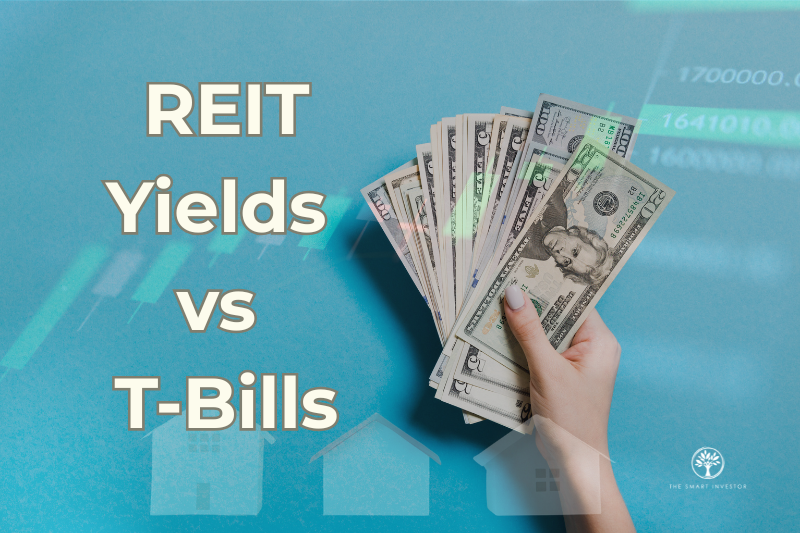
Singaporeans just love to compare, and a common matchup is usually Singapore Real Estate Investment Trusts (REITs) versus Singapore Treasury Bills (T-Bills).
As global interest rates rose, T-Bills began offering yields that closely rivalled REITs.
While both are fantastic tools in generating cash flow, they play completely different roles in our portfolio.
This left many questioning whether it was even worth taking on equity risk when guaranteed money paid so well.
Recently, the macroeconomic landscape has shifted yet again.
Here’s why the yield gap has opened up significantly in favour of REITs, and how investors can deploy their cash.
Why the Yield Gap Matters
To understand where to put our money, we need to look at the classic risk-reward trade-off.
Since T-Bills are backed by the government, they are essentially risk-free.
Meaning, our initial capital is safe from stock market crashes.
REITs, on the other hand, are equities.
When buying REITs, we take on real-world property risks like tenants breaking their leases and macroeconomic downturns.
Thus, investors expect a “risk premium” – a higher yield to justify that extra risk.
The yield spread is simply the difference between what a REIT pays and what a T-Bill pays.
When this spread widens, we flock toward REITs to capture higher payouts.
But when the spread shrinks, we run right back to the comfort of guaranteed returns.
What Happened During the Interest Rate Surge?
T-Bills get the spotlight the moment central banks hike interest rates to combat inflation.
When that happens, we naturally go for secured and hassle-free returns.
At the same time, those high interest rates put massive pressure on REITs.
Higher interest rates mean higher borrowing costs, forcing a REIT’s interest expenses to skyrocket when refinancing property loans.
With higher interest expenses eating into profits, its distribution per unit (DPU) – the actual payout we receive – gets directly hit.
Additionally, when investors fear falling distributions and property valuations, they sell off their REIT holdings, driving unit prices down.
Has the Gap Widened Again?
Today, with interest rates easing and T-Bill yields pulling back, that extra premium is back on the table.
The May 2026 6-month Singapore T-Bill cut-off yield fell back down to hover around 1.45%.
Compared to the near 4% peaks during the height of the global inflation scare, this drop is massive.
On the flip side, REIT distributions and unit prices have gone through a healthy reset.
High-quality REITs like Keppel REIT (SGX: K71U) mended their fundamentals and comfortably trade at an average yield of 5.5%.
Some players including Digital Core REIT (SGX: DCRU) and Stoneweg Europe Stapled Trust (SGX: SET) stretched beyond 7%.
Comparing a capped 1.45% T-Bill against a 5.6% average REIT payout, the yield spread has aggressively widened to around 4.15%.
The stock market is finally providing a massive risk premium to reward investors for stepping out of cash and back into REITs.
REITs Still Offer Something T-Bills Cannot
Buying T-Bills keeps your returns fixed and static until maturity.
REITs, however, can actively give us a pay raise.
Through positive rental reversions or acquiring new, income-generating properties, a well-managed REIT can grow its DPU year after year.
REITs also offer the potential for capital appreciation, unlike T-Bills where your capital stays exactly the same at maturity.
As borrowing costs ease and property valuations recover, underlying unit prices will rise alongside improving business fundamentals.
Lastly, REITs are known to be reliable inflation hedges.
Most commercial and industrial leases come with indexation clauses, where rental income increases with inflation, preventing it from eroding our purchasing power.
T-Bills Still Deserve a Place in Your Portfolio
However, if we need cash for short-term goals like a housing down payment, a wedding, or our emergency fund, we cannot afford stock market risk.
That’s where T-Bills come in, keeping our capital 100% secure.
Because our money is locked up for just six months to a year, they provide great flexibility.
If the stock market experiences a pullback, we have guaranteed cash maturing soon to buy in at a massive discount.
Sometimes, the peace of mind we get from government-backed assets is also worth far more than higher potential returns.
Which Type of Investor Should Choose Which?
If our main goal is growing a substantial passive income stream, and we can ride out short-term stock market dips, shifting toward high-quality REITs makes perfect sense – especially with the wider yield gap now.
However, if we want to protect our money or need certainty over growth, T-Bills are the place to go.
But why choose one if we can have both?
T-Bills can protect short-term cash needs and emergency funds, while REITs anchor our long-term portfolio to achieve compounding wealth.
Yield Alone Isn’t Enough
Before diving back into the REITs market, we cannot look strictly at the headline distribution yield.
That is the fastest way to fall into a yield trap.
Often, unsustainably high yields are simply a warning sign that a REIT’s unit price has crashed because its underlying business fundamentals are in deep trouble.
For starters, we can look at the occupancy rate.
High occupancy means properties are in demand and actively generating cash, rather than sitting empty.
While high yields are attractive, we should always check the balance sheet strength.
REITs with a gearing ratio well under 40% provide a comfortable safety buffer, below the regulatory 50% leverage limit.
Consistent, positive rental reversions are vital too, proving that the REIT has a strong economic moat and the pricing power to outpace inflation.
Get Smart: The Right Choice Depends on Your Goals
When global interest rates spiked, the yield gap compressed, making T-Bills look incredibly attractive next to REITs.
But since the landscape flipped again, the yield spread has widened and is heavily compensating those who take on equity risk.
However, neither option is inherently superior.
The right choice depends entirely on our personal financial goals and how we combine both assets to help build our wealth.
If you want to retire with a constant stream of dividends, these 5 stocks might be all you need. We’ve found 5 SG stocks that have kept paying (and growing) through inflation, rate hikes, and recessions. See what they are with our latest free report for SGX dividend investors. Click here to get instant access.
Follow us on Facebook, Instagram and Telegram for the latest investing news and analyses!
Disclosure: Si-Fan T. does not own shares in any of the companies mentioned.