Singapore companies are buying back their shares at a pace we have not seen in years.
Over the first five months of 2026, 57 primary-listed companies repurchased S$1.26 billion of their own shares on the open market. That is up from around S$930 million in the same period of 2025, and S$505 million the year before that.
The big names led the way. Singtel (SGX: Z74), OCBC (SGX: O39) and Keppel (SGX: BN4) topped the table, each spending tens or hundreds of millions. Singtel alone bought back close to S$497 million of stock. That is a big number, and big numbers get the attention.
But further down the list sit three much smaller companies.
Their buybacks run to hundreds of thousands of dollars, not hundreds of millions. That is the part worth pausing on.
For a small company, a buyback is not a capital management exercise dressed up for the annual report. It is a quiet decision, made with spare cash, and it tells you something about how the people running the business see their own shares.
The question I always come back to is a simple one. Can the company buy back stock without putting the dividend at risk? Free cash flow (FCF) is the lifeblood of dividends. The companies worth watching are the ones returning cash they actually have, not cash they had to borrow. All three below clear that bar.
Credit Bureau Asia (SGX: TCU)
Credit Bureau Asia (CBA) sells credit and risk information to banks, financial institutions and government bodies across Southeast Asia. It bought back S$113,170 of shares over the first five months of 2026. A small sum, but not a small thing for a company this size.
The balance sheet is where the comfort lies. At the end of December 2025, the group carried no debt, S$46.5 million in cash, and another S$24.7 million in short-term financial assets. That is S$71.1 million in liquid assets all in. FCF for the year was S$27.2 million.
That strength let the group lift its full-year dividend to S$0.042 per share, from S$0.040 the year before.
What caught my eye is that the rise came in a soft year. Revenue inched up just 0.7% to S$60.1 million, and profit attributable to owners fell 4.4% to S$10.7 million, dragged down by lower interest income and a weaker contribution from its Cambodia joint venture.
So the higher dividend and the buyback are being paid for out of the balance sheet, not out of growth. That is fine while the cash is there. It is worth keeping an eye on if the soft patch drags on.
Micro-Mechanics (Holdings) Ltd (SGX: 590)
If Credit Bureau Asia is the steady earner, Micro-Mechanics is the one with the wind behind it.
The company makes consumable tools and parts used in semiconductor manufacturing, and it repurchased S$368,321 of its shares over the period.
The recent numbers show why management might rate the stock.
For the third quarter ended 31 March 2026 (3QFY2026), revenue rose 16.2% to S$18.6 million, and net profit climbed 18.8% to S$3.8 million. The push came from its Consumable Tools segment, where sales jumped 20.9% on the back of demand from artificial intelligence, computing and memory. Gross margin widened to 51.6%, from 50.5% a year earlier.
The group finished the quarter with S$25.7 million in cash and no bank borrowings.
One thing for income investors to note: FCF for the quarter slipped to S$2.8 million from S$3.6 million a year ago, as a heavier working capital load weighed on operating cash flow.
Micro-Mechanics also pays dividends only in its second and fourth quarters, so there was no payout this time. The cash pile gives it room to keep both the buybacks and the dividends running.
Kimly (SGX: 1D0)
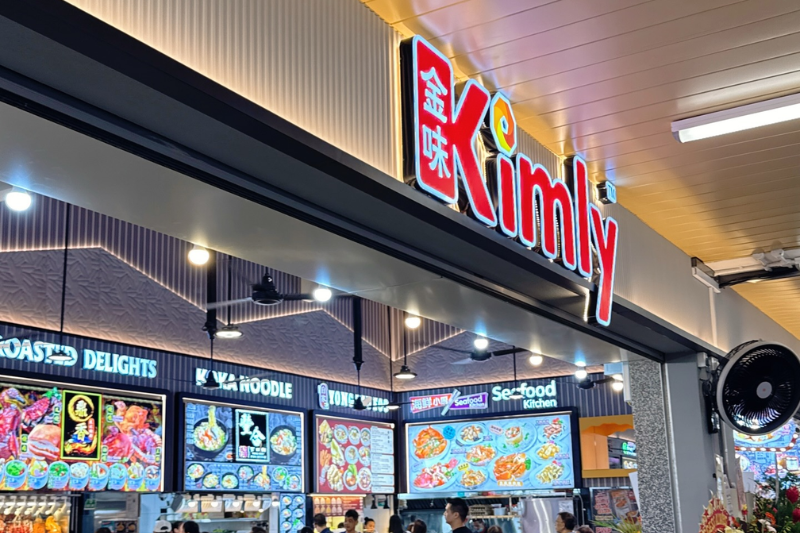
One of Singapore’s largest coffee shop operators, Kimly was the busiest buyer of the three. It repurchased S$538,682 of shares over the period. It is also the one that needs reading with the most care.
For the first half of its financial year ending 30 September 2026 (1HFY2026), revenue edged up 1.3% to S$161.4 million, while profit attributable to owners rose 10.6% to S$16.4 million, helped by a margin improvement from 27.5% to 28.3%.
The FCF line is where I would slow down.
Kimly reported S$27.0 million for the half, but that figure was pulled lower by a one-off S$12.1 million spent buying a coffee shop property at Haig Road. Take that purchase out, and underlying free cash flow was closer to S$39.2 million – a healthier picture once you look past the one-off.
The group held S$65.1 million in cash against S$10.6 million in borrowings, and held its interim dividend at S$0.010 per share.
Management was upfront that the food and beverage trade still faces rising costs across raw materials, utilities, rentals and labour. So the buyback here reads as confidence, with one eye on the weather.
Get Smart: The Signal Beneath the Small Numbers
It would be easy to skip past these three. Next to Singtel’s near-S$500 million, a few hundred thousand dollars of buybacks barely shows up.
But the size is not the point.
What links Credit Bureau Asia, Micro-Mechanics and Kimly is that each one holds net cash, each one generates FCF, and each one has chosen to hand some of that spare cash back to shareholders rather than let it sit.
A buyback paid for out of surplus is a different thing from one paid for with debt. All three are squarely in the first camp.
So read a buyback for what it tells you, not just for what it costs.
When a company sitting on net cash quietly starts buying its own shares, it is worth asking why. These three are a sensible place to start.
You walk past million-dollar opportunities every single day. Your coffee shop. Your commute. Your grocery run. But these “boring” Singapore companies are quietly building fortunes while everyone chases crypto and overpriced tech stocks. Our latest report reveals 5 small-cap goldmines hiding in plain sight. Click here to download for free now before prices catch up.
Follow us on Facebook, Instagram and Telegram for the latest investing news and analyses!
Disclosure: Calvina L. does not own shares of any companies mentioned. Chin Hui Leong contributed to the article and owns shares of CBA and Micro-Mechanics.