Most people see companies as places to spend money.
Long-term investors see them differently: they ask, “Can this business pay me back instead?”
The “Wallet Test” is a simple investing idea based on everyday observation.
Sometimes, consumers spot strong businesses before analysts do.
If people keep returning to the same company, it can signal a brand’s strength, pricing power, and customer loyalty.
But investors should not stop at the product alone.
A popular business does not automatically make a great stock; valuation, profitability, and long-term growth still matter.
Here are five companies many Singaporeans use daily, and why investors still like them.
Sheng Siong Group Ltd (SGX: OV8)
If you live in Singapore, chances are you’ve dashed into a Sheng Siong supermarket for groceries or a quick household fix.
For starters, this supermarket chain stands out for its tight operations, steady cash flow, and reliable profits.
Look at its latest results: revenue hit S$452.8 million in the first quarter ended 31 March 2026 (1Q2026), up 12.4% year on year (YoY).
Net profit climbed 12.6% to S$43.4 million.
As at 31 March 2026, the group had a cash balance of S$461.1 million, which supports its regular dividends, a big draw for income-focused investors.
Competition in Singapore’s supermarket sector, however, remains intense, and higher labour and operating costs could also pressure margins over time.
DBS Group Holdings Ltd (SGX: D05)
From salary crediting and savings accounts to credit cards and digital banking, DBS has built deep customer relationships across the region.
DBS stands out as Southeast Asia’s biggest bank, known for steady profits and a wealth management business that’s picking up steam.
Return on equity (ROE) stayed strong at 17.0% in 1Q2026.
DBS also paid out an ordinary dividend of S$0.66 per share for the quarter, plus an extra capital return dividend of S$0.15.
Even with interest rates dropping, the bank grew net profit 1% YoY to S$2.93 billion.
Falling interest rates might put pressure on net interest margins.
Pay close attention to loan growth and credit quality, as those numbers get more important if the regional economy starts to wobble.
Singapore Telecommunications Limited (SGX: Z74), or Singtel
From mobile plans and broadband to roaming and digital services, Singtel is woven into the everyday life for many Singaporeans.
Singtel attracts investors with its stable cash flow and its growing footprint in digital infrastructure.
The company also diversified into data centres, AI, and IT services through Nxera and NCS.
In FY2026, underlying net profit climbed 12% to S$2.77 billion.
Singtel also declared its highest annual dividend of S$0.185 per share, including extra value realisation dividends.
However, competition in Singapore’s telecommunications market remains intense.
Expanding into AI and digital infrastructure will require heavy spending, which could weigh on future dividends.
ComfortDelGro Corporation Limited (SGX: C52), or CDG
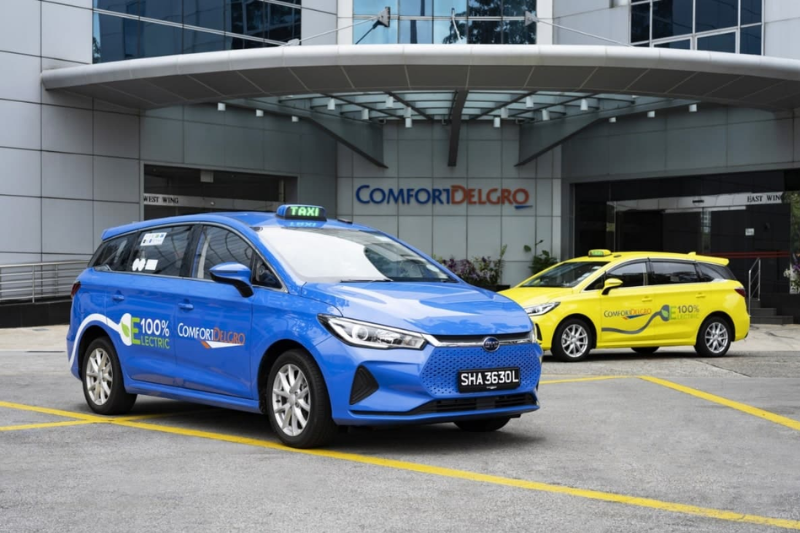
If you live in Singapore, you would have taken a CDG taxi or hopped onto one of its buses.
CDG operates an essential service business supported by recurring commuter demand and defensive cash flows.
In FY2025, CDG pulled in S$5.06 billion in revenue, up 13.0% YoY, with profit attributable to shareholders climbing 9.4% to S$230.3 million.
The company also remained well-capitalised, with S$868.4 million in cash and short-term deposits as at FY2025.
The transport giant has also steadily increased its dividend, with total dividend per share rising from S$0.0777 in FY2024 to S$0.0850 in FY2025.
Labour shortages and wage hikes are always concerns in this space, while ride-hailing apps have put pressure on CDG’s taxi business.
Fuel costs have also been unpredictable, with oil prices swinging due to geopolitical tensions.
CapitaLand Integrated Commercial Trust (SGX: C38U), or CICT
CICT stands out as Singapore’s largest REIT, offering an exposure to a diversified portfolio of prime retail and commercial properties, such as Plaza Singapore, CapitaSpring, and the impending acquisition of Paragon.
The REIT continued to deliver stable performance in 1Q2026, with net property income rising 7.9% YoY to S$314.4 million.
Retail and office rent reversions stayed positive at 4.4% and 6.1% respectively.
Portfolio occupancy remained healthy at 95.2%, while aggregate leverage stayed manageable at 38.5%.
However, investors should monitor tenant sales and occupancy trends closely.
Any prolonged spike in interest rates could also pressure future distributions by driving up borrowing costs.
What Makes a Consumer Habit a Potential Investment Opportunity?
Strong consumer habits often point to strong businesses.
Companies with loyal customers, recurring spending, essential services, and pricing power tend to enjoy durable demand — qualities long-term investors often look for.
A popular product alone does not guarantee a great investment.
Investors should also look at valuation, profitability, balance sheet strength, and whether dividends can be sustained over the long term.
Get Smart: Turn Everyday Spending Into Passive Income.
Some of the best investment ideas start just by noticing what you use every day.
Those companies you trust with your own money – be it your supermarket or the mall it’s housed in – deserve a closer look as investments.
Shifting your mindset from consumer to owner can be a powerful way to start building long-term wealth.
The world’s gotten unpredictable, but some Singapore companies have quietly kept thriving. You’ve probably seen them in your daily life. And yes, they’ve kept paying dividends through it all. Meet 5 resilient stocks built to navigate global storms. Get the free report here and see how they’ve done it.
Follow us on Facebook, Instagram and Telegram for the latest investing news and analyses!
Disclosure: Joseph G. does not own shares of any companies mentioned.