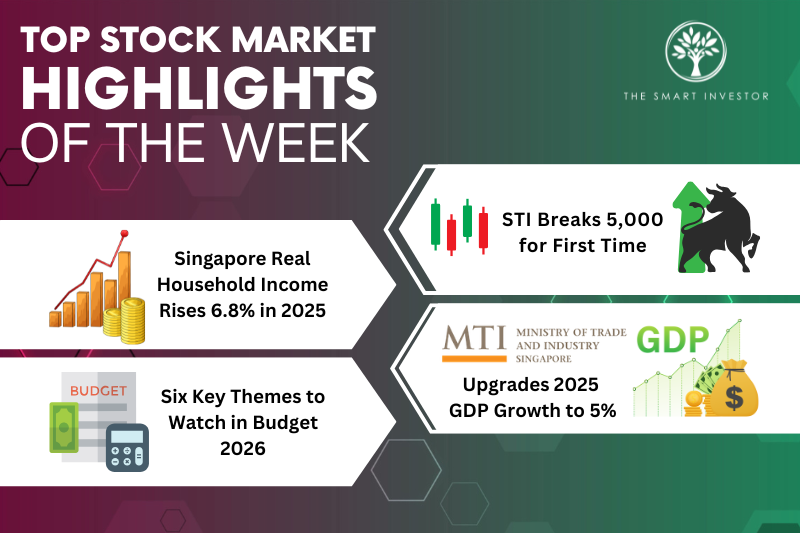
Singapore’s financial markets entered uncharted territory this week as the Straits Times Index (SGX: ^STI) breached the 5,000-point mark for the first time in history.
This record-breaking rally is underpinned by a powerhouse economy: 2025 GDP growth has been revised upward to a robust 5%, while real household incomes have surged by 6.8%.
Prime Minister Lawrence Wong’s Budget 2026 statement doubled down on artificial intelligence adoption and business transformation, whilst maintaining support for households through enhanced voucher schemes and a new CPF investment option.
STI crosses 5,000 mark for first time to record high
The Straits Times Index (STI) surpassed the 5,000 mark for the first time on 12 February 2026, hitting 5,004.02 in morning trading.
This historic milestone came well ahead of analyst forecasts and was driven by strong gains across blue-chip constituents, particularly the three local banks which comprise around half the index by weight.
DBS Group (SGX: D05) rose 0.5% to S$57.77, OCBC Bank (SGX: O39) climbed 1.3% to S$21.62, and UOB (SGX: U11) advanced 0.9% to S$39.23.
The breakthrough follows an impressive 22.7% gain for the STI in 2025 and reflects the success of measures to revitalise Singapore’s equities market, including the Monetary Authority of Singapore’s (MAS) S$5 billion Equity Market Development Programme and the proposed SGX-Nasdaq dual-listing framework.
Analysts have turned increasingly bullish, with JP Morgan (NYSE: JPM) projecting the index could reach as high as 6,500 points by year-end.
Singapore median household market income up 6.8% in real terms
Singapore’s median household market income grew 6.8% in real terms in 2025, according to new data from the Department of Statistics (SingStat) released on 9 February 2026.
This marks the first calculation under SingStat’s expanded definition which now captures “market income” including non-employment sources such as rental income, investment income, annuity and Central Provident Fund (CPF) payouts.
Median monthly household market income rose 7.7% in nominal terms to S$12,446, whilst per household member it increased 8.4% nominally to S$4,160.
Average monthly household market income per household member rose across all income deciles, ranging from 4.2% to 13.5% in nominal terms, with lower-income households experiencing higher growth rates.
Employment remained the main income source at 79.6% of total household market income, though this share declined slightly from 81.1% in 2024.
Income inequality also fell to its lowest level since 2015, with the Gini coefficient declining to 0.452 from 0.46 in 2024.
Singapore revises 2025 GDP growth to 5% from 4.8%, bolstered by strong Q4
The Ministry of Trade and Industry (MTI) revised Singapore’s 2025 GDP growth upwards to 5.0% on 10 February 2026, from the advance estimate of 4.8%, exceeding the official forecast of “around 4%”.
Fourth-quarter growth was adjusted upwards to 6.9% year on year from the advance estimate of 5.7%, driven by robust performance in manufacturing, wholesale trade, and finance and insurance sectors.
The electronics cluster and machinery, equipment and supplies segment benefited from strong artificial intelligence-related demand, whilst all segments of finance and insurance recorded broad-based growth.
For 2026, MTI raised its GDP growth forecast to 2% to 4%, up from 1% to 3% previously, citing improved global economic outlook and sustained AI investment momentum.
Most economists upgraded their 2026 forecasts accordingly, with projections ranging from 2.8% to 3.6%.
The stronger outlook has increased expectations for monetary policy tightening, with several economists anticipating MAS will steepen the Singapore dollar nominal effective exchange rate appreciation bias in April or July.
Budget 2026: AI adoption, foreign worker policy tweaks and household relief
Prime Minister Lawrence Wong delivered Budget 2026 on 12 February 2026, emphasising artificial intelligence as a “decisive factor for success” in Singapore’s economic future.
A new National AI Council chaired by PM Wong will drive the AI agenda, whilst a “Champions of AI” programme will support comprehensive business transformation through AI.
The Enterprise Innovation Scheme will be expanded to include AI expenditure, and Singaporeans enrolling in selected AI courses will receive six months of free access to premium AI tools.
SMEs will receive up to 70% funding support for internationalisation, whilst the start-up ecosystem gained a S$1 billion Startup SG Equity injection and S$1.5 billion Anchor Fund tranche.
CPF members will gain access to a new voluntary life-cycle investment scheme offering potentially higher returns for those with a longer runway to retirement.
PM Wong also announced measures including CDC vouchers and cost-of-living payments, increased vehicle taxes to encourage electric vehicle adoption, and indicated carbon tax may stay at the lower S$50 to S$80 per tonne range by 2030 if global climate momentum continues to weaken.
How do rich Singaporeans invest when volatility hits?
They turn to companies with cash, history, and discipline. This free report highlights 5 blue chips that deserve your attention. Get your copy here and see who made the list.
Follow us on Facebook, Instagram and Telegram for the latest investing news and analyses!