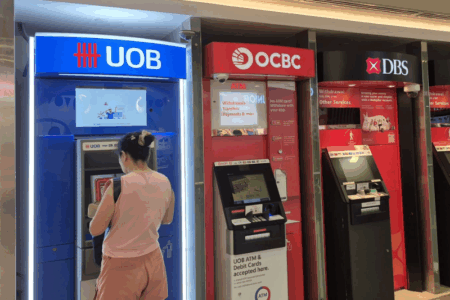
Global stock markets have been in turmoil since several weeks ago.
Yet, amid the fracas, DBS Group (SGX: D05) has done well since 2020.
For context, The Smart Dividend Portfolio, our flagship service, bought shares in April 2020 at a split-adjusted price of S$17.58.
Fast forward to May this year and Singapore’s largest bank broke new ground by becoming the first Singapore-listed company to exceed S$100 billion in market capitalisation.
What about today?
With DBS Group’s share price at S$33.65, is it still a buy?
It’s not hard to see why the stock has been good to shareholders for the past four-plus years.
Firstly, there is a capital gain of almost 100% since the portfolio’s April purchase.
Secondly, the stock has also paid out around S$6 in cumulative dividends (split-adjusted) since 2020.
When you tally it up, the returns are over 125%.
That means for every S$10,000 invested, the stock has turned into more than S$22,500.
It’s a great return for the level of risk taken.
Then again, that is in the past.
The question remains: what about today?
How do stocks go up?
To figure out whether DBS Group is still a buy today, you need to understand what drives stock prices higher.
In my eyes, the share price consists of the book value per share (representing the bank’s business) and the price-to-book value (P/B, representing the multiple the stock market gives the bank).
Hence, there are only two reasons why a stock goes up.
It’s either one, the business does well and results in a higher book value or two, the market decides to award the bank with a higher P/B multiple.
For The Smart Dividend Portfolio, both cases apply.
Firstly, on the business side, the bank’s book value per share rose from a split-adjusted S$18.25 in December 2019 to S$22.12 at the end of June 2024 for a gain of over 21%.
Secondly, on the P/B multiple side, the ratio rose from less than one time its book value to around 1.52 times today, an increase of around 60%.
The product of the two figures adds up to the gain in share price from S$17.58 in April 2020 to S$33.65 today.
Now, at first glance, the conclusion would be to buy the stock when it is at one time its book value. After all, the majority of the gain came from the expansion of the P/B multiple and less so from the gain in book value per share.
But it’s easier said than done.
When opportunity meets preparation
For starters, DBS Group’s shares rarely trade at or below one times their book value.
If you look back over the past 20 years, there have only been three instances when that has happened: in 2009 during the Great Financial Crisis (GFC), 2016 during the oil and gas downturn and in 2020 during the onset of the pandemic.
So, was The Smart Dividend Portfolio fortunate to have bought the stock close to its lows?
My answer is YES and NO.
On one hand, you could argue that the stock hardly ever trades below its book value. Hence, the portfolio was lucky to have bought the shares on this rare occasion.
But was it all really all just luck?
I would argue it’s not — if you look back at April 2020, the world was rife with uncertainty.
Lest we forget, back then, there was a virus making its way through the world.
There was no vaccine available nor any timeline on when it would be available.
Meanwhile, the Singapore government instituted a two month circuit-breaker for the whole nation starting from April 2020, the same month of the purchase.
Banks, along with many other businesses, were not spared.
In July 2020, the Monetary Authority of Singapore (MAS) called on banks to cap their dividend at 60% of 2019’s dividend payout. Subsequently, all three major banks, including DBS Group, cut their payouts for a year.
In short, everything was far from certain.
Here’s the thing: to get a low multiple, there has to be great uncertainty in the future of the bank.
Just like a pandemic.
Just like when oil prices tanked and dragged down an industry in 2016.
Just like when the world’s financial system was threatened during the GFC in 2008 and 2009.
Having followed DBS Group for close to a decade, the portfolio was able to make a decision DESPITE the uncertainty.
This confidence is borne out of watching the banks navigate through the 2016 oil and gas downturn and taking a chance that the management will be able to navigate through the challenges that came.
Get Smart: The real question lies with you
If you buy DBS Group shares today, you have to accept that shares could be trading cheaper in the future.
That’s because no one can tell what multiple the stock market will award the bank in the near term.
However, we do know that the bank just paid out around S$0.54 per share in dividends in its latest quarter. When annualised, that’s around S$2.16 per share or a dividend yield of a little over 6.4%.
Is that a yield that is good enough for you?
There is no single answer to this question.
For a person looking to do better than inflation, that 6%-plus yield may be enough. Yet, for the investors looking for higher returns, that may not be enough to satisfy their wants.
Waiting for a better value point may be the answer instead.
But be warned.
As we have shown above, low valuations are rare.
You could be left waiting for years for shares to trade below one times book value. In the interim, you will miss out on all the dividends paid.
What’s more, when the time comes, you have to be prepared to face great uncertainty when you buy.
If you’re nervous, confused, or worried about buying your first stock, then our latest beginner’s guide to investing can help. It’s easy to read yet packed with valuable insights. Download it for free today, and buy your first stock in the next few hours. Click here to get started.
Follow us on Facebook and Telegram for the latest investing news and analyses!
Disclosure: Chin Hui Leong owns shares of DBS Group.