A dividend that rises every quarter feels like a pay rise you never had to ask for.
But a raise is only as good as the money behind it.
Some companies lifted their payouts because profits grew.
Others leaned on lower costs or one-off gains, and those raises rarely last.
Three stocks backed by Temasek, a global investment company headquartered in Singapore, raised their latest quarterly payouts from a year ago.
Where each raise came from tells you more than its size.
According to Temasek’s portfolio page, it held a 51% direct stake in Singapore Technologies Engineering Ltd (SGX: S63), or STE, as at 31 March 2026.
Temasek held a 28.3% stake in DBS Group Holdings Ltd (SGX: D05), directly and through Maju Holdings, as at 10 February 2026.
In Mapletree Logistics Trust (SGX: M44U), or MLT, Temasek held a 34.3% deemed interest through Mapletree as at 29 May 2026.
| Company | Temasek stake (as at) | Period | Payout | Change (YoY) |
|---|---|---|---|---|
| STE | 51% direct (31 Mar 2026) |
3Q2026 interim (single quarter) | S$0.05 | +25% |
| DBS | 28.3% (10 Feb 2026) |
3Q2026 (single quarter) | S$0.66 ordinary; S$0.15 capital return |
Ordinary +10%; capital return unchanged |
| MLT | 34.3% deemed (29 May 2026) |
2QFY2027 (single quarter) | S$0.01816 | +0.1% |
Can STE keep raising its dividend?
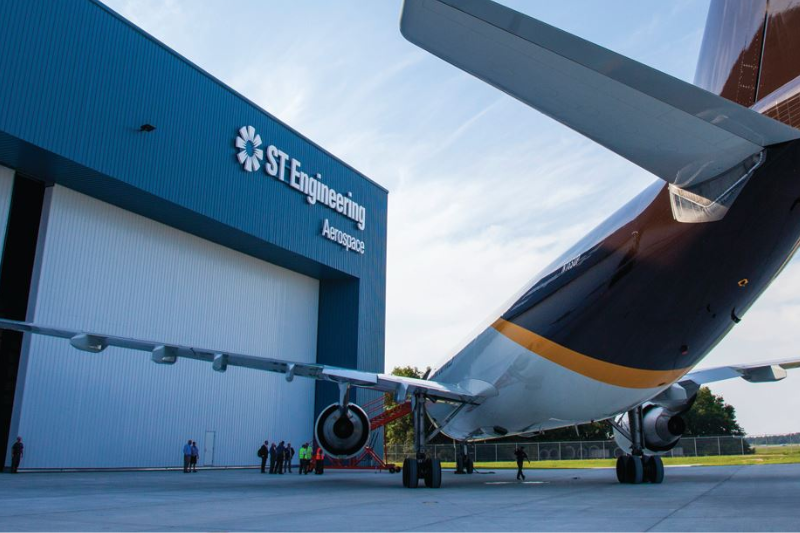
STE is a global technology, defence and engineering group headquartered in Singapore.
Its third-quarter interim dividend of S$0.05 per share was 25% higher than the S$0.04 paid a year ago.
For the first nine months of 2026 (9M2026), STE has declared S$0.14, up from S$0.12.
The step-up came earlier: STE also paid S$0.05 in the second quarter.
A rule drives the increase.
From FY2026, STE’s new dividend policy pays out about one-third of each year’s increase in net profit as extra dividends.
The dividend grows only if profit does.
Is profit growing? STE won’t say until full-year results.
The group reports half-yearly and gives only business updates in the first and third quarters, so its 9M update carries no profit or cash flow figures.
Revenue offers the best clue.
It rose 10% year on year (YoY) to S$10.0 billion in 9M2026, or 13% excluding LeeBoy, a business STE divested on 4 September 2025.
The risk sits inside the formula.
If full-year profit stalls, the policy adds nothing to the dividend.
Why did DBS pay more while its profit fell?
DBS declared a S$0.66 ordinary dividend for the third quarter of 2026 (3Q2026), 10% more than the S$0.60 a year earlier.
It also declared a S$0.15 capital return dividend, unchanged from a year ago.
Together, the S$0.81 sits 8% above last year’s S$0.75.
The quarter itself was weaker.
Net profit fell 4.8% YoY to S$2.81 billion after markets trading non-interest income dropped to S$17 million from S$419 million.
Net interest margin narrowed from 1.96% to 1.87% as Singapore interest rates fell.
So why pay more? The core bank kept growing.
Commercial book income, which excludes trading, rose 4%, while customer loans grew 9.5% to S$478.58 billion.
Nine-month net profit reached a record S$8.82 billion, up 2%.
Here’s the thing: the ordinary dividend grew 10% while nine-month profit grew 2%.
In other words, DBS appears to be paying out a larger share of what it earns.
Its update gives no payout ratio, so that gap is worth watching.
For 2027, management expects total income growth in the mid-single-digit range.
CEO Tan Su Shan also warned that the outlook has become more uncertain, citing elevated energy prices, tighter financial conditions and geopolitical risks.
Is MLT’s 0.1% DPU increase worth anything?
MLT owns 172 logistics properties in nine markets.
Its distribution per unit (DPU) for 2QFY2027 was S$0.01816, up just 0.1% from S$0.01815 a year ago.
MLT’s fiscal year ends in March, so 2QFY2027 covers the three months to 30 September 2026.
The properties did better than the payout.
Net property income (NPI) rose 1.0% to S$154.8 million, helped by the redeveloped Mapletree Joo Koon Logistics Hub, acquisition in India and organic growth, mainly in Singapore.
A stronger renminbi and Australian dollar also helped, and currency gains can reverse.
Where did the rest go?
Distributions to perpetual securities holders rose 33.6% after MLT issued S$400 million of new perpetual securities ahead of a planned November 2026 redemption.
Carrying both issues at once is a cost that should ease once the old one is redeemed.
Other offsets look stickier.
MLT lost income from divested properties.
Portfolio rental reversion improved to 2.1%, but China stayed negative at -1.7%.
China, again, is the drag.
Aggregate leverage of 37.5% also flatters the balance sheet.
On a pro forma basis, it would have been 40.4%.
Get Smart: Measure the raise against what pays for it
Before you celebrate a higher payout, set its growth beside the growth of the money behind it.
At STE, a published rule ties the dividend to profit growth.
At DBS, the ordinary dividend grew 10% against nine-month profit growth of 2%.
At MLT, NPI grew 1.0% while DPU grew 0.1%, and costs took the difference.
When each company reports its full-year numbers, ask yourself one question: which of these raises can happen again?
You’ve probably shopped at their malls, banked with them, or bought their products this month. These 6 SGX companies have paid dividends for 20 straight years, GFC and COVID included. Our FREE report shows you which ones, and what has kept their dividends going for 20 years and more. Grab your copy here.
Follow us on Facebook, Instagram, Telegram and YouTube for the latest investing news and analyses!
Disclosure: Joanna Sng owns shares in STE. DBS and MLT.