Having covered dividend basics and compared REITs and blue chips in our first two guides, we turn to two key metrics every investor should understand.
Most beginners assume that a stock offering a 7% dividend yield is a better investment than one with a 4% yield.
This is a common rookie mistake – focusing solely on dividend yield because it shows you how much income you can receive.
However, a high dividend yield doesn’t tell you everything you need to know about a stock.
Experienced investors look beyond dividend yield and also examine the dividend payout ratio.
What Is Dividend Yield and How Do You Calculate It?
Dividend yield measures how much a company pays shareholders in annual dividends relative to its current share price.
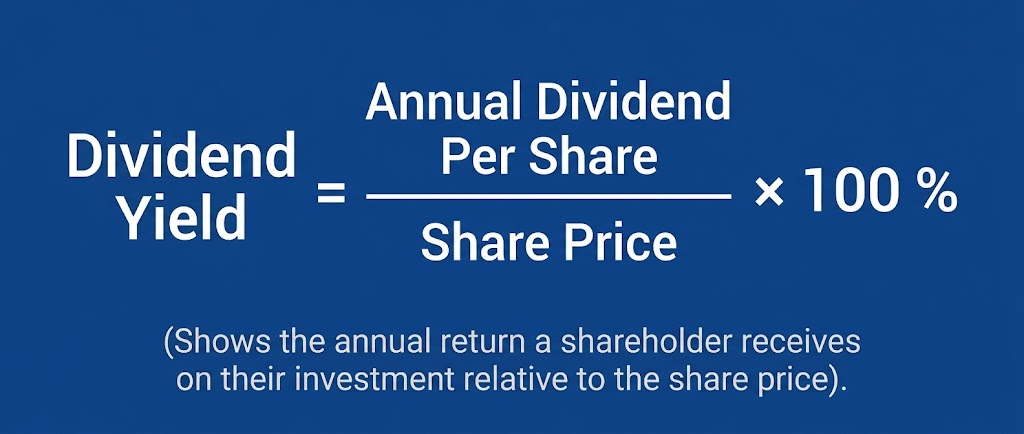
If a stock trades at S$5 and pays annual dividends of S$0.25 per share, its dividend yield is 5%.
Even when the payouts remain unchanged, the yield can change with share price fluctuations.
If the share price falls to S$4 and annual dividends stay at S$0.25 per share, the yield rises to 6.25%.
Hence, yield alone is not a foolproof indicator of a good investment.
Dividend yields from the past are not an assurance of future dividends.
Companies can also reduce or suspend dividends without warning.
What Is Dividend Payout Ratio and Why Does It Matter?
The dividend payout ratio is the percentage of a company’s earnings that it distributes to shareholders as dividends.
Investors can tell how much of a company’s profit is paid to the shareholders and how much remains undistributed.
A company that earns S$0.50 per share and pays out S$0.25 per share in dividends will have a dividend payout ratio of 50%.
Singapore’s largest bank, DBS Group Holdings Ltd (SGX: D05), paid out about 64% of its FY2025 earnings as ordinary dividends, or about 80% once its capital return dividends are included.
A sustainable payout ratio is generally considered to sit between 40% and 70%.
Earnings not paid out to shareholders can fund business expansion, repay debt or support other corporate purposes.
A company that consistently pays out a high share of its earnings might have less flexibility to manage unexpected challenges or sustain dividends during trying times.
Singapore real estate investment trusts (S-REITs), however, must distribute at least 90% of their taxable income to qualify for tax transparency.
Hence, REIT investors should focus on distribution-related metrics and cash flow instead.
Dividend Yield vs. Dividend Payout Ratio: Key Differences
Dividend yield and dividend payout ratio measure different aspects of a company’s dividend performance.
| Factor | Dividend Yield | Dividend Payout Ratio |
|---|---|---|
| What it measures | Dividend income relative to share price | Dividends relative to earnings |
| Formula | Annual DPS ÷ Share Price | DPS ÷ EPS |
| Main purpose | Estimates income yield | Helps assess payout sustainability |
| Affected by | Share price and dividend changes | Earnings and dividend changes |
| Key concern | High yield may reflect a falling share price | High payout may leave little earnings buffer |
Dividend yield helps investors assess potential dividend returns, whereas the payout ratio provides insight into dividend sustainability.
Neither metric should be used in isolation; investors should always consider the company’s financial health, such as cash flow, earnings stability, and debt levels before making investment decisions.
Can a Stock Have a High Dividend Yield but an Unsustainable Payout Ratio?
The short answer is yes.
Consider this:
| Metric | Company A | Company B |
|---|---|---|
| Share Price | S$5.00 | S$5.00 |
| Annual Dividend Per Share | S$0.25 | S$0.35 |
| Earnings Per Share | S$0.50 | S$0.25 |
| Dividend Yield | 5% | 7% |
| Dividend Payout Ratio | 50% | 140% |
Compared with Company A’s 5%, Company B’s 7% dividend yield is higher.
However, Company B is paying out more than what it earns with a 140% dividend payout ratio.
This puts pressure on its financial resources and increases the risk of future dividend cuts.
For a real-world case of a high yield paired with a stretched payout, consider ComfortDelGro Corporation Limited (SGX: C52).
It paid S$0.085 per share in dividends for FY2025.
At its share price of S$1.25 on 16 November 2026, that works out to a dividend yield of 6.8%.
ComfortDelGro paid out 80% of its FY2025 profit as dividends.
However, it kept its 1H2026 interim dividend at S$0.0391 per share even as PATMI (profit after tax and minority interests) fell 19.7% year on year.
With net debt rising to S$1.03 billion as at 30 September 2026, from S$730.1 million at the end of 2025, ComfortDelGro has limited flexibility to increase its payout.
Management, however, expects net gearing of 26.1% to ease by year end, as it typically peaks in the third quarter.
How Should Beginners Use These Two Metrics?
It is not about choosing between dividend yield and payout ratio, but about using both metrics together to get a complete picture when researching dividends.
When evaluating a dividend-paying stock, consider three simple questions:
- Is the dividend yield attractive relative to the risks?
- Is the company earning enough to support its dividend payments?
- Has the company maintained or increased its dividends over time?
If the answer to all three questions is yes, you might have identified a promising dividend stock.
If any answer is no, treat it as a warning sign of an unsustainable payout or a yield trap, which we will cover in the next article of this series.
Ultimately, dividend metrics are not a standalone reason to invest, but a starting point for deeper research.
Get Smart: Look Beyond the Yield
While dividend yield measures annual dividend income relative to the share price, the payout ratio shows how much of a company’s earnings are distributed to shareholders.
A high dividend yield is only attractive if it is financially sustainable.
Rather than treating these metrics as an either-or, investors should evaluate them together to assess a dividend stock’s true potential.
In the next article in our dividend investing for beginners series, “The Dividend Trap: Why High-Yield Singapore Stocks Aren’t Always Better”, we will explore how unusually high dividend yields can conceal underlying financial risks – and why a bigger payout does not always mean a better investment.
Imagine a life where steady income flows, no matter the market. Our new free report, “Retire Early with Dividends,” reveals how. We’ve pinpointed 5 dependable Singapore dividend stocks that offer a proven, stress-free path to financial freedom. Stop just dreaming and start building your early retirement plan today. Your free guide awaits here.
Follow us on Facebook, Instagram, Telegram and YouTube for the latest investing news and analyses!
Disclosure: Wenting A. does not own any of the stocks mentioned above.