Ever wondered how you can earn extra income without working extra hours?
Taking your first step into investing can feel overwhelming, but building passive income is simpler than you think.
Dividend investing lets you become a co-owner in successful companies that share their cash profits directly with you.
Over the next four weeks, The Smart Investor is breaking down everything you need to know.
Whether you are new to investing or preparing for a secure retirement, we are here to help you take those first confident steps toward long-term wealth.
What Is a Dividend and How Does It Work?
A dividend is a payment that a company makes to its shareholders, usually from its profits.
In Singapore, investors can earn dividend income by owning shares in dividend-paying companies listed on the Singapore Exchange (SGX).
Take the familiar heartland supermarket operator Sheng Siong Group (SGX: OV8) as an example.
Suppose you purchased 1,000 shares of the company.
In the financial year ended 31 December 2026 (FY2026), Sheng Siong paid a dividend of S$0.07 per share.
That means, as a shareholder, you would have received S$70 in dividends.
But that is not all.
There are two ways to earn money when you buy shares:
- Dividends: Cash received from owning shares.
- Capital gains: Profit earned when shares are sold at a higher price than their purchase price.
But it is important to remember that dividends are not guaranteed, and share prices can also rise or fall regardless of dividend payments.
Why Do Companies Pay Dividends?
When a company turns a profit, there are a few things they can do with that cash.
One, they can reinvest in the business to support future growth.
Two, they can use these earnings to pay down debt.
Established companies with stable businesses often generate predictable cash flow, frequently more than they need to reinvest.
These companies may choose the third option: pay regular dividends to return that surplus to shareholders.
This can signal the company’s financial strength and boost shareholders’ confidence in future earnings.
Familiar names such as DBS Group Holdings Ltd (SGX: D05), Singapore Telecommunications Limited (SGX: Z74), or Singtel, and Singapore Exchange Limited (SGX: S68) are examples of established companies with regular dividend payouts.
However, not all companies pay dividends and paying dividends does not automatically make a company a good investment.
How Much Passive Income Can You Get From Dividends?
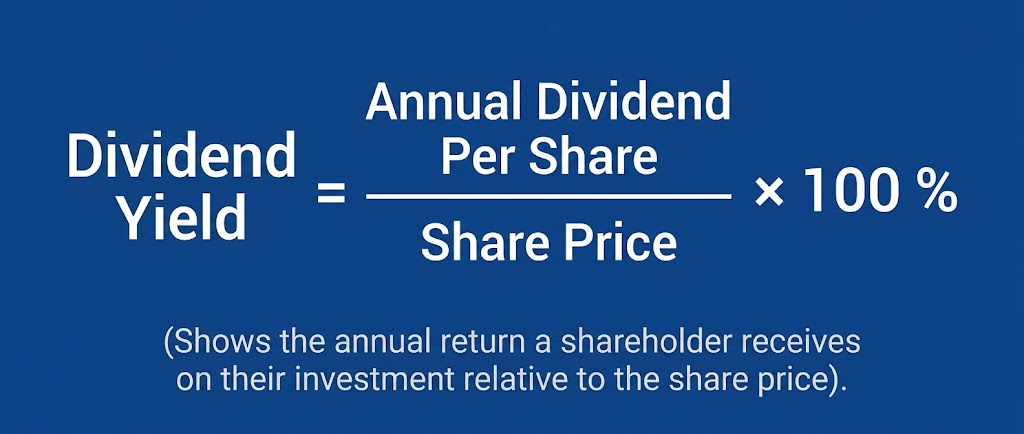
A good place to start is the dividend yield, which is calculated as the annual dividend per share divided by the share price, expressed as a percentage.
If you invested S$10,000 in a stock with an annual dividend yield of 3%, that will translate to S$300 a year in dividends.
As illustrated below, a higher yield means more dividend income for the same amount invested.
| Illustrative Dividend Yield | Annual Dividend Income |
|---|---|
| 3% | S$300 |
| 5% | S$500 |
| 7% | S$700 |
Dividends may be paid quarterly, half-yearly or annually, depending on the company.
However, unlike a monthly salary, dividend income is neither fixed nor guaranteed.
Where Can Singapore Investors Find Dividend-Paying Stocks?
Investors can buy shares in Singapore-listed companies on SGX.
Two common categories of dividend-paying investments are:
- Blue-chip stocks: Companies with long operating histories, strong reputations and consistent financial performance that tend to pay regular dividends, such as DBS and Singtel.
- Real estate investment trusts (REITs): Trusts that own income-generating properties, collect rent from tenants and distribute rental income to unitholders. For example, Frasers Centrepoint Trust (SGX: J69U) is a leading Singapore suburban retail REIT that owns major heartland malls, including Causeway Point in Woodlands and NEX in Serangoon.
What Can You Do With the Dividends You Receive?
When you receive dividends, you can cash them out and use the income to cover everyday expenses or supplement your retirement income.
Another approach is to reinvest them to buy more shares.
Take the example of 1,000 Sheng Siong shares bought at S$2.36 per share on 3 November 2026.
The table below shows how reinvesting dividends sparks compounding: your new shares start earning their own dividends alongside your original ones.
Compounding 1,000 Sheng Siong Shares Over Time
| Time Horizon | Shares Owned | Annual Dividends Received (S$) | Total Portfolio Value (S$) | Total Return (% Gain) |
|---|---|---|---|---|
| Start (Year 0) | 1,000.00 | S$70.80 (baseline) | S$2,360.00 | — |
| 1 Year | 1,030.00 | S$72.92 | S$2,430.80 | +3.0% |
| 5 Years | 1,159.27 | S$82.08 | S$2,735.88 | +15.9% |
| 10 Years | 1,343.92 | S$95.15 | S$3,171.65 | +34.4% |
| 15 Years | 1,557.97 | S$110.30 | S$3,676.81 | +55.8% |
Note: For illustration only. Assumes a constant 3% yield, constant share price, and full dividend reinvestment.
Over time, this snowball effect steadily expands your position and passive income without costing an extra cent.
What Are the Risks of Dividend Investing?
No investment is 100% risk-free.
There are three important risks to consider in dividend investing.
First, dividends can be reduced or stopped, as companies may cut payouts when business conditions deteriorate.
Second, share prices can also fall, and receiving dividends does not prevent investors from losing money on their investments.
Finally, high yields may look attractive but they can also be red flags in a business.
It may signal that a company is paying out more than it can afford – or that its stock price has tumbled due to underlying business troubles, pushing its yield up.
Before you invest, take the time to understand the business behind the dividend: how it makes money, whether its earnings are stable and whether it generates enough cash to keep paying shareholders.
Rather than putting all your eggs in one basket, diversify your holdings across different business sectors and geographic markets to protect and grow your capital.
Get Smart: Your First Step to Passive Income
Think of dividend investing as putting your money to work so you don’t have to work forever.
Dividends let you collect regular passive income from companies you co-own without selling a single share.
Building lasting wealth takes patience and a focus on solid Singapore businesses, not chasing sky-high yields.
Start small; there is no need to invest all your savings at one go.
Consider familiar names first, ease in at your own pace, and always align every investment with your personal financial goals.
Now that you know how dividends work, where should you invest?
In our next article, REITs vs. Blue-Chip Stocks: Which Offers Better Passive Income on the SGX?, we’ll compare two of the most popular Singapore dividend investments.
This could be the fastest way to jump from a “newbie” investor to a seasoned pro. Our beginner’s guide shows everything you need to know to buy your first stock and beyond. Click here to download it for free today.
Follow us on Facebook, Instagram, Telegram and YouTube for the latest investing news and analyses!
Disclosure: Gisella C. does not own shares in any of the companies mentioned.