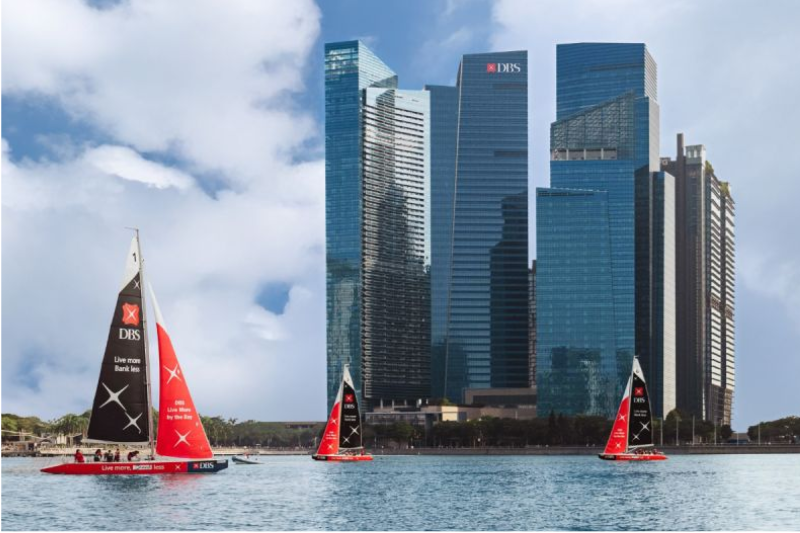
DBS Group Holdings Ltd (SGX: D05) has long been a local favourite among Singapore investors seeking reliable dividend income.
The group’s popularity stems from its strong banking franchise, consistent profitability and track record of rewarding shareholders.
However, if you had S$10,000 to invest today, how much dividend income could DBS realistically generate in 2027?
In this article, we will examine the numbers and whether the bank’s current valuation makes it an attractive income investment.
How Many DBS Shares Can S$10,000 Buy?
On 6 November 2026, DBS shares closed at S$69.72.
With S$10,000, investors could purchase 140 shares.
This amounts to 14 board lots of 10 shares each, following Singapore Exchange’s reduction of DBS’s board lot size in October 2026.
At this price, the investment would cost S$9,760.80 before brokerage fees.
Assuming a S$10 brokerage fee, investors would have S$229.20 remaining.
Importantly, a higher share price means fewer shares for the same investment.
Had shares been bought at a lower price, the yield on cost would be higher, assuming dividends remain unchanged.
How Much Dividend Income Could DBS Pay in 2027?
DBS has progressively increased its ordinary dividends.
Recently, the bank declared S$0.66 per share for each quarter from 1Q2026 to 3Q2026.
Annualising these quarterly payments gives an ordinary dividend of S$2.64 per share.
Separately, DBS introduced a Capital Return dividend of S$0.15 per share quarterly in 2025, which management plans to maintain through 2027.
This represents another S$0.60 per share annually, although these additional dividends should not be treated as permanent recurring dividends beyond the announced period.
Assuming investors hold 140 DBS shares throughout 2027 and receive four quarterly payments, here are three potential scenarios.
| Scenario | Ordinary DPS | Total 2027 Income* |
|---|---|---|
| Conservative | S$2.40 | S$420 |
| Base Case | S$2.64 | S$453.60 |
| Optimistic | S$2.88 | S$487.20 |
*Includes the S$0.60 annual Capital Return dividend.
Under the base case, investors would receive S$369.60 in ordinary dividends and S$84 in Capital Return dividends, bringing total annual income to S$453.60.
This annual income works out to a monthly equivalent of approximately S$37.80.
The conservative scenario assumes ordinary dividends decline amid weaker earnings.
Meanwhile, the optimistic scenario assumes a further increase supported by stronger profitability.
Can DBS Sustain Its Dividend Payments?
DBS’s latest quarterly results showed some pressure, but overall earnings were resilient.
In the third quarter of 2026 (3Q2026), total income fell 1% year on year (YoY) to S$5.85 billion, while net profit declined 5% to S$2.81 billion.
The picture was slightly better when looking at the first nine months of 2026 (9M2026), with net profit rising 2% YoY to S$8.82 billion.
For 9M2026, net interest income slipped 1% YoY to S$10.79 billion as lower Singapore interest rates were largely offset by loan growth and hedging.
In 3Q2026 alone, net interest income rose 4% YoY.
Meanwhile, its wealth management business continued to grow strongly.
For 9M2026, wealth management fees grew 24% YoY to S$2.69 billion, contributing to a 15% YoY increase in net fee income to S$4.37 billion.
In addition, DBS reported a Common Equity Tier 1 (CET1) capital ratio of 15.9% as at 20 September 2026.
With annualised earnings per share of S$4.15 for 9M2026 and an annualised ordinary dividend of S$2.64, DBS’s payout ratio works out to approximately 63.6%.
This provides some comfort for income investors, as loan growth and asset quality remained healthy in 9M2026.
However, lower interest rates, slower loan growth or higher credit costs could still put pressure on future earnings.
Is DBS Still Worth Buying for Dividend Income?
At S$69.72 per share, DBS’s annualised ordinary dividend of S$2.64 gives a yield of approximately 3.8%.
The inclusion of the planned Capital Return dividend would also increase the prospective 2027 yield to about 4.6%.
However, investors must recognise that this higher yield includes a time-limited payout.
At S$69.72 per share, DBS trades at around 2.85 times its net book value of S$24.47 per share as at 30 September 2026.
This multiple is known as the price-to-book (P/B) ratio.
The premium reflects DBS’s strong profitability, with return on equity reaching 17% for 9M2026.
However, its relatively high valuation also means that a slowdown in earnings growth could weigh on its share price.
Furthermore, investors should consider the risks of putting nearly all their S$10,000 into a single bank.
If investors spread their capital across different companies and sectors, it could help reduce their exposure to DBS’s performance.
Get Smart: How Much Can S$10,000 in DBS Really Earn?
Based on its current dividend payments and planned capital returns, having a S$10,000 investment in DBS could generate between S$420 and S$487 in dividend income in 2027.
The base case estimate of S$454 annually appears reasonable given DBS’s resilient earnings, capital position and current ordinary dividend level.
However, investors should note that the capital return dividend is only planned through 2027 and ordinary dividends are dependent on future profitability.
Ultimately, DBS is an appealing dividend stock, but its relatively high valuation means investors should weigh income received against potential capital losses.
A reliable dividend is valuable, but paying the right price for that income matters just as much.
Retirement doesn’t happen overnight. It’s built one decision at a time.
We found 6 SGX companies that have paid dividends every year for more than 20 years, through the Global Financial Crisis, COVID-19, and rising interest rates.
If you’re building long-term income for retirement, this free report is a great place to start. Download your copy today.
Follow us on Facebook, Instagram, Telegram and YouTube for the latest investing news and analyses!
Disclosure: Gabriel L. does not own shares in any of the companies mentioned.