Singaporean investors love a good dividend.
This earnings season, the bigger story sat one line above the payout.
Two Singapore-listed financial companies set records in the third quarter of 2026 (3Q2026).
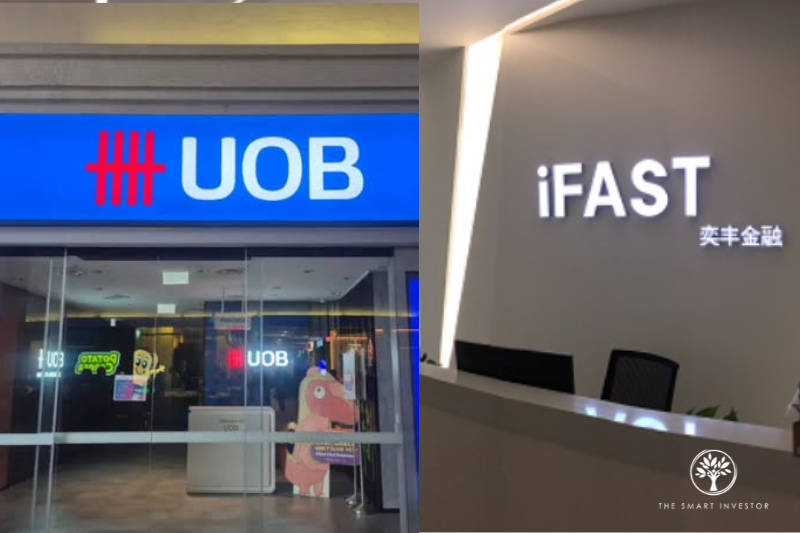
United Overseas Bank Limited (SGX: U11), or UOB, earned a record S$733 million in net fees.
iFAST Corporation Ltd (SGX: AIY) ended the quarter with a record S$36.8 billion in assets under administration (AUA).
Here’s the thing: both records arrived while bank lending margins shrank.
UOB’s net interest margin (NIM) narrowed to 1.68% from 1.82% a year ago.
At DBS Group Holdings Ltd (SGX: D05), NIM fell to 1.87% from 1.96%.
Why should you care?
Banks earn fees on the money they manage and the services they sell, so fee income ties up less capital than lending.
Fee income also depends less on interest rates.
So which of these three companies turns fee growth into dividends most directly?
Let’s start with the smallest.
| Metric (3Q2026) | iFAST | DBS | UOB |
|---|---|---|---|
| Fee or recurring income | Recurring net revenue S$95.4 million, up 22.0% | Net fee and commission income S$1.43 billion, up 6% | Net fee income S$733 million (record), up 19% |
| Net interest margin | Not applicable | 1.87% (from 1.96%) | 1.68% (from 1.82%) |
| Dividend declared | S$0.0320, up 39.1% | S$0.66 ordinary and S$0.15 capital return | None (pays half-yearly) |
How much of iFAST’s growth keeps coming back?
iFAST runs a global digital banking and wealth management platform.
It serves retail investors through FSM Global, and financial advisers and institutions through its business-to-business arm.
Its AUA rose 20.0% year on year (YoY) to a record S$36.8 billion.
Clients added S$1.24 billion of net inflows, and rising markets helped too.
Better still, most of iFAST’s income repeats.
Recurring net revenue grew 22.0% YoY to S$95.4 million, which made up 86.2% of net revenue.
Net profit attributable to owners rose 24.5% YoY to S$32.4 million.
And shareholders are getting a bigger slice.
The third interim dividend rose 39.1% YoY to S$0.0320.
Management expects a FY2026 dividend of at least S$0.1200, above its April 2026 guidance of S$0.1050.
On the flip side, iFAST now carries more debt.
Borrowings, excluding lease liabilities, rose to S$234.3 million from S$113.1 million at the end of 2025.
A S$120 million note issue in March 2026 accounts for most of the increase.
Can DBS’s fees make up for a weak trading quarter?
DBS serves retail, wealth and corporate customers across Asia.
Its customer businesses kept growing.
Net fee and commission income rose 6% YoY to S$1.43 billion, and treasury customer sales and other income grew 19% to S$685 million.
Trading was a different story.
Markets trading non-interest income fell to S$17 million from S$419 million a year ago.
Net profit for the quarter dropped 4.8% to S$2.81 billion.
To be sure, one weak quarter doesn’t undo the year.
Net profit for the first nine months of 2026 reached a record S$8.82 billion.
The dividend comes in two parts, so read them separately.
DBS declared an ordinary dividend of S$0.66 per share and a capital return dividend of S$0.15 per share.
The S$0.81 total is 8% higher than the S$0.75 paid a year ago.
Management expects structural growth in wealth management to continue.
For 2027, it guides for total income growth in the mid-single-digit range.
Is UOB’s record fee haul enough to lift its payout?
UOB serves more than 8 million customers across the region.
Its net fee income rose 19% YoY to the record S$733 million, with wealth, cards and loan-related activities driving the gain.
The rest of the bank had a tougher quarter.
Other non-interest income fell 29% to S$370 million on lower trading and investment income.
Operating profit before allowances declined 2.8% to S$1.8 billion, while total expenses rose 2%.
If you’re waiting for a dividend, it’s not due yet.
UOB pays dividends twice a year, so it declared none this quarter.
That’s a matter of timing, not a cut.
Look closer at the 2027 guidance.
UOB expects fee income to grow at a mid- to high-single-digit pace and operating costs to rise at a similar rate.
If both forecasts hold, fees alone won’t widen the gap between income and costs.
UOB says it is investing in capital-light businesses that broaden its sources of revenue.
Get Smart: Follow the fees, then follow the payout
A record fee number is a good start.
But it doesn’t tell you how much of that money reaches you.
When the next set of results arrives, check whether the fee line is growing faster than costs.
Then check whether the dividend follows.
iFAST’s recurring revenue and its dividend are both rising today.
DBS has raised its total payout.
As for UOB, the answer comes with its final dividend for 2026.
Keep asking both questions, quarter after quarter.
What if every stock trade in Singapore puts money in your pocket? One company earns whenever the market moves. Its free cash flow has grown close to 10% a year, and dividends are set to rise 40% over the next three years. Our free 2026 Dividend Playbook reveals this legal monopoly. Download it for free now.
Follow us on Facebook, Instagram, Telegram and YouTube for the latest investing news and analyses!
Disclosure: The Smart Investor owns shares in UOB, DBS and iFAST.