A high distribution yield tells you what a real estate investment trust (REIT) has paid.
It can’t tell you what comes next.
Rank the three Singapore REITs below by yield.
Then rank them by growth in distribution per unit (DPU).
The order flips.
Distribution Yield
| Stock Name (Stock Ticker) | Latest Unit Price | Latest DPU | Annualised Distribution Yield | DPU Growth (YoY) |
|---|---|---|---|---|
| CapitaLand Ascendas REIT (SGX: A17U) | S$2.23 | S$0.07482 (1H2026) | 6.7% | +0.1% |
| Mapletree Pan Asia Commercial Trust (SGX: N2IU) | S$1.17 | S$0.0196 (1QFY2027) | 6.7% | -2.5% |
| Mapletree Industrial Trust (SGX: ME8U) | S$1.79 | S$0.0311 (1QFY2027) | 6.9% | -4.9% |
As at 26 October 2026.
Why didn’t CLAR’s income growth reach unitholders?
CapitaLand Ascendas REIT (SGX: A17U), or CLAR, owns 234 properties across Singapore, Australia, the US, the UK/Europe and Japan.
CLAR reports half-yearly.
For the first half of 2026 (1H2026), its distributable income grew 8.6% year on year (YoY) to S$359.4 million.
DPU rose just 0.1% to S$0.07482.
So where did the extra income go?
CLAR raised equity in both 1H2025 and 1H20-26.
The pie grew, but so did the number of slices.
Gross revenue rose 6.7% YoY to S$805.5 million, while net property income (NPI) climbed 6.2% to S$556.1 million, as acquisitions more than offset 2025 divestments.
Rental reversion was 8.5%, and management expects high single-digit reversions for the full year.
Occupancy dipped to 89.1% from 91.8% a year ago, or 90.3% excluding two newly completed properties.
Watch how CLAR funds its pipeline.
Its 39.7% aggregate leverage is the highest of the three, and its cost of debt is 3.5%.
It has another S$638.1 million of acquisitions announced and five ongoing projects worth S$507.2 million.
The proposed S$200.4 million sale of Kim Chuan Telecommunications Complex, at a 32% premium to valuation, will help.
If CLAR turns to unitholders again, though, DPU could stay flat even as income grows.
How long can lower interest costs protect MPACT’s DPU?
Mapletree Pan Asia Commercial Trust (SGX: N2IU), or MPACT, owns 15 commercial properties across Singapore, Hong Kong, China, Japan and South Korea, with Singapore making up 61% of portfolio value.
For the first quarter of the financial year ending 31 March 2027 (1QFY2027), MPACT’s NPI fell 6.8% YoYto S$154.8 million.
DPU fell a milder 2.5% to S$0.0196.
Lower interest costs made the difference: MPACT used divestment proceeds to pay down debt, and finance expenses fell 18.4% YoY.
Its cost of debt improved to 2.94%, with aggregate leverage at 37.7%.
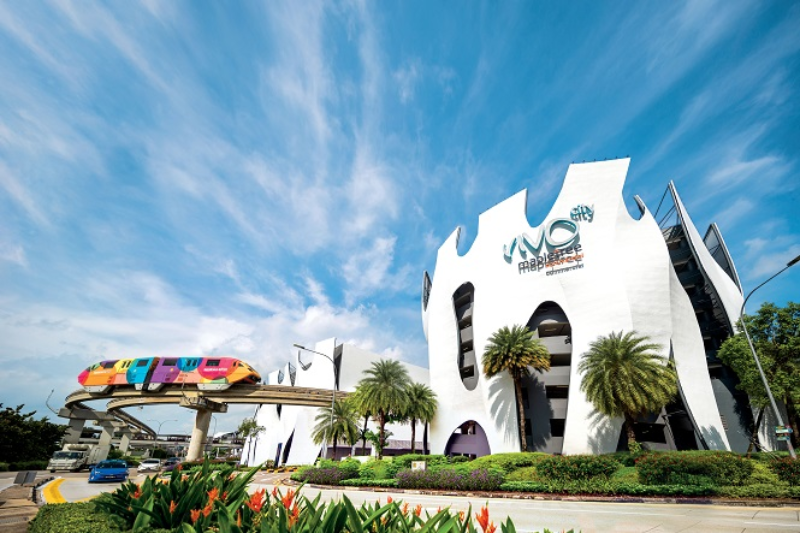
VivoCity carries the portfolio.
Its NPI grew 8.9% YoY after its Basement 2 asset enhancement.
Rental reversion hit 13.5%, and tenant sales rose 4.9%.
Portfolio committed occupancy slid to 84.4% from 89.3% a year ago, with Japan at 56.0% and China at 82.4%.
Reversions were 29.2% in China and 9.1% at Festival Walk.
But repaid debt can only cut interest once.
For DPU to grow again, MPACT needs to fill space in Japan and China.
Festival Walk’s 18,800-square-foot reconfiguration offers some hope.
It began operating in July 2026 and delivers close to a 50% return on investment.
Can Singapore hold up MIT while it trims North America?
Mapletree Industrial Trust (SGX: ME8U), or MIT, owns 135 properties across Singapore, North America and Japan.
It offers the highest yield of the three, and its DPU has fallen the most.
For 1Q20FY27, MIT’s NPI fell 8.5% YoY to S$122.3 million, and DPU dropped 4.9% to S$0.0311.
MIT lost income from three Singapore properties sold in August 2025, and from North American non-renewals and higher operating costs.
A weaker US dollar and costlier replacement interest rate swaps added to the pressure.
On the flip side, a 24.6% fall in borrowing costs and a bigger contribution from Japan softened the blow.
Still, DPU rose 0.6% quarter on quarter, mainly because there was no cyclical maintenance this quarter.
One quarter isn’t a trend, though.
Singapore is pulling its weight, with occupancy up to 94.3% from 93.4% three months earlier and rental reversion at 5.3%.
Japan stayed fully occupied.
North American occupancy slipped to 82.5% from 86.1%, though reversion there stayed positive at 2.2%.
MIT plans to sell S$500 million to S$600 million of North American assets, and each sale removes income.
It sold the Philadelphia Data Centre for US$14.5 million, above its US$13.9 million valuation.
It also signed about 364,500 square feet of North American leases, including a 10-year lease at Hawthorne Data Centre.
Aggregate leverage stood at 37.5%.
Get Smart: What filled the gap?
When DPU falls less than NPI, something fills the gap.
At MPACT and MIT, lower interest costs did much of that job, and that cushion has a limit.
At CLAR, the gap ran the other way: income grew, but new units soaked it up.
You can run this check on any REIT.
Compare the change in DPU with the change in NPI and distributable income, then trace the difference.
The next time a REIT tempts you with a 7% yield, start with one question: what’s holding up the DPU?
Imagine owning businesses that continued paying shareholders even when markets were falling. That’s the appeal of dividend investing done well. Our FREE report reveals 6 SGX companies that paid dividends every single year for two decades, through the Global Financial Crisis, COVID-19, and 2022’s rate shock. Start building the kind of income stream that could fund a more comfortable retirement. Get your free report here.
Follow us on Facebook, Instagram, Telegram and YouTube for the latest investing news and analyses!
Disclosure: The Smart Investor owns units of MPACT, MIT and CLAR.