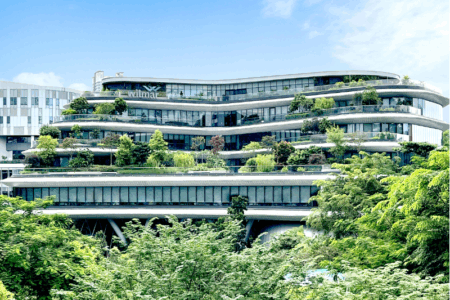
Mapletree Logistics Trust (SGX: M44U), or MLT, owns logistics properties across Singapore, Hong Kong SAR, China, Japan, South Korea, Australia, Malaysia, Vietnam, and India.
At a unit price of S$1.07 as of 16 October 2026, MLT offers a trailing 12-month distribution yield of around 6.8%.
That is an eye-catching number for income investors.
But a high yield is only worth having if the distribution behind it holds up.
So let’s look at how sustainable MLT’s distribution per unit (DPU) is.
The latest results: a small but meaningful rise
For the first quarter of the fiscal year ending 31 March 2027 (1Q FY2027), MLT reported a DPU of S$0.01816, up 0.2% year on year.
It is a small increase.
But it is the first year-on-year rise in headline DPU since 3Q FY2024.
| S$ million (except DPU) | 1Q FY2027 | 1Q FY2026 | YoY change |
| Gross revenue | 178.9 | 177.4 | +0.8% |
| Net property income | 156.4 | 153.4 | +2.0% |
| Distributable income | 93.0 | 92.0 | +1.1% |
| DPU (S$) | 0.01816 | 0.01812 | +0.2% |
Source: MLT 1Q FY2027 results
Gross revenue rose 0.8%, while property expenses and borrowing costs fell.
Together, these lifted distributable income by 1.1% to S$93.0 million.
Lower costs are welcome tailwinds, but they are not growth.
Sustained DPU growth will ultimately need rents to rise.
Is the DPU sustainable? Start with leasing
Portfolio occupancy eased to 96.4% in 1Q FY2027, from 96.9% in the previous quarter.
Occupancy fell in Singapore, China, and Australia because of leasing downtime.
Blended portfolio rental reversion was +0.9%, or +2.3% excluding China.
Outside China, every market that reported a reversion figure was positive this quarter.
China remains MLT’s weakest market, but its rental reversions have improved steadily for seven straight quarters and are on the verge of reaching zero.
China’s reversion should turn positive within the next few quarters, but the final stretch looks to be the slowest.
China’s occupancy slipped to 93.8% from 94.2%.
The manager noted that this still compares favourably with the Chinese logistics industry average of around 80%.
Why lease expiries matter for distributions
MLT’s weighted average lease expiry (WALE) stood at 2.5 years, down from 2.7 years a year ago.
More than half its leases expire in FY2027 and FY2028 — an area to watch.
The balance sheet is stable, with one soft spot.
MLT’s debt metrics are broadly unchanged from a year ago:
- Gearing: 40.5% (41.2% a year ago)
- Cost of debt: 2.6% (2.7%)
- Fixed-rate debt: 82% (84%)
- Interest cover ratio: 2.9 times (2.9 times)
A lower cost of debt and a high share of fixed-rate borrowings help protect distributions from rate swings.
The interest cover ratio is the soft spot.
At 2.9 times, it clears the regulatory requirement.
But it leaves a thin buffer if borrowing costs stay high.
A new exit route out of China
Hong Kong SAR and China together still account for around 41% of MLT’s assets under management and roughly 31% of gross revenue.
After the quarter closed, MLT announced three divestments with a total agreed property value of around S$155 million, namely Mapletree (Wuxi) Logistics Park, Mapletree Wuxi New District Logistics Park, and 39 Changi South Avenue 2 in Singapore.
The two Wuxi properties form part of the seed portfolio of the Mapletree China Logistics RMB Fund.
The fund was launched by MLT’s sponsor, Mapletree Investments, with China Life Capital, and is valued at around RMB1.5 billion.
The two Wuxi sales are not a material change on their own.
What has changed is that a route out now exists.
If the sponsor scales up the fund, MLT gains a way to exit Chinese assets without relying on third-party buyers.
For the record, as of 15 July 2026, MLT had completed S$300 million of divestments out of a pipeline of about S$1 billion identified in FY2025.
The manager’s outlook is cautious.
It expects the global economy to moderate on high energy prices and persistent inflation.
It also sees currency volatility and elevated borrowing costs continuing as headwinds.
On the positive side, leasing demand is holding up.
Get Smart: a solid yield, but growth is still missing
At S$1.07, MLT offers a trailing distribution yield of around 6.8%.
There are several positives that support the REIT’s distribution: occupancy above 96%, positive rental reversions outside China, mostly fixed-rate debt, and the first year-on-year DPU increase since 3Q FY2024.
But the recent DPU gain came mainly from lower costs, not rising income.
For the distribution to keep growing, two things need to happen: China’s rental reversions need to turn positive, and the manager needs to keep using its sponsor’s fund to recycle capital.
Until China’s rental reversions turn positive and divestment proceeds are redeployed into income-producing assets, headwinds are likely to keep any improvement in MLT’s distributions subdued.
Imagine receiving steady rent increases for more than two decades. It sounds unusual, but one healthcare REIT already has rental escalations locked in until around 2042. Income visibility like this is hard to find today. We break down how this REIT built such dependable cash flow in our FREE dividend report and how it could strengthen a retirement portfolio. Get the free report here.
Follow us on Facebook, Instagram, Telegram and YouTube for the latest investing news and analyses!
Disclosure: Chin Hui Leong owns units of MLT.