Singapore’s aviation industry has bounced back well from the pandemic; Changi Airport handled close to 70 million passengers in 2025, about 2.5% above 2019.
Terminal 5, due for completion in the mid-2030s, will add room for roughly 50 million more a year.
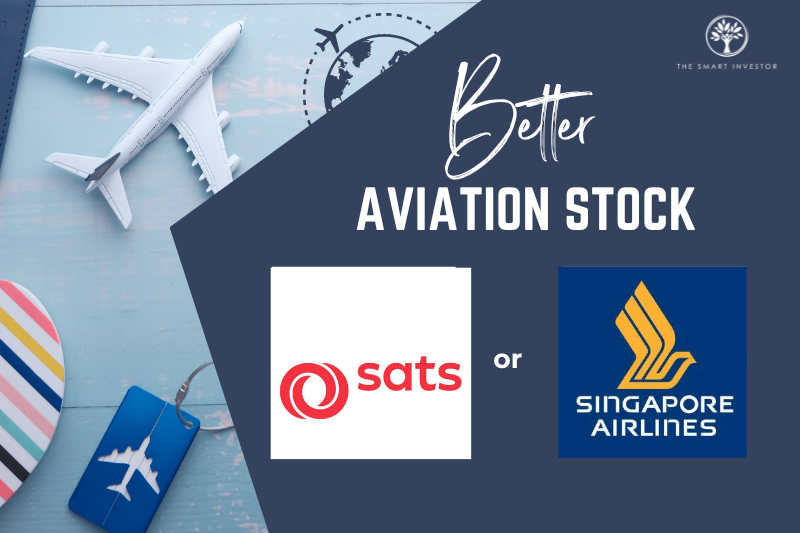
Two Singapore-listed names could benefit: SATS Ltd (SGX: S58) and our flagship carrier, Singapore Airlines Limited (SGX: C6L), or SIA.
They share an industry but make money in very different ways, and this year’s fuel shock has pulled their fortunes apart.
SATS vs SIA: Two Different Ways to Invest in Aviation
SATS provides ancillary services around a plane; think services such as ground and cargo handling, and the provision of food on board flights.
SATS’s 2023 acquisition of Worldwide Flight Services (WFS) beefed up the company’s cargo-handling footprint, which now spans some 225 stations in 27 countries.
SATS earns money per flight handled, per tonne of cargo moved, and per meal served on board a plane. So, a busier airport means more business.
SIA operates aircraft itself through the Singapore Airlines and Scoot brands.
Its top line depends on how many passengers fly, how full the seats are (load factor), how much it earns per passenger per kilometre (yield) and how much cargo it carries.
It’s not easy operating an airline given high costs (with fuel the biggest item), heavy capital spending requirements (aircraft), and intense competition from rivals chasing the same air routes.
Which Company Is Benefiting More from the Aviation Boom?
Singapore’s aviation figures are more mixed than you think: from January to August, passenger numbers stood at 46.7 million, up 0.3% year on year (YoY).
Cargo growth is healthier, with year-to-date airfreight up 8.4% YoY on AI-related chip shipments.
That favours SATS, whose cargo volume rose 8.6% YoY in the April to June quarter.
If Singapore’s exports keep holding up, SATS looks better placed than SIA, since SIA is more dependent on passenger numbers and more exposed to fuel costs.
SATS grew revenue 11.3% YoY to S$1.68 billion in the April to June 2026 quarter (1QFY2027).
But operating profit was up by only 6.8% YoY to S$133.8 million as the operating margin slipped from 8.3% to 8.0%.
WFS’s contribution to SATS’s business hasn’t quite shown up in the margin yet.
SIA carried 6.3% more passengers YoY for the same time period on 5.9% more capacity.
Revenue leapt 19.3% YoY to S$5.71 billion, but the extra sales didn’t flow to the bottom line.
Operating profit fell 73.8% YoY to S$105.5 million, mainly because of ballooning fuel costs.
Financial Performance: Which Business Is More Profitable?
| Latest results | SATS | SIA |
|---|---|---|
| Revenue growth, April to June 2026 | +11.3% | +19.3% |
| Operating profit, April to June 2026 | S$133.8 million (+6.8%) | S$105.5 million (-73.8%) |
| Net profit, April to June 2026 | S$75.1 million | –S$75.8 million |
| Operating margin | 8.3% | 5.2% |
| Free cash flow, last financial year | S$726.2 million | S$2.5 billion |
| Return on equity | 10.8% | 7% |
SIA shows how revenue can grow while profit shrinks.
Fuel accounted for around 40% of its expenses in the quarter, and higher fares recovered only part of it.
SATS faces cost pressures too, and management warns they could be more pronounced in the coming quarters because contract prices adjust with a lag.
On most metrics except top-line growth, SATS has been doing better than SIA recently.
Balance Sheet Strength: Which Company Is Financially Healthier?
SATS still carries debt from the WFS deal.
Total debt was S$4.2 billion at 30 June 2026, including leases, or 1.41 times equity, and gross debt was about 3.3 times EBITDA.
Free cash flow was S$726.2 million in the last financial year (ended 31 March 2026) and negative S$22.6 million in 1QFY2027.
With cash at S$726 million, SATS seems to be in a decent position to continue deleveraging its balance sheet should it be able to maintain its operating performance.
SIA holds S$10.5 billion in cash and longer-term deposits against S$10.7 billion of debt, and also has S$3.2 billion of undrawn credit lines.
Capital spending was S$2.6 billion in the latest financial year ended 31 March 2026, though operating cash flow of S$5.1 billion covered it.
In a downturn, SIA has the bigger cushion, while SATS’ debt leaves less room to manoeuvre.
Dividends: Which Stock Is Better for Income Investors?
SATS last paid an annual dividend of S$0.07 per share for FY2026, up 40% from a year ago.
That’s 36.5% of earnings for the year, and free cash flow more than covers it, so there’s room to grow.
SIA last paid an annual dividend per share of S$0.37, made up of an ordinary dividend of S$0.27 and a special dividend of S$0.10.
The ordinary part accounted for roughly 43% of free cash flow, leaving ample headroom for further increases.
Based on share prices on 15 October 2026, SATS yields around 1.6%, and SIA yields around 4.2% on ordinary dividends.
Valuation: Is SATS or SIA the Better Buy Today?
| SATS | SIA | |
|---|---|---|
| Price-to-earnings, last 12 months (LTM) | 19.4 | 17.1 |
| Price-to-book | 2 | 1.2 |
SIA looks cheaper at 17.1 times LTM earnings, but the airline’s earnings for FY2026 sat near a peak.
SATS has a price-to-earnings ratio of 19.4 times and a price-to-book ratio of nearly 2 times; this means it’s priced for steady cargo growth, subject to execution risk.
The key risks for SATS are poor integration of WFS, high debt, rising labour costs and weaker cargo demand.
At SIA,the risks are fuel costs, falling fares as capacity returns, competition and aircraft spending.
Get Smart: Which Aviation Stock Would I Buy?
SATS is the infrastructure and cargo play; SIA the direct bet on passengers.
While both companies’ performance should track aviation activity, in a higher-fuel-cost environment, SATS might edge out SIA.
That said, SIA’s strong balance sheet gives it more headroom to weather a downturn, an area where the airline is ahead of the aviation ancillary services provider.
The choice of which company to buy depends on your risk profile and whether there’s a specific part of the aviation industry you’d like a more direct exposure to.
Busy airports don’t guarantee good shareholder returns.
What counts is which company turns traffic into durable profit and cash flow, and which you can buy at a sensible price.
What are the stock secrets to Singapore’s “quiet millionaires?” Chances are, you’ll find at least one of their favourites in this free report. Download it now and see how these stocks could power your portfolio!
Follow us on Facebook, Instagram, Telegram and YouTube for the latest investing news and analyses!
Disclosure: Wilson H. does not own shares in any of the companies mentioned.