I remember it very clearly.
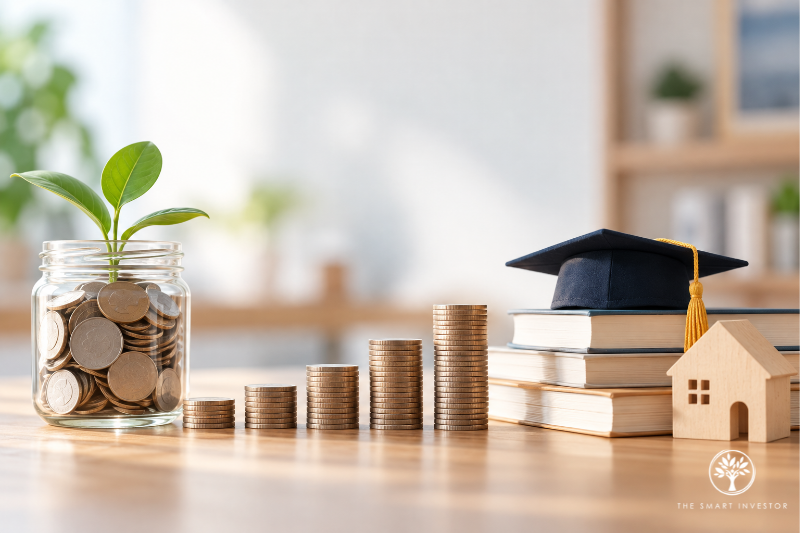
One of the first things I did when my daughter was born was to open a children’s savings account (and a Child Development Account, or CDA) for her.
The plan my husband and I had was to regularly put in a small amount every month, as well as ang bao money she would get from her first-month celebration or at future birthdays and even during the Chinese New Year season.
When our second and third children came along, we did the same for them.
The assumption was that this saving habit would build up to a nice, sizeable amount that they could eventually use for university tuition, their first home, or whatever big milestone lay ahead.
Seeing those account balances grow brought a great deal of comfort.
Unlike stock prices, cash feels solid and safe.
You deposit S$1,000, and six months later, it’s still S$1,000.
And maybe that is the problem.
Over time, while cash preserves the nominal digit in a bank book, it quietly destroys what that money can actually buy.
With university fees and daily living costs climbing across Singapore, holding too much cash for a long period presents a silent, ongoing challenge for our children’s future.
Why Cash Savings May Not Be as Safe as They Seem
Inflation acts like a silent tax on savings.
When prices rise, the purchasing power of every dollar shrinks.
To put this in perspective: at a steady 3% annual inflation rate, an expense costing S$10,000 today will shoot up to roughly S$18,061 in 20 years.
That means the S$10,000 you have in the bank today will not buy as much as it does now.
Singapore’s core inflation is projected to average 1.5% to 2.5% in 2026.
Meanwhile, basic kids’ savings accounts or standard bank deposits often yield base rates well below that mark.
Real return is what remains after subtracting inflation from your interest rate.
If your money earns a 1% base interest rate while inflation averages 3%, your real return is negative 2% each year – meaning your savings are steadily losing real-world value.
Unlike short-term adult savings, money set aside for a child often sits untouched for 10, 15, or even 20 years.
Over such long horizons, even tiny gaps between interest rates and inflation compound into massive losses in purchasing power.
The Real Cost of Raising and Educating a Child
As Prime Minister Lawrence Wong highlighted at the recent National Day Rally, the costs of raising and educating a child continue to weigh heavily on parents, prompting the government to step in with enhanced financial packages and reduced preschool fees.
For instance, under the newly announced SG Child Support Package, every Singaporean child will receive nearly S$70,000 in total direct financial support from birth to age 17 – including cash gifts, annual child credits, and post-secondary education top-ups.
While government support provides a welcome boost, the long-term price tag of major milestones remains significant.
University tuition and specialised enrichment programmes historically experience inflation rates that outpace general headline inflation.
Beyond tuition, many parents also hope to help their children with down payments for their first home or postgraduate studies.
Saving a fixed lump sum today without accounting for inflation leaves a shortfall decades down the road.
Rather than assume today’s costs will hold, map out when your child will need the funds and adjust expected expenses upward for inflation.
Why Investing Could Be a Better Long-Term Strategy
To see how much difference investing can make over time, consider a hypothetical S$10,000 saved for 20 years.
| Time Horizon | 1% p.a. (Cash / Savings) | 4% p.a. (Balanced / Conservative) | 7% p.a. (Growth / Equities) |
| Initial (Year 0) | S$10,000 | S$10,000 | S$10,000 |
| After 5 Years | S$10,510 | S$12,167 | S$14,026 |
| After 10 Years | S$11,046 | S$14,802 | S$19,672 |
| After 15 Years | S$11,610 | S$18,009 | S$27,590 |
| After 20 Years | S$12,202 | S$21,911 | S$38,697 |
Note: These figures are illustrative and assume all dividends or returns are fully reinvested annually, with no interim withdrawals.
While returns are never guaranteed, reinvesting dividends and market gains historically helps build real purchasing power over multi-decade periods.
Broad-market exchange-traded funds (ETFs) offer an accessible starting point by providing instant exposure to hundreds of global companies.
For local dividend income and stability, established Singapore blue chips like DBS Group Holdings Ltd (SGX: D05) or defensive real estate investment trusts (REITs) like CapitaLand Integrated Commercial Trust (SGX: C38U), or CICT, generate steady cash flows that can be automatically reinvested to accelerate growth.
Of course, time helps cushion volatility, but it does not eliminate risk entirely.
Stock markets go through down cycles, and prices fluctuate.
Investing for a child’s future requires accepting this short-term volatility in exchange for potential inflation-beating long-term growth.
How Parents Can Build Their Children’s Wealth Consistently
Building long-term wealth for your children does not require a massive lump sum upfront.
Here is how parents can build that foundation over time:
- Start with small, regular contributions: Putting even a modest S$200 a month into a low-cost ETF builds serious compounding momentum over 15 to 20 years.
- Reinvest dividends and distributions: Automatically reinvesting every payout buys more units along the way, quietly multiplying your portfolio’s long-term engine.
- Review the portfolio as your child grows: When your child nears major milestones around age 16 or 17, gradually shift those volatile growth holdings into safer, liquid cash assets to protect what you’ve built.
At the same time, we need to steer clear of a few common mistakes.
While leaving 100% of their money in cash guarantees a slow loss of buying power over time, jumping to the other extreme by chasing speculative, high-risk punts is equally dangerous.
Avoid investing without a clear horizon – putting money you’ll need in two years into equities leaves you exposed if the market takes a temporary dip.
Lastly, don’t miss the chance to talk to your kids about money along the way.
Teaching them how saving, interest, and compounding work in the real world ensures they inherit financial wisdom alongside the nest egg you’ve built for them.
Get Smart: Protect Their Future Purchasing Power
At the end of the day, cash isn’t the enemy.
It remains essential for emergency buffers, everyday expenses, and short-term peace of mind.
But holding a child’s entire long-term reserve in a standard bank account for 15 or 20 years quietly exposes their future to serious inflation risk.
The secret lies in matching every dollar to its timeline – keeping near-term funds in safe, liquid accounts while letting long-term money grow in a diversified investment portfolio.
By giving every dollar a clear job and a realistic time horizon, we can ensure the money we save for our children today actually retains its real buying power when they need it tomorrow.
Imagine owning businesses that continued paying shareholders even when markets were falling. That’s the appeal of dividend investing done well. Our FREE report reveals 6 SGX companies that paid dividends every single year for two decades, through the Global Financial Crisis, COVID-19, and 2022’s rate shock. Start building the kind of income stream that could fund a more comfortable retirement. Get your free report here.
Follow us on Facebook, Instagram, Telegram and YouTube for the latest investing news and analyses!
Disclosure: Calvina L. owns shares/units of DBS and CICT.