My eldest daughter is in Primary 6, and this week marks a pretty big milestone at home: the start of her PSLE journey with the oral examinations.
Watching her get ready has been a gentle reality check on just how fast these primary school years fly by.
Before we know it, our kids will be grown up and making major financial decisions of their own.
Most of us want to give our children a solid financial head start, but it’s easy to assume that requires dropping a massive lump sum into an account on day one.
It doesn’t.
Simple consistency and time are usually far more effective wealth builders.
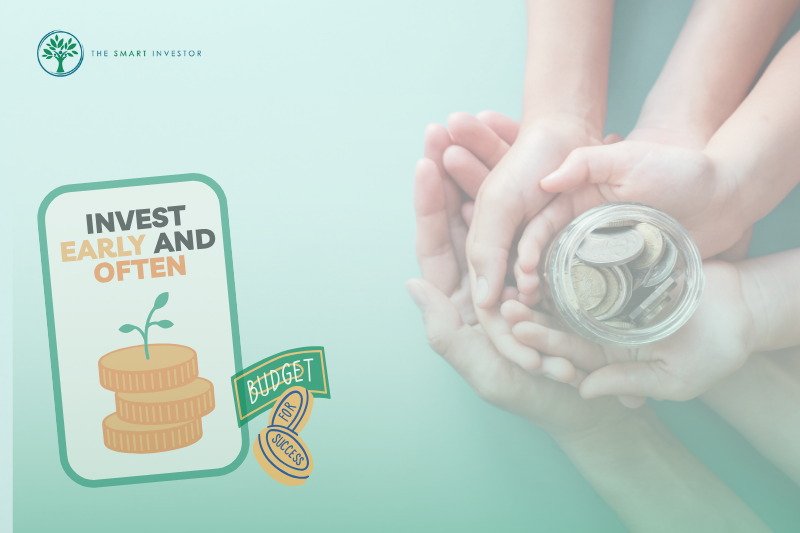
Setting aside a modest S$200 a month right from birth might not feel like much in the beginning, but over 21 years, compounding has a way of turning those quiet, regular efforts into something truly substantial.
The Mathematics: What Could S$200 a Month Become?
Let’s take a look at the numbers.
If you commit to setting aside S$200 a month over 21 years, your total out-of-pocket contribution comes to exactly S$50,400.
While that is a respectable sum on its own, compounding can significantly alter the outcome.
| Annual Return | Potential Portfolio Value at Age 21 |
| 3% | Approx. S$70,000 |
| 5% | Approx. S$90,000 |
| 7% | Approx. S$110,000 |
These figures are hypothetical illustrations, as actual market returns naturally fluctuate, but the key takeaway remains the same: the parent contributes S$50,400, while time and compounding potentially do the heavy lifting.
Starting as early as possible gives every dollar the maximum time to grow.
Why Starting Early Beats Waiting for a Lump Sum
A child’s absolute best asset when it comes to investing isn’t money – it’s time.
When you have a 21-year horizon ahead of you, short-term market dips and noisy headlines lose a lot of their power to disrupt your strategy.
The portfolio has decades to breathe, ride out the rough patches, and recover.
A long runway also gives compounding space to fire on all cylinders.
It isn’t just about price appreciation; any dividends collected along the way can be put straight back to work buying more shares, which then generate their own dividends.
Pair that with stable underlying corporate growth, and those unassuming S$200 monthly contributions gradually snowball into a substantial sum over time.
What Should Parents Invest In for a 21-Year Horizon?
When building a 21-year portfolio, parents typically consider three broad approaches.
Option 1: Broad Market ETFs
By spreading capital across hundreds or thousands of companies globally, Exchange-Traded Funds (ETFs) offer broad diversification and lower reliance on picking individual stock winners.
This provides a simpler, lower-maintenance option for parents who prefer a set-and-forget strategy.
Option 2: Singapore Blue-Chip Dividend Stocks and REITs
For parents seeking tangible, income-generating businesses, high-quality Singapore blue chips and Real Estate Investment Trusts (REITs) present an attractive domestic foundation:
- DBS Group (SGX: D05): Singapore’s largest lender boasts a strong business franchise and a solid dividend-paying track record. In 2Q2026, total income crossed S$6 billion for the first time. The bank posted a net profit of S$3.1 billion and declared a total quarterly payout of S$0.81 per share (comprising a S$0.66 ordinary dividend and a S$0.15 capital return dividend).
- Singapore Exchange (SGX: S68), or SGX: Operating as an asset-light business with recurring revenue streams, the bourse operator reported a 13.9% year-on-year (YoY) rise in FY2026 net revenue to S$1.5 billion and rewarded shareholders with total FY2026 dividends of S$0.570 per share (including a one-off additional dividend of S$0.125 from capital recycling gains).
- Sheng Siong Group (SGX: OV8): As a defensive consumer staple, Sheng Siong offers stable cash generation. For 1H2026, revenue rose 11.9% YoY to S$855.4 million and net profit grew 11.7% to S$80.8 million, backed by a strong balance sheet with S$402.3 million in cash and zero debt.
- CapitaLand Integrated Commercial Trust (SGX: C38U), or CICT: As Singapore’s largest listed REIT, CICT provides resilient income backed by a portfolio of prime retail and office assets. For 1H2026, CICT delivered a 7.1% YoY increase in distribution per unit (DPU) to S$0.0602, driven by an 8.7% rise in net property income to S$630.5 million while maintaining high portfolio occupancy of 95.6% and a healthy aggregate leverage ratio of 37.4%.
Option 3: A Combination of Growth and Income
A child’s portfolio does not need to focus solely on dividends.
Over a 21-year horizon, a long-term portfolio could combine global growth companies, Singapore dividend stocks, ETFs, and suitable REITs.
The overarching goal is to grow the capital base during the early accumulation years and build future income later.
How to Build the Portfolio Step by Step
Step 1: Automate your S$200 monthly contributions so investing becomes an effortless habit.
Step 2: Immediately reinvest every dividend payout to maximise compounding.
Step 3: Do a quick annual check-in to monitor business quality – there is no need to over-trade.
Step 4: Boost the portfolio by redirecting ang baos and bonuses into the account.
By age 21, this nest egg can cover university tuition or seed your child’s own investing journey.
Success simply requires staying disciplined: avoid keeping cash in low-yield accounts where inflation erodes value, and keep buying through market downturns to collect quality businesses at a discount.
Get Smart: The Best Gift Is Time
Setting up a solid financial safety net for your child does not demand a sudden windfall or an overly complicated strategy.
And if you didn’t start the moment you brought them home from the hospital, don’t worry – it is never too late to begin.
The maths still works in your favour as long as you start today rather than tomorrow.
A steady S$200 monthly investment in quality assets, given room to breathe and compound, can accumulate into a very real financial springboard by the time they reach 21.
Ultimately, the best gift we can pass down isn’t just a number in a bank account.
It is the gift of time, the compounding engine, and the practical investing habits that will serve them for the rest of their lives.
Imagine owning businesses that continued paying shareholders even when markets were falling. That’s the appeal of dividend investing done well. Our FREE report reveals 6 SGX companies that paid dividends every single year for two decades, through the Global Financial Crisis, COVID-19, and 2022’s rate shock. Start building the kind of income stream that could fund a more comfortable retirement. Get your free report here.
Follow us on Facebook, Instagram and Telegram for the latest investing news and analyses!
Disclosure: Calvina L. owns shares of DBS, SGX and CICT.