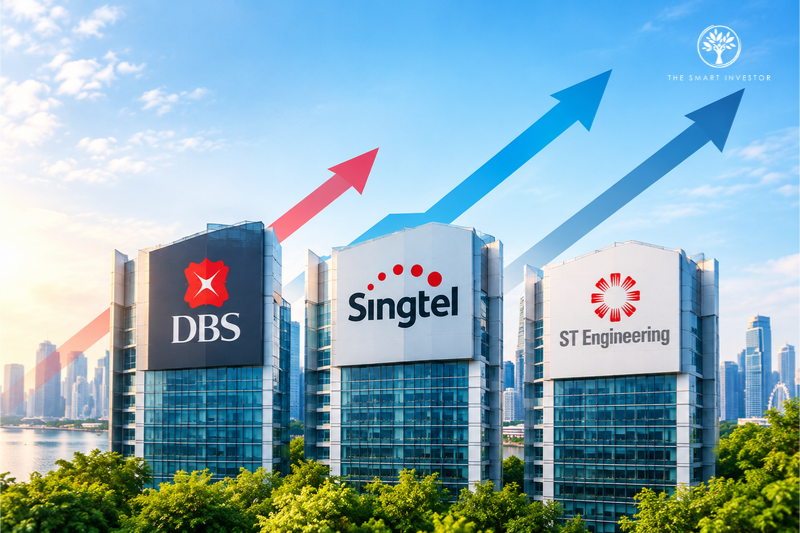
DBS Group Holdings (SGX: D05) is up nearly 37% year-to-date (YTD), while Singapore Technologies Engineering (SGX: S63), or ST Engineering not far behind with a gain of 29%.
Singapore Telecommunications (SGX: Z74), or Singtel, has had a bumpier ride – its share price was up sharply earlier to reach a record high in March 2026 before pulling back, resulting in a negative 6% YTD return.
All three have posted stellar growth in earnings, dividends and cash flow in recent times; the harder question now is which one’s fundamentals still justify buying at today’s prices.
Let’s find out.
DBS: Strong Earnings, But Has the Valuation Caught Up?
DBS’s YTD rally is backed by strong profitability for the second quarter of 2026 (2Q2026).
Its return on equity (ROE) came in at a robust 17.9% and was accompanied by a record quarterly net profit of S$3.08 billion, up 9% compared to a year ago.
Steady loan growth of 5% YTD helped buffer the decline in DBS’s net interest margin (NIM) to 1.87% from 2Q2025’s 2.05%.
Encouragingly, fee income of S$1.7 billion represented year-on-year (YoY) growth of 22%, with wealth management continuing to be the standout; wealth management income rose a staggering 41.6% YoY to S$919 million.
Critically, management rewarded shareholders by raising the dividend for 2Q2026 by 8% YoY to S$0.81 per share.
With global interest rates rising, DBS’s NIM may recover, supporting further earnings growth.
DBS trades at a rich valuation of more than 3x book value and roughly 19x forward earnings, while sporting a dividend yield of 4.1%; all these metrics comfortably surpass its historical averages.
The main risks for investors to monitor include NIM compression, any pickup in credit costs, slower loan growth, and simply how much of DBS’s quality has been baked into its current valuation.
Singtel: Can the Transformation Deliver More Upside?
Singtel’s share price climbed for several years, up to a peak in March 2026, because its telco business held up and its regional associates kept growing.
Singtel Singapore earned S$230 million in earnings before interest and taxes (EBIT) for the fiscal quarter ended 30 June 2026 (1QFY2027), down 2% from a year ago.
Optus and NCS carried the growth: Optus’s EBIT rose 14% YoY to A$152 million, while NCS’s EBIT jumped 29% to S$102 million.
Together they lifted Singtel’s overall EBIT by 10% YoY to S$462 million.
Turning to Singtel’s regional associates, their post-tax profit rose 16.1% YoY to S$543 million, led by Bharti Airtel and AIS.
The regional associates’ post-tax profit was roughly two-thirds of Singtel’s S$831 million in underlying net profit (up 27% YoY) during the quarter.
Singtel has been returning capital to shareholders.
There was a record dividend of S$0.185 per share for FY2026, up 8.8% from FY2025.
The dividend combined a S$0.134 per share core dividend (80% of underlying profit) and a S$0.051 per share value realisation dividend funded by asset sales.
In addition, Singtel has conducted a near-billion-dollar buyback YTD.
But it’s worth noting that the core dividend can only rise as fast as underlying profit, and Singtel’s EBIT is guided to grow by just a low-to-mid single-digit percentage rate in FY2027.
That said, Singtel is in discussions to sell a significant minority stake in Optus, which could provide capital for further value realisation dividends.
Singtel currently yields about 4.3%, while trading at a forward earnings multiple of around 20.
The catch is that Singtel’s dividend has exceeded its earnings in recent periods, with asset sales filling the gap.
Singtel’s main risks include intensifying telecom competition, increased regulatory pressure and execution on its digital transformation strategy.
ST Engineering: The Growth Story Behind the Rally
ST Engineering has increasingly been valued as a growth and income stock rather than a traditional defence contractor, and the numbers support this shift.
Revenue surged 11% YoY to S$6.6 billion for the first half of 2026 (1H2026), with net profit jumping 27% to S$512 million.
ST Engineering’s business is supported by a robust order book of S$35.7 billion as of 30 June 2026.
Free cash flow was healthy at S$628.6 million, or S$0.20 per share, which comfortably covers the dividend of S$0.09 per share for the period.
ST Engineering’s Commercial Aerospace segment continues to ride structural MRO (maintenance, repair and overhaul) demand, while the Defence and Public Security segment benefits from rising government spending under long-duration contracts.
The company’s order book grew 14% YoY in 1H2026, which is faster than its revenue growth.
This gives real visibility into future revenue – although margins on that revenue are not guaranteed.
ST Engineering trades at a premium valuation of 30x forward earnings, a rich multiple that assumes continued flawless operational execution.
Which Stock Still Offers the Best Value?
| DBS | Singtel | ST Engineering | |
| YTD share-price performance | 38% | -6.3% | 29% |
| Earnings growth (YoY) | 9% | 27% | 27% |
| Dividend yield | 4.1% | 4.2% | 1.7% |
| Dividend growth (YoY) | 8.0% | 8.8% | 12.5% |
| Free cash flow (last FY) | NM (bank) | S$2.4 billion | S$1.2 billion |
| P/E (Next Twelve Months) | 19x | 20x | 30x |
| Price-to-book (Last Twelve Months) | 3.1x | 2.6x | 13.4x |
| Growth catalysts | Wealth management / Recovery in NIM | Asset recycling / Digital transformation | Order-book conversions, continued strength in aerospace and defence |
| Main risk | Valuation, interest rates | Intensifying telecom competition | Valuation, execution |
Across the three, DBS (3.1x book) and ST Engineering (29.7x forward earnings) seem to price in the most growth.
Although both are arguably higher-quality businesses than Singtel, the telecom giant may be the better-priced stock if it continues to execute.
ST Engineering’s valuation leans most on its premium multiple holding up, given how sharply it has been re-rated.
DBS’s re-rating has been more gradual and is arguably backed by rising ROE.
Any re-rating for Singtel, by contrast, would be catching up with fundamentals, not running ahead of them.
Investors would do well to monitor these developments in the coming quarters: for DBS, its net interest margin; for Singtel, the Optus sale and how proceeds are split between debt and shareholder returns; and for ST Engineering, contract wins and margins.
Get Smart: A Great Stock Can Still Become Expensive
Each stock rallied for its own reasons.
DBS is a highly profitable bank that returns plenty to shareholders, Singtel is still restructuring, and ST Engineering is benefiting from demand for aerospace and defence work.
After a run like this, what counts is what each can earn, generate in cash and pay out from here, against today’s price.
All three still have a case, but DBS and ST Engineering already have much of their quality priced in, while Singtel has less.
One of these six companies is the only one legally allowed to operate in Singapore. It has increased its dividend for 16 consecutive years. Discover which one it is in our free report here.
Follow us on Facebook, Instagram, Telegram and YouTube for the latest investing news and analyses!
Disclosure: Wilson H. does not own shares of any of the companies mentioned.