Simplicity grabs attention.
Advertisers know it.
But crucially, so does Wall Street, with its knack for simplifying complicated technological trends into attention-grabbing acronyms.
The modus operandi is unmistakable:
Pick the hottest stocks of the day; slap a label on it; observe the capital inflow as investors chase it.
The implications?
Wall Street benefits.
But how about the man-on-the-street investor throwing his money into it?
Chasing These Hot Stocks? Think Again.
Past performance does not necessarily imply future performance, even if droves of investors believe it does, driving these eye-catching names to unbelievable valuation multiples.
Unbearable fear of missing out (FOMO) adds fuel to the fire, driving them even higher.
The result?
Investors pay premium prices for hot stocks that represent their historical growth rather than the fair value of their future cash flows.
As elevated prices become increasingly detached from their fair value, the chances of a massive correction grow.
Not convinced?
Look no further than 2022’s tech drawdown that brought the prices of the biggest tech titans to their knees.
Instead of “Buy Low, Sell High”, investors did the opposite and jettisoned Wall Street’s strongest names at cyclical bottoms.
Conversely, patient investors were rewarded, as corporate earnings eventually surged beyond their prior valuations, sending stock prices roaring back to historic highs.
MANGOS – No, It’s Not Your Favourite Tropical Fruit
In 2013, FANG burst onto the scene, with Jim Cramer praising the businesses’ potential to dominate the market.
That’s Facebook, Amazon.com, Inc. (NASDAQ: AMZN), Netflix Inc (NASDAQ: NFLX) and Google.
Apple (NASDAQ: AAPL) joined the party in 2017, resulting in FAANG.
The narrative shifted again in 2023.
This time, it was towards generative AI and the cloud infrastructure providers that power it, as well as notable hardware players such as Tesla (NASDAQ: TSLA) and NVIDIA (NASDAQ: NVDA), giving rise to the “Magnificent Seven”, or “Mag Seven”.
More hardware exposure allows the Mag Seven grouping to cut across a wider cross-section of the S&P 500, unlike the software-heavy FANG and FAANG groupings.
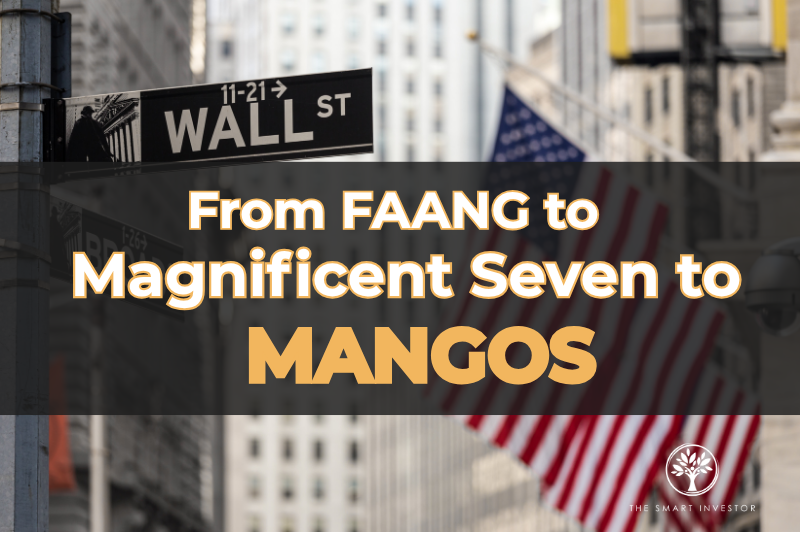
2026 minted yet another grouping that brings together the greatest movers and shakers in AI compute, frontier models, and the nascent space economy: MANGOS.
While NVIDIA dominates general-purpose AI compute, Google parent, Alphabet (NASDAQ: GOOGL), offers Tensor Processing Units (TPUs), which are crucial alternatives for specialised AI workflows.
OpenAI and Anthropic represent the leading edge of proprietary frontier model development, while the latest Muse models from Meta (NASDAQ: META) are catching attention.
Not to forget the nascent space economy – trailblazed and anchored by SpaceX (NASDAQ: SPCX).
Together, they make up MANGOS, the latest Wall Street acronym to grace the market runway.
Notably, not all members of this grouping are publicly listed yet, underscoring the increasing significance of the private equity market’s role as a cradle for new tech giants.
MANGOS – Is the Deal Sweet or Sour?
MANGOS is heavily aligned with the broader AI growth supercycle.
However, rising capital expenditure (CapEx) to keep the AI growth engine humming shows no signs of slowing, souring the underlying financial realities.
It’s not a problem if the companies in the grouping have the financial firepower to sustain it.
But do they?
From 2025 to 2027, the projected increase in their capex is expected to outpace their growth in operating cash flow by 57%.
Crucially, Alphabet’s 2Q2026 (second quarter of 2026) results show early signs of this.
Its capex reached US$44.9 billion, sending its free cash flow (FCF) into negative territory (-US$5.9 billion), for the first time in a long while.
A silver lining is that Alphabet’s trailing twelve months’ FCF remains in the green at US$53.3 billion.
How about Anthropic and OpenAI?
They are reportedly loss-making, but have targets to break even in FCF by 2027-2028 and 2029-2030, respectively.
However, this break-even timeline could shift further as the wider industry seeks budget optimisation over “tokenmaxxing” (maximising AI usage).
Chinese open-source models are already offering alternatives, while Meta is looking to open-source its latest models.
This sets the stage for a possible price war – a potential headwind for proprietary model developers.
Get Smart: Fundamentals Over Fashion
From FANG to MANGOS, Wall Street’s rotating carousel of acronyms attracts additional capital inflow by providing entertainment over the dry numbers of discerning analysts’ reports.
It doesn’t hurt to stay entertained.
However, chase their overextended valuations at your own peril.
Moreover, while MANGOS’s grouping includes strong businesses such as Meta and NVIDIA that are poised for long-term growth, it conveniently omits key players such as Microsoft (NASDAQ: MSFT) and prominent chipmaker Taiwan Semiconductor Manufacturing Company (NYSE: TSM) in favour of a playful name.
Smart investors look past the entertainment value of these acronyms and ask the hard questions:
- Do these businesses possess a competitive moat?
- Are the revenues not just growing but also defensible against margin compression?
- Can these businesses generate FCF in the long run?
- Are their current valuations reasonable?
The goal is clear – own resilient, cash-generative businesses, not transient fashion tribes.
A market dip can either hurt your returns… or accelerate them.
The difference comes down to one thing: how you deploy your cash. We break it down step by step in this FREE report. Get your copy for free now.
Follow us on Facebook, Instagram, Telegram and YouTube for the latest investing news and analyses!
Disclosure: Larry L. owns shares of Apple, NVIDIA, Alphabet, Meta, and Microsoft.