Dividends hold a special place in the hearts of many investors.
While capital gains remain paper gains until a stock is sold, receiving a dividend provides a more tangible return on investment.
These payouts are made from a company’s net profit, usually on a quarterly or twice-yearly basis.
This is popular with some investors, such as retirees, who seek a return on their investment via regular payments.
Notably, a dividend provides investors with a return regardless of share price performance.
However, many of the largest and most popular stocks today, including NVIDIA Corporation (NASDAQ: NVDA) and Meta Platforms, Inc. (NASDAQ: META), pay little to no dividends.
Yet, investors in these tech giants still benefit from share buybacks, which is another way companies return capital to shareholders.
Buybacks – also known as share repurchases – involve a company repurchasing its own shares, thus reducing the number of shares outstanding.
Since earnings per share (EPS) is determined by dividing a company’s earnings by its outstanding number of shares, a lower denominator mechanically increases EPS.
This benefits remaining shareholders, and sometimes management teams, who may be compensated on the basis of EPS growth.
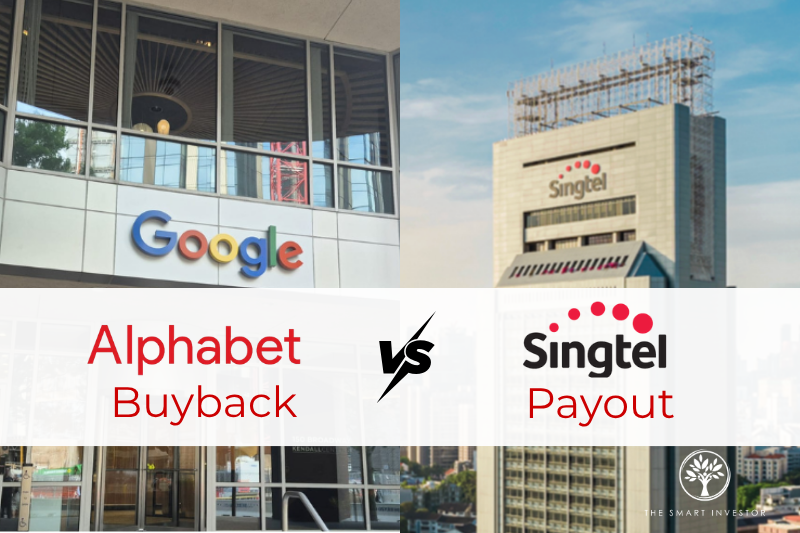
This article will compare buybacks and dividends, using Alphabet Inc. (NASDAQ: GOOG) and Singapore Telecommunications Limited (SGX: Z74I), or Singtel, – two companies with very different capital allocation strategies – to illustrate that neither approach is inherently superior.
Why Alphabet Prefers Buybacks
Between 2023 and 2025, Alphabet spent nearly US$170 billion to repurchase over 1.1 billion shares (spread across its Class A and C shares).
Over that same period, it paid US$17.4 billion in dividends, or around 10% of the amount used for share repurchases.
Alphabet can return significant amounts of capital to shareholders as it has been both a fast-growing business and a free cash flow (FCF) generating machine.
Between 2023 and 2025, revenue rose by 31%, from US$307 billion to US$403 billion.
High operating income margins – 32% in 2025 – have translated into high levels of FCF, which came in at US$73 billion in 2025.
Over the same period, buybacks helped to reduce Alphabet’s total shares, which fell from 12.7 billion to 12.2 billion.
This also helped to offset employee stock compensation, which amounted to 334 million shares over the period.
But most importantly, the share repurchases provide Alphabet with more flexibility over capital allocation – unlike income investors who react badly to dividend cuts, growth investors do not typically react as negatively when share repurchases are cut.
This is especially important at the moment, since it gives Alphabet the option to divert capital to invest in infrastructure for AI and cloud computing.
Alphabet’s most recent financials illustrate this pivot.
Capital expenditure has doubled from US$22 billion in 2Q2025 to nearly US$45 billion in 2Q2026, resulting in negative FCF of US$6 billion.
Recently, Alphabet even raised US$80 billion by selling shares to fund its AI ambitions, which is effectively the opposite of a share buyback.
As such, Alphabet’s share repurchases for the first half of 2026 have gone to zero.
Although its share price has been volatile, investors still seem to trust its capital allocation decisions, as demonstrated by the 64.2% increase in the price of its Class C shares over the past year (as of 25 August 2026).
Why Singtel Prioritises Dividends
In contrast, Singtel’s telecommunications business is more mature, enabling it to generate stable operating cash flows, and to pay out regular, progressively increasing dividends.
This attracts an income-focused shareholder base.
In its financial year ending March 2026 (FY2026), Singtel paid S$0.185 per share in dividends, 2.5 times the amount paid in FY2021, with yearly increases over the period.
The company’s shares are currently yielding around 4.1%.
Singtel also repurchases its shares, but the amounts spent are far smaller compared to what it pays out in dividends.
In the three-year period between FY2024 and FY2026, Singtel paid a total of S$7.5 billion in dividends.
In May 2025, Singtel’s management announced a share buyback programme of up to S$2 billion, to be implemented over a three-year period.
However, as of April 2026, just S$200 million has been deployed.
Singtel’s preference for paying dividends fits the slower growth profile of its overall business – revenue grew by just 0.8% between FY2025 and FY2026.
Between FY2024 and FY2026, it generated S$7.5 billion in FCF, equal to the amount of its dividends over the same period.
As of 25 August 2026, Singtel’s shares have returned 5.7% (excluding the dividend) for the year, which is far lower than Alphabet’s return.
However, Singtel’s shares are less volatile, with a beta of 0.25, compared to the latter’s 1.24.
Shares with a higher beta swing more, up or down, than the market in general (which has a beta of 1).
Should Investors Prefer Buybacks or Dividends?
The decision on whether to prefer Alphabet or Singtel depends on an investor’s profile and preferences.
Growth-oriented investors may prefer a company that returns capital primarily through share buybacks, as these typically offer higher growth and more capital appreciation, with greater share price volatility as the trade-off.
Income-oriented investors, by contrast, may prefer the predictability of regular dividends, and not having to rely on selling shares to realise a tangible return on their investment.
Luckily, investors don’t have to choose between the two: a diversified portfolio can include both Alphabet and Singtel.
Get Smart: Different Paths, Same Destination
Alphabet and Singtel reward shareholders in different ways because they operate very different businesses with different growth opportunities and investor bases.
Buybacks can enhance long-term shareholder value by increasing ownership and boosting per-share metrics, while dividends provide immediate, tangible income backed by recurring cash flows.
Rather than asking which approach is better, investors should ask whether management is allocating capital in a way that maximises long-term shareholder value.
A market dip can either hurt your returns… or accelerate them.
The difference comes down to one thing: how you deploy your cash. We break it down step by step in this FREE report. Get your copy for free now.
Follow us on Facebook, Instagram, Telegram and YouTube for the latest investing news and analyses!
Disclosure: Silas H. owns shares of Singtel.