

Blue-chip stocks are well known for their reputation and track record.
Their resilience makes them a favourite for investors who are looking for stable returns without losing too much sleep.
If you are an income investor, a bonus is that many of these stalwarts also pay out regular dividends.
It still makes sense to include a core of strong blue-chip names as the bedrock of an investment portfolio.
But with the current market volatility and interest rates expected to ease in 2026, investors may be wondering whether these familiar names are still worth buying today.
If you have S$30,000 to spare, these three blue chips could still be on your watchlist.
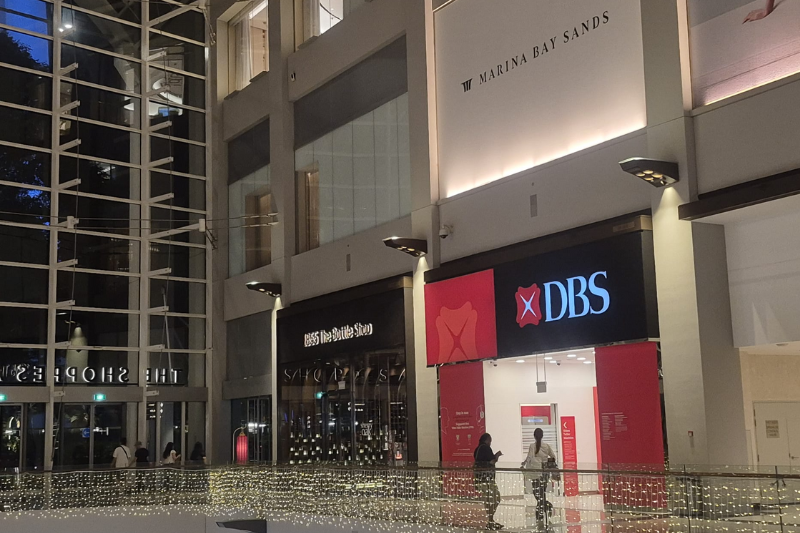
DBS Group Holdings (SGX: D05)
DBS needs no introduction, as Singapore’s largest bank by market capitalisation.
The lender has gone through many economic cycles unscathed and this is a testament to not just its brand strength but also its effective risk control policies.
DBS has benefited from higher interest rates in recent years, though margins have begun to normalise as rates ease.
For its full-year results for the financial year ended 31 December 2025 (FY2025), the bank reported a solid set of financial results, with total income rising 3% year on year (YoY) to S$22.9 billion.
DBS delivered a resilient FY2025 with profit before allowances rising 2% to S$13.7 billion, driven by record wealth management fees and a jump in non-interest income that offset narrowing interest margins.
While net interest income (NII) remained stable at S$14.5 billion amid falling rates, reported net profit dipped 3% to S$10.9 billion due to the new 15% global minimum tax.
Despite this tax impact, asset quality improved and the bank maintained a healthy return on equity (ROE) of 16.2%.
In line with its strong capital position, DBS continued to reward shareholders generously.
The board declared total dividends of S$3.06 per share for FY2025, comprising S$2.46 in ordinary dividends and S$0.60 in capital return dividends, representing a 38% increase YoY.
Despite rate headwinds trimming net interest margins, DBS’s record fee income, disciplined cost management, and generous capital returns underscore the bank’s ability to deliver for shareholders across market cycles.
Singapore Exchange Limited (SGX: S68)
Singapore Exchange Limited, or SGX, is Singapore’s sole stock exchange operator.
The group enjoys a natural monopoly and has also been consistently paying out an annual dividend since 2001.
SGX has steadily evolved into a multi-asset exchange, offering products across equities, fixed income, derivatives, commodities, and foreign exchange.
For the first half of fiscal year 2026 (1HFY2026), SGX reported net revenue of S$695.4 million, up 7.6% YoY.
Adjusted net profit rose 11.6% YoY to S$357.1 million, fuelled by double-digit growth in both the Equities – Cash division and the FICC segment.
The bourse operator proposed an interim quarterly dividend of S$0.11 per share, bringing its total dividend for 1HFY2026 to S$0.2175 per share, up 20.8% YoY.
SGX has also outlined plans to raise its dividend by S$0.0025 every quarter from FY2026 to FY2028, subject to earnings performance.
Looking ahead, the group continues to build out its fully integrated and scalable FX platform, positioning itself to benefit from rising institutional participation and global market volatility.
Keppel Ltd (SGX: BN4)
Keppel is a global asset manager and operator with three distinct divisions — infrastructure, real estate, and connectivity.
The group has transformed in recent years after divesting its offshore and marine business, sharpening its focus on becoming an asset-light platform with recurring income.
Keppel’s latest FY2025 earnings reflect this progress.
Net profit for its core ‘New Keppel’ operations rose 39% YoY to S$1.1 billion, with all three business segments improving, and infrastructure contributing the largest share of profits.
On asset monetisation, Keppel announced S$2.9 billion of deals in 2025, bringing cumulative monetisation since October 2020 to S$14.5 billion.
The Non-Core Portfolio carried a value of S$13.5 billion as at 31 December 2025, with the group targeting to substantially monetise this by 2030.
ROE for the New Keppel reached 18.7%, up from 14.9% in FY2024.
For FY2025, Keppel proposed a total distribution of about S$0.47 per share, up 38% YoY, comprising S$0.34 per share in ordinary cash dividends.
This translates to a trailing yield of about 3.8% based on its share price of S$12.27 as of 27 March 2026.
Keppel has also strengthened its shareholder return framework, giving a total shareholder return of 58.5% in 2025, outperforming the Straits Times Index’s 28.8%.
Management has indicated that dividends will be linked to the earnings performance of the New Keppel, with part of the cash unlocked from asset monetisation also used to reward shareholders.
Get Smart: Familiar Names, New Context
When markets sit near record highs, it is natural to hesitate.
But strong blue-chip companies rarely stay cheap for long.
DBS, SGX, and Keppel are priced where they are today due to resilient earnings, disciplined capital management, and consistent cash returns to shareholders.
Paying for quality does not automatically mean overpaying.
History shows that well-run companies can continue to deliver attractive long-term returns, even at elevated valuations, provided earnings and cash flows keep growing.
For patient investors, what looks “expensive” today could still turn out to be rewarding over time.
Disclosure: Royston Y. owns shares of DBS Group and Singapore Exchange Limited. Joseph G. does not own shares of any companies mentioned.


