Only three months into 2026 and the global markets have already experienced a roller-coaster ride, especially in recent weeks.
As investors are busy keeping track of the rising tariffs in the United States, the recent developments in the Middle East are creating a new level of uncertainty.
Rising oil prices, along with the disruption of shipping routes in the Gulf area, are affecting the global financial markets.
This period of market turbulence may be challenging for investors.
But price movements also create opportunities to buy fundamentally strong companies at more reasonable valuations – particularly established blue-chip stocks with stable earnings and reliable dividends.
What Is Market Volatility and Why Does It Happen?
When we talk about market volatility, we are referring to how much stock prices swing.
In other words, high volatility means bigger and more unpredictable price fluctuations.
High confidence in markets generally leads to smooth and orderly price changes.
However, when there is uncertainty in the markets, for instance, geopolitical events and policy changes, prices are likely to move in a more dramatic manner.
Despite the erratic price swings, market volatility is bound to happen in financial markets and is a test of investor confidence.
Why Blue-Chip Stocks Often Attract Investors During Volatile Periods
Blue chips are often viewed as safer bets during market turbulence.
These companies typically possess stronger balance sheets, allowing them to maintain earnings and healthy cash flow even during downturns.
In addition, blue-chip stocks often provide regular dividends.
This offers investors a consistent income stream, providing a cushion even when stock prices fluctuate sharply.
Key Metrics to Evaluate Before Buying
When it comes to Singapore blue chip stocks, investors should focus on specific factors that reveal the strength of a company’s business model.
However, these metrics vary significantly depending on the industry.
For bank stocks, which represent a large portion of the Straits Times Index (SGX: ^STI), profitability metrics such as return on equity (ROE) are essential.
This figure offers insight into how efficiently a bank generates returns for its shareholders.
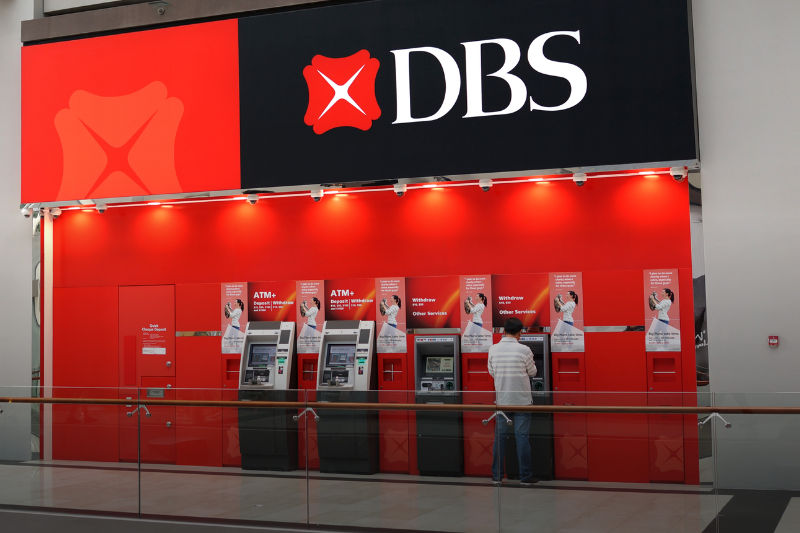
A prime example is DBS Group (SGX: D05), which achieved an ROE of 16.2% in FY2025, demonstrating high profitability and efficient capital management.
In capital-intensive or service-oriented sectors, free cash flow is a vital indicator of financial health and dividend sustainability.
This metric represents the actual cash a company has left over after paying for its operating expenses and the capital expenditure (capex) required to maintain or expand its infrastructure.
A business that consistently generates high free cash flow possesses the “financial firepower” to fund its own growth, pay down debt, and increase dividends to shareholders without needing to rely on external borrowing.
In a volatile market, companies with robust cash generation are often better positioned to weather economic downturns.
Meanwhile, investors evaluating real estate investment trusts (REITs) should prioritise distribution yields and portfolio stability.
Large-scale retail REITs, such as CapitaLand Integrated Commercial Trust (SGX: C38U), or CICT, are often evaluated based on their rental income and asset diversification.
Based on its FY2025 distributions per unit (DPU) of S$0.1158 and at a unit price of S$2.33, it delivered a distribution yield of approximately 5%.
By applying these sector-specific indicators, investors can better determine whether a blue chip has the financial muscle to withstand periods of market volatility.
Potential Advantages of Buying During Volatility
Market uncertainty can often work in an investor’s favour.
When stock prices decline due to general market-wide sentiment – rather than specific issues within a company – it creates an opportunity to acquire shares at a price below their intrinsic value.
A good example is the early stage of the pandemic in 2020. During that period, DBS’s share price fell significantly as global markets reacted to lockdowns and economic disruption.
However, as the economy recovered and interest rates adjusted, the stock rebounded and eventually soared to new highs.
The bank reached a record S$60 on 29 January 2026, driven by strong wealth management, record fee income, and a robust dividend outlook.
During these sell-offs, investors can also secure more attractive dividend yields.
By buying fundamentally strong companies when prices are depressed, you effectively lock in a higher yield on your investment while waiting for the market to recognise the company’s true value in the long run.
Risks Investors Should Consider
Investors must remember that blue-chip stocks are not immune to market risk and can still experience sharp fluctuations during periods of high volatility.
An economic slowdown may weigh on earnings, particularly for companies in cyclical industries or those sensitive to global demand trends.
A market decline may not necessarily turn every stock into a buying opportunity.
Even companies with solid foundations can see their share price remain under pressure for extended periods.
Therefore, investors should look beyond temporary price fluctuations and focus on the company’s fundamental business health and broader market conditions before making an investment decision.
Get Smart: Turning Volatility into Opportunity
While it is true that market volatility can cause anxiety, it often also serves as a window of opportunity for long-term investors.
By maintaining a clear-headed approach, you can turn short-term turbulence into long-term gains.
Some of the strategies include dollar-cost averaging (DCA), regular portfolio rebalancing, and a focus on dividends and sectoral diversification.
Having a disciplined plan helps reduce emotional decision-making.
By focusing on companies with strong balance sheets, consistent dividend policies, and proven earnings records, you can build a resilient portfolio that thrives through multiple market cycles.
Many Singapore stocks fall behind inflation, which means your money quietly loses strength over time. Dividend stocks have a very different track record. Some continued delivering 6% to 13% every year across the toughest market conditions.
In this FREE report, discover 5 crisis-tested dividend stocks that kept rewarding investors while the market struggled. Download your dividend investing guide now.
Follow us on Facebook, Instagram and Telegram for the latest investing news and analyses!
Disclosure: Darien.C does not own shares in any of the companies mentioned.