For most Singaporeans, the CPF Ordinary Account (OA) is like a reliable kopitiam for your meals – it gets the job done without fuss.
Below age 55, your first S$20,000 earns 3.5%.
From age 55, the first S$30,000 earns 4.5%.
The rest earn the 2.5% base rate.
But if you are looking to add a bit more flavour to your passive income stream, the Singapore Exchange (SGX: S68) holds a few intriguing options.
In particular, three SGX-listed companies offer yields above the CPF OA base rate.
All three hold cash and carry no borrowings.
Cash guarantees nothing, but it buys a company time to keep paying.
What each one does with that time decides the rest.
Info-Tech Systems Ltd (SGX: ITS) and Credit Bureau Asia Ltd (SGX: TCU) reported full-year results for the year ended 31 December 2025.
VICOM Ltd (SGX: WJP) reported results for the quarter ended 31 March 2026.
The three sets of numbers do not compare like for like.
Can a first-year dividend be trusted?
Info-Tech Systems sells cloud accounting and human resource software to small and medium-sized businesses across Singapore, Malaysia and the region.
2025 revenue climbed 29% year on year (YoY) to S$56.5 million from S$43.7 million.
Profit attributable to owners rose 22% to S$15 million.
One-off IPO listing and Malaysia relocation costs of around S$2.9 million weighed on that number.
Strip them out and adjusted profit grew 46% YoY to S$18 million.
The board declared a second interim dividend of S$0.0155 per share and proposed a final dividend of S$0.0195 per share.
2025 dividends totalledl S$0.035 per share, or 60% of net profit after tax.
At S$0.985, Info-Tech shares offer a 3.6% dividend yield.
That beats the 2.5% base rate and clears the 3.5% your first S$20,000 already earns.
The dividend payout cost roughly S$9 million.
Free cash flow of S$15.7 million covered the payout with room to spare, though it still fell from S$17.6 million a year ago as receivables built up and capital spending rose.
Cash climbed to S$67.3 million from S$29.7 million, though net IPO proceeds supplied most of that jump rather than retained profit.
Info-Tech carries no borrowings.
2025 marks the company’s first dividend year as a listed company.
One year does not make a record.
What pays for a rising dividend when profit falls?
Credit Bureau Asia (CBA) supplies credit and risk information to banks and government bodies across Southeast Asia.
2025 revenue edged up 0.7% YoY to S$60.1 million.
The Financial Institution Data segment grew 3% to S$28 million on higher new credit applications.
The Non-FI Data segment slipped 1.3% to S$32.1 million as demand for global credit risk reports weakened.
Profit attributable to owners fell 4.4% YoY to S$10.7 million.
Weaker interest income and a weaker USD did most of the damage.
The dividend still rose.
A final dividend of S$0.022 per share brings the 2025 total to S$0.042 per share, a 5% increase on S$0.04.
At S$1.07, CBA shares sport a 3.9% dividend yield.
Free cash flow is the lifeblood of dividends.
CBA generated S$27.2 million of it.
Cash and bank balances stood at S$46.5 million, and treasury bills and money market funds added another S$24.7 million.
The group carries no borrowings.
Read that cash flow with care.
CBA runs its bureaus through partly owned entities across Singapore, Cambodia and Myanmar.
Group free cash flow does not all belong to shareholders.
Does the highest yield have the strongest support?
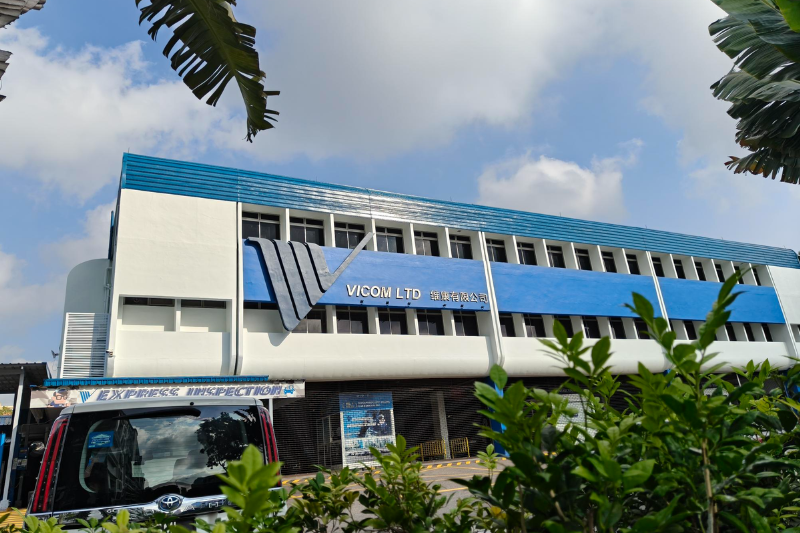
VICOM tests and inspects vehicles in Singapore.
VICOM is a subsidiary of ComfortDelGro Corporation (SGX: C52).
VICOM produced the strongest quarter of the three.
First quarter 2026 (1Q2026) revenue rose 11.5% YoY to S$37.2 million.
Operating profit surged 33.7% to S$12 million.
The operating margin widened to 32.4% from 27%.
Net profit attributable to owners jumped 33.6% YoY to S$10 million.
Cash stood at S$59.9 million as at 31 March 2026, and the group carries no borrowings.
Free cash flow tells a harder story.
It came in at S$2.2 million for the quarter against S$4.5 million a year ago.
Capital expenditure of S$11.6 million on the Jalan Papan integrated testing centre absorbed the difference.
VICOM declared no dividend for the quarter, since the group declares at half-year and full-year.
Management pointed to fading drivers.
ERP 2.0 On-Board Unit installations are slowing as the programme nears completion.
Demand for Oil and Gas testing felt the impact of the Middle East conflict in March.
At S$1.85, VICOM provides a 4.5% dividend yield, the highest of the three.
The biggest yield sits on the thinnest quarter of cash generation and the drivers closest to running out.
The S$59.9 million cash pile buys VICOM room while it builds Jalan Papan.
Get Smart: What does the extra yield ask of you?
Your CPF OA is like that reliable cai png meal at the kopitiam – you know what to expect, and it can feed you every day.
A dividend, on the other hand, asks you to underwrite a business.
Ask where the cash paying that dividend comes from.
The follow-up matters more: what the company must spend to keep generating it.
Then work out what happens to the payout once the current growth driver runs out.
Info-Tech, CBA and VICOM answer differently.
Decide which answer you can live with before the extra yield decides for you.
While your friends debate which tech stock to buy next, money is quietly flowing into these 5 Singapore companies you see every day. They are proven to have steady dividends and strong balance sheets. Our FREE report shows you exactly which ones and why they’re safer than flashy darlings everyone’s chasing. Download your free report now.
Follow us on Facebook, Instagram and Telegram for the latest investing news and analyses!
Disclosure: Calvina L. does not own any of the stocks mentioned. Chin Hui Leong contributed to the article and owns shares of Credit Bureau Asia and VICOM.