Healthcare stocks have been historically prized for their resilience and stable growth.
But that perception may be changing soon, especially in Asia.
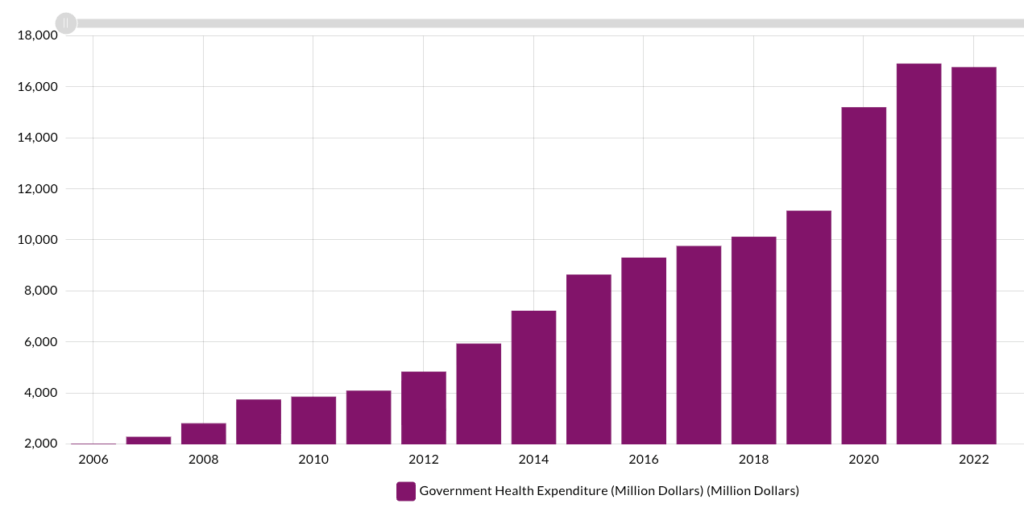
Take Singapore’s health expenditure, shown in the graph below.
Between 2006 to 2019, the decade prior to the pandemic, healthcare spending rose by about 11% per year.
While it’s an impressive growth rate, government healthcare spending shifted to a higher gear with the onset of the pandemic.
When the virus hit Singapore’s shores, spending rose by over 50% in just two years to meet emergency needs.
While that initial spike was driven by containment and vaccines, the “reset” is permanent.
For FY2026, Singapore’s health budget is projected to exceed S$20 billion for the first time, as the focus moves from pandemic control to managing an aging population through initiatives like Healthier SG.
We saw this trend in major Asian countries as well.
In Indonesia, healthcare expenditure has continued its rapid ascent, climbing from under 114 trillion rupiah in 2019 to approximately 640 trillion rupiah by 2024 as the nation expands its universal health coverage.
Meanwhile, in China, the surge in 2020 spending has evolved into a long-term fiscal commitment, with total national health expenditure reaching over nine trillion yuan to support an aging demographic.
At the same time, India continues to spend big, with the health ministry’s budget allocation reaching nearly 1 trillion rupees for the 2025-2026 fiscal year to bolster medical infrastructure and insurance.
As Asia’s healthcare systems retool, the demand for services is being sustained not just by population growth, but by a regional aging demographic and a heightened focus on preventive care.
Living a longer, better life
The average life expectancy in lower-middle and low-income countries in Asia reached 72 years in 2024, up from 64 years in 2000.
As a whole, Singaporeans are living longer too.
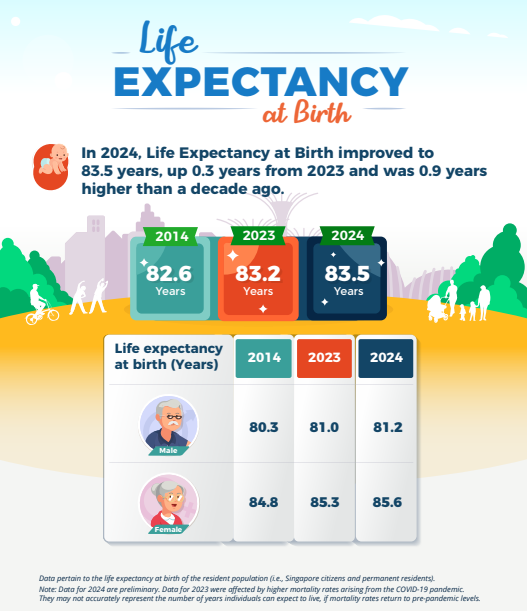
The average life expectancy for Singaporeans at birth was a little under 82.6 years back in 2014.
By 2024 the life expectancy grew to 83.5 years, as shown in the diagram below.
Unfortunately, living longer also comes with complications.
According to an April 2019 study, Singaporeans are spending more years in ill health compared to previous decades.
In short, while the population is living longer, there is an increasing need for better medical care as we advance in age.
The structural shift in demographics should benefit multiple industries such as hospitals, drug manufacturers, medical device producers, hospital suppliers, and distributors of medical-related products.
The Coming Silver Tsunami
Singapore’s population, on average, is progressively becoming older.
According to SingStat, the proportion of residents aged 65 or older has risen to 19.1% as of 2024.
Parkway Life REIT (SGX: C2PU) highlighted this trend and its strategic position to capitalise on the structural growth of the healthcare industry across Asia Pacific and Europe.
This trend is not expected to slow in the coming years.
By 2030, the Asian Development Bank (ADB) projects that approximately one in four Singaporean residents will be 65 and above.
And by 2050, that ratio is expected to reach one in three.
The rise in the number of older residents is not unique to Singapore.
Korea is expected to have about 40% of its population aged above 65 years by 2050.
China and Thailand may both see its elderly cohort account for 30% of their population over the same period.
As a whole, ADB is estimating that there will be 1.2 billion elders in Asia by 2050.
In essence, the demographic shift supports growing demand for affordable and quality healthcare in Asia.
More importantly, we expect this trend to last for years, and possibly even decades.
Get Smart: The Sweet Spot
We’re investing for our long-term financial future.
And when we do that, we look at industries that will still be highly relevant in 10 years time and more.
The Asian healthcare industry, propelled by a “super-aged” demographic and the multi-billion dollar Silver Economy, certainly fits the bill.
However, the rising tide will not lift all boats.
As we move further into 2026, the focus has shifted from pandemic recovery to operational efficiency.
Medical tourism has also evolved; it is no longer just about elective surgeries but has matured into a high-value wellness and longevity market
In this environment, not every stock within the industry will succeed.
Investors must distinguish between legacy providers and those “future-proofing” their portfolios for a more digital, preventive era.
Don’t let market uncertainty hijack your financial dreams. While headlines scream gloom, 5 Singapore companies have been quietly building wealth and paying reliable dividends. You’re probably overlooking them. Discover these resilient giants and their secrets to sustained income, even through global storms. Click here to download your free report now and secure your financial future!
Follow us on Facebook, Instagram and Telegram for the latest investing news and analyses!
Disclosure: Chin Hui Leong owns shares of Parkway Life REIT.