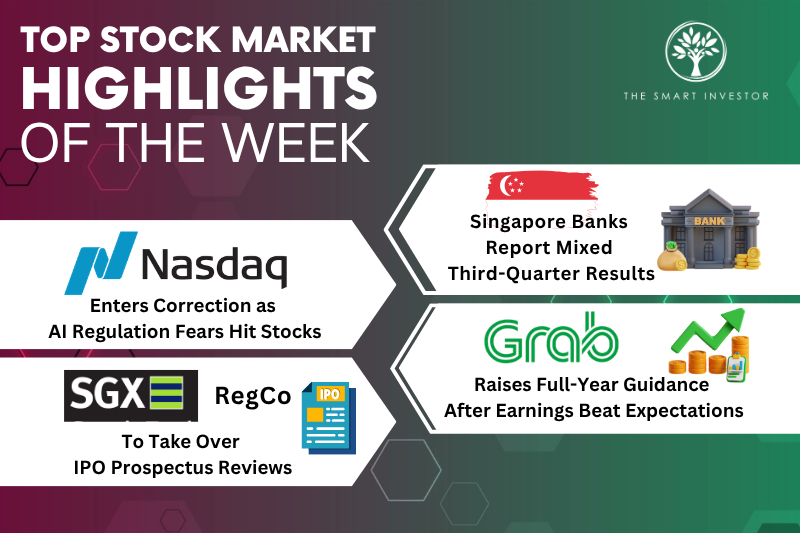
This week’s highlights cover bank earnings, a Wall Street sell-off, an upgraded outlook and a regulatory shift for local listings.
Singapore’s three local banks reported mixed third-quarter results.
In the US, the NASDAQ suffered its worst day in 19 months on fears of tighter AI regulation.
A leading super-app beat expectations for the quarter and raised its full-year targets.
Closer to home, the bourse’s regulatory arm will take over prospectus reviews from the central bank, a move meant to make listing in Singapore faster and more predictable.
Local banks post mixed third-quarter results
Singapore’s three local banks delivered mixed results for the third quarter of 2026 (3Q2026) amid narrowing margins and volatile markets.
DBS Group (SGX: D05) reported a 5% year-on-year (YoY) fall in net profit to S$2.81 billion, missing the S$2.95 billion consensus forecast as markets trading income plunged 65% to S$152 million.
Even so, the bank raised its quarterly dividend to S$0.81 per share, from S$0.75 a year ago.
DBS is also exploring a prime brokerage business, and chairman Peter Seah will hand over to Anthony Lim on 1 January 2027.
OCBC (SGX: O39) was the only one of the three to beat expectations, with net profit rising 3% to S$2.04 billion.
Its net interest margin (NIM) fell 18 basis points to 1.66%, and lower contributions from insurance arm Great Eastern Holdings (SGX: G07) cut non-interest income by 10%.
OCBC nonetheless raised its 2026 loan growth guidance to the low double digits.
UOB (SGX: U11) posted a 182.2% jump in net profit to S$1.25 billion, but this came off a low base and still missed the S$1.38 billion forecast.
The bank now expects full-year NIM to come in below its earlier guidance of 1.75% to 1.8%, and its shares fell 5% on the day.
NASDAQ slides into correction on AI regulation fears
The NASDAQ Composite fell 5.52% to 24,315.00 on 5 November 2026.
It was the index’s steepest one-day decline since the “Liberation Day” tariff announcement in April 2025.
The drop left the NASDAQ more than 10% below its record close on 6 October 2026, confirming a technical correction.
The S&P 500 fell 4.36% to 7,353.73, while the Dow Jones Industrial Average lost 3.44%.
The sell-off came after the Democrats won control of the US Congress in the midterm elections.
Some of the newly elected officials have opposed new data centres, raising concerns that tighter regulation could slow the AI infrastructure build-out that has driven markets this year.
Chipmakers led the decline, with NVIDIA Corp (NASDAQ: NVDA) among the hardest hit.
Qualcomm Inc (NASDAQ: QCOM) also fell after its smartphone chip sales missed estimates.
Despite the rout, the S&P 500 and NASDAQ remain up 7.4% and 4.6% year to date respectively.
Attention now turns to US jobs data, with traders expecting the Federal Reserve to raise rates again in December.
Grab lifts full-year guidance after an earnings beat
Grab Holdings (NASDAQ: GRAB) raised its 2026 forecasts on 3 November 2026 after its quarterly results beat expectations.
For 3Q2026, revenue rose 27% YoY to US$1.1 billion, roughly in line with estimates.
Adjusted earnings before interest, taxes, depreciation and amortisation (EBITDA) jumped 74% to US$237 million, well above the US$194.2 million analysts had projected.
The major technology player added about three million monthly transacting users in the quarter, taking its total to 57 million.
Grab now expects full-year revenue of up to US$4.2 billion and adjusted EBITDA of up to US$800 million.
In August, it had guided for up to US$4.15 billion and US$740 million respectively.
Headwinds remain, as Indonesia has capped commissions on motorcycle ride-hailing and rising fuel prices continue to drive up operating costs.
Additionally, Taiwan’s competition regulator recently blocked Grab’s proposed US$600 million acquisition of Foodpanda’s local business.
Singapore streamlines its IPO approval process
From 4 January 2027, Singapore Exchange Regulation (SGX RegCo), the regulatory subsidiary of Singapore Exchange Limited (SGX: S68), will take over the prospectus review functions of the Monetary Authority of Singapore (MAS).
This will cover listing applications for both the Mainboard and the Global Listing Board.
Today, issuers file their prospectus with MAS and their listing application with SGX RegCo separately.
Under the new arrangement, both will go to SGX RegCo through a single electronic portal.
Complete applications are expected to be processed within six to eight weeks.
SGX RegCo will also stand down its Listings Advisory Committee to reduce the number of regulatory touchpoints.
SGX RegCo CEO Tan Boon Gin said the change would streamline initial public offerings (IPOs) and give issuers more regulatory certainty.
MAS will continue to oversee SGX RegCo and will keep the power to grant prospectus exemptions.
The Equities Market Review Group first proposed the change, which marks a shift towards a disclosure-based regime, where investors, rather than regulators, judge the merits of a listing.
You’ve probably shopped at their malls, banked with them, or bought their products this month. These 6 SGX companies have paid dividends for 20 straight years, GFC and COVID included. Our FREE report shows you which ones, and what has kept their dividends going for 20 years and more. Grab your copy here.
Follow us on Facebook, Instagram, Telegram and YouTube for the latest investing news and analyses!