Singapore’s Budget 2026 has unveiled a sweeping vision to future-proof the nation against demographic shifts and global tech competition.
From raising the retirement age to 64 to a massive S$800 million commitment towards semiconductor R&D, the government is aggressively pivoting towards high-value manufacturing and workforce longevity.
Additionally, a landmark overhaul of the CPF investment landscape promises to simplify retirement planning through a new life-cycle fund model.
For the strategic investor, these policy shifts represent a fundamental realignment of Singapore’s economic engine, signalling where growth and stability will intersect in the decade ahead.
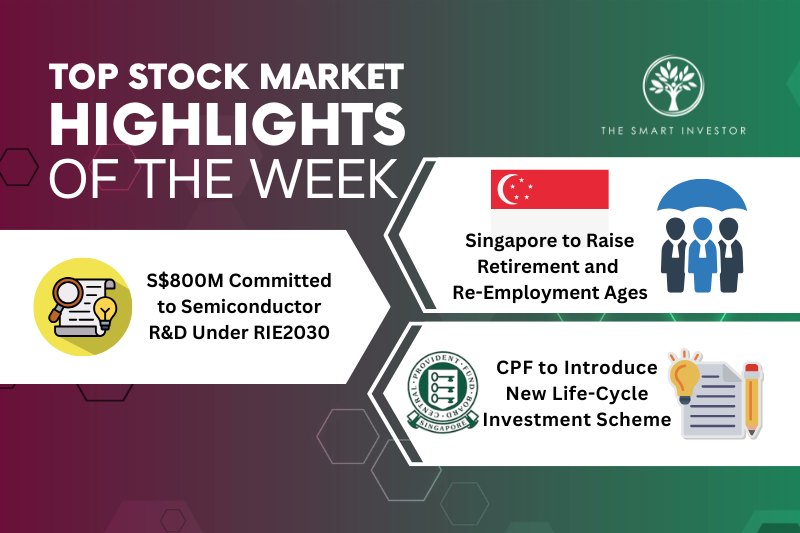
Singapore Raises Retirement and Re-Employment Ages to Support Longer Careers
Singapore will raise its retirement age from 63 to 64, and its re-employment age from 68 to 69, with effect from 1 July 2026.
Manpower Minister Tan See Leng confirmed the changes during the Ministry of Manpower’s Committee of Supply debate on 3 March, reaffirming the government’s trajectory towards a retirement age of 65 and re-employment age of 70 by 2030.
The move is designed to give senior workers greater flexibility and assurance while allowing employers to retain experienced talent.
Labour force participation among residents in their 60s has risen from around 58% to nearly 60% over the past five years, reflecting a broader societal shift towards longer working lives.
To ease the transition for businesses, the Senior Employment Credit and Part-Time Re-Employment Grant have both been extended until December 2027, providing wage offsets to help employers adjust.
CPF contribution rates for workers aged above 55 to 60 will also be raised by 1.5 percentage points from 2027, while those aged above 60 to 65 will see a one percentage point increase.
An automatic one-year CPF Transition Offset will cushion the resulting rise in employer costs.
Singapore Commits S$800 Million to Semiconductor R&D Under RIE2030 Plan
The government has earmarked S$800 million for semiconductor research and development as part of the Republic’s Research, Innovation and Enterprise 2030 (RIE2030) plan.
The funding will be channelled through a semiconductor flagship programme that coordinates Singapore’s publicly funded R&D efforts, with a focus on areas where the city-state holds established strengths, such as advanced packaging and advanced photonics.
The semiconductor sector contributes close to 7% of Singapore’s gross domestic product, and past RIE investments have already attracted more than S$30 billion in commitments from semiconductor companies over four years.
As part of the initiative, an additional S$60 million will go towards establishing a new National Semiconductor Translation and Innovation Centre (NSTIC) for Power Electronics, expected to commence operations by April 2026.
The centre will house an open-innovation 8-inch silicon carbide R&D pilot line and forge partnerships between industry and academia to commercialise wide-bandgap semiconductor technologies.
These materials — including silicon carbide and gallium nitride — are increasingly critical for data centres and high-performance electric vehicles, sectors where demand continues to accelerate.
Singapore Technologies Engineering (SGX: S63) and other locally listed technology and defence companies stand to benefit from the broader uplift to Singapore’s innovation ecosystem.
New CPF Life-Cycle Investment Scheme to Appoint Two to Three Fund Managers
A new voluntary CPF investment scheme, targeted for launch in the first half of 2028, will offer members a simplified, low-cost route to grow their retirement savings.
The scheme will adopt a glide-path mechanism that automatically shifts member allocations from higher-risk assets, such as equities, towards lower-risk assets, such as bonds, as they approach their target retirement age.
Manpower Minister Tan See Leng indicated that the CPF Board will likely appoint only two to three reputable commercial providers to keep choices simple and fees competitive.
All-in fees will be capped by the government, which is also prepared to provide time-limited support to participating members.
Applications from potential providers will be assessed by independent investment consultants on criteria including investment capability and track record.
An industry briefing is planned for March 2026, with an expression-of-interest exercise to follow.
Selected providers are expected to be announced in the first half of 2027. The scheme is distinct from the existing CPF Investment Scheme (CPFIS), which will continue to allow members to invest in a wider range of instruments. DBS Group Holdings (SGX: D05), Oversea-Chinese Banking Corporation (SGX: O39), and United Overseas Bank (SGX: U11) are among the institutions likely to be watching the tender process closely, given the substantial pool of CPF savings at stake.
It almost feels like the government is paying companies to make you wealthier. Singapore’s new S$5 billion market boost could send fresh money into local stocks. We identified 5 companies positioned to benefit, including familiar names with surprising wealth potential. Our free report reveals these hidden opportunities before the money flows in. Download it now before it’s too late.
Follow us on Facebook, Instagram and Telegram for the latest investing news and analyses!