Passive income does not require a six-figure portfolio to get started.
Every dividend investor begins somewhere, and that first milestone is often the most important.
But when we talk about a S$500 passive income goal, what does that actually mean in practice?
Depending on your timeline, the target looks very different.
If your goal is to earn S$500 a year, an average portfolio yield of 5% means you only need S$10,000 invested to hit the mark.
However, if you want to pocket S$500 every single month, that same 5% yield requires building up a S$120,000 portfolio.
Going from zero to six figures can feel daunting, but that is exactly why milestones matter.
By breaking your passive income journey into smaller, bite-sized targets, those larger goals become much more achievable.
Here is how three dependable Singapore dividend stocks can help you jumpstart your journey and cross your first major milestone.
Quality Over Quantity: Choosing Your First Three Dividend Stocks
More is not always better when generating passive income, and quality often wins out over quantity.
A great starting point is with three stocks, which keeps a portfolio simple to understand and monitor, while still providing diversification across different sectors.
In dividend investing, slow and steady wins the race.
For beginners, companies with strong, sustainable dividend payouts and the potential to grow those payouts over time are far better long-term prospects than those with eye-popping but risky yields.
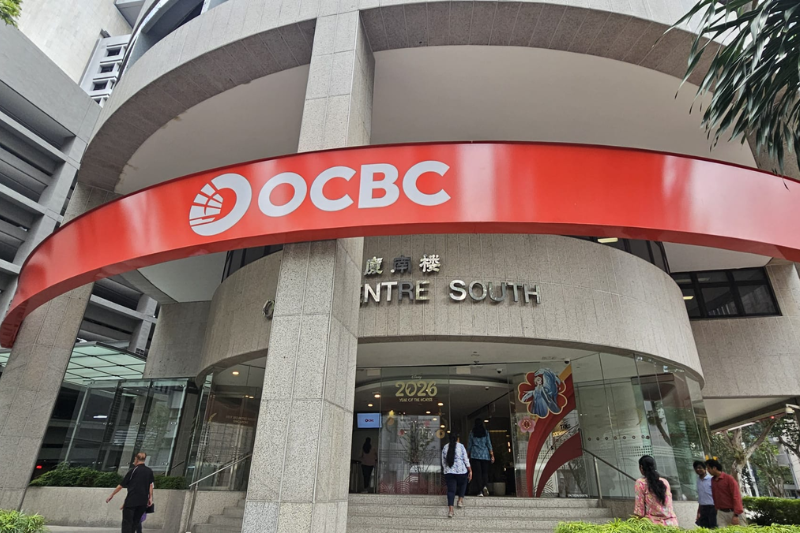
OCBC Ltd (SGX: O39) — The Dividend Anchor
Every income portfolio needs a solid foundation, and OCBC Ltd fits the bill.
The bank stands out with steady earnings, a solid capital base, and a history of growing dividends – qualities that long-term income investors look for.
OCBC reported another strong quarter in 1Q2026 with net profit rising 5% year on year (YoY) to S$1.97 billion.
The bank’s record non-interest income played a big role here, driven by rising wealth management fees, more trading income, and solid insurance contributions.
Asset quality was also healthy with the ratio of non-performing loans holding steady at 0.9%.
The bank has maintained a strong payout.
Total dividends for FY2025 were S$0.99 per share, comprising an interim dividend of S$0.41, a final dividend of S$0.42 and a special dividend of S$0.16.
Based on OCBC’s share price of S$24.26 as of 16 June 2026, this translates into a trailing dividend yield of about 4.1%.
OCBC highlights why a stable dividend anchor is often the first piece of the puzzle for investors building passive income.
Frasers Centrepoint Trust (SGX: J69U), or FCT — The REIT Income Booster
For investors looking to fast-track their passive income journey, FCT presents an attractive blend of yield and stability.
As the largest suburban retail REIT in Singapore, it has recurring rental income from malls in densely populated residential areas.
FCT delivered another strong set of results for 1HFY2026.
The REIT’s financial performance remained robust, with gross revenue rising 20.3% YoY to S$221.9 million and net property income increasing 20.2% to S$160.8 million.
Distribution per unit (DPU) rose 1.4% YoY to S$0.06136. Committed occupancy rate stood at a strong 99.8%.
The REIT also reported positive rental reversions of 6.5%, indicating healthy tenant demand across its portfolio.
Based on its latest annualised DPU of S$0.1227 and unit price of S$2.27 as of 16 June 2026, FCT offers a distribution yield of about 5.4%.
With its resilient suburban mall portfolio and dependable distributions, FCT can provide a meaningful boost to portfolio income.
Singapore Exchange Limited (SGX: S68), or SGX — The Dividend Growth Compounder
Growth is just as important in dividend investing.
While SGX may offer a lower yield than many banks and REITs, it has grown its dividend over the years.
The exchange has also built a diversified business spanning equities, derivatives, market data, and connectivity services.
For the first half of FY2026 (1HFY2026), SGX posted a record adjusted net profit of S$357.1 million.
That’s an 11.6% increase compared to the year before, with net revenue jumping 10.1% to S$636.6 million.
Thanks to this solid performance, SGX bumped up its interim quarterly dividend to S$0.11 per share.
Altogether, that adds up to S$0.2175 in dividends for the first half of FY2026, a 20.8% increase YoY.
The exchange has also developed a dividend track record, increasing its annual dividend per share from S$0.30 in FY2018 to S$0.375 in FY2025.
Management expects quarterly dividends to continue rising by S$0.0025 annually through FY2028.
Based on SGX’s share price of S$24.17 as of 16 June 2026, its latest quarterly dividend of S$0.11 translates into an annualised dividend yield of around 2%.
For long-term investors, SGX shows how steadily growing dividends can be just as powerful as a high starting yield.
Get Smart: Passive Income Is Built One Step at a Time
The first $500 in passive income is the hardest but most critical milestone.
Picking the right stocks is only part of the passive income equation.
Reinvesting dividends, regularly adding new money and buying when the market is down can help grow your portfolio faster.
Investors should avoid chasing unsustainably high yields, over-concentrating on a single stock or sector, or ignoring business fundamentals in the quest for income.
In the long term, the size of the starting portfolio matters less than consistency.
Great income portfolios don’t happen overnight.
If you’re nervous, confused, or worried about buying your first stock, then our latest beginner’s guide to investing can help. It’s easy to read yet packed with valuable insights. Download it for free today, and buy your first stock in the next few hours. Click here to get started.
Disclosure: Joseph G. does not own shares in any of the companies mentioned.