Imagine being presented with two Singapore stocks:
- Stock A offers a 10% dividend yield
- Stock B offers a 4% dividend yield
Which would you choose?
Stock A would obviously look like a more attractive option with its higher dividend yield, especially for income investors who seek passive income.
However, focusing only on the yield without fully understanding the company’s financial health is dangerous.
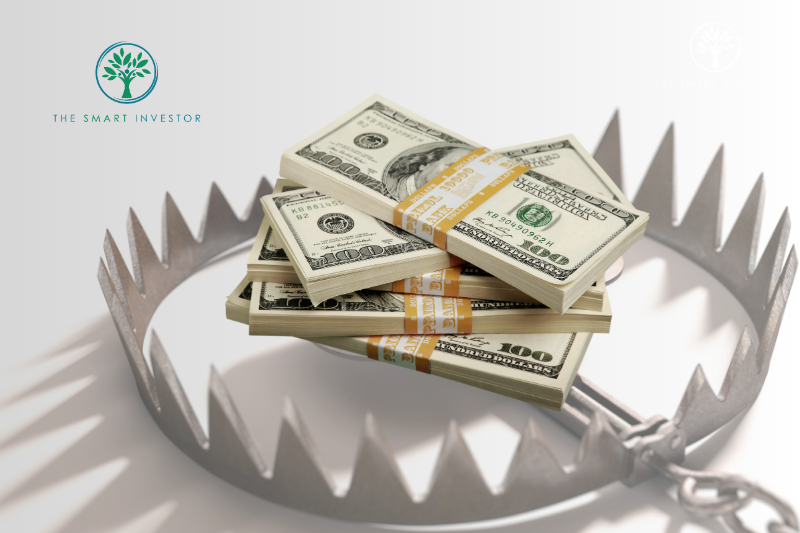
A high dividend yield can sometimes be a dividend trap (also called a yield trap) – a warning sign instead of an investment opportunity.
What Is a Dividend Trap?
A dividend trap is when a stock appears attractive because of its high dividend yield, but its payout is unsustainable, or its underlying business is deteriorating.
A falling share price can cause the dividend yield to rise.
As we learnt in the earlier article “Dividend Yield vs. Dividend Payout Ratio: What’s the Difference?”, yield is calculated by dividing annual dividends per share by the current share price (expressed as a percentage).
If a stock trades at S$5 and pays annual dividends of S$0.25 per share, its dividend yield is 5%.
However, if the share price falls to S$2.50 but the dividend stays at S$0.25 per share, the dividend yield surges to 10%.
The higher yield here may not present a better income opportunity.
Instead, the lower share price could reflect market worries about the company’s future earnings or financial health.
Why Do High Dividend Yields Sometimes Signal Trouble?
First, falling share prices mechanically increase dividend yields.
The decline may indicate that investors expect weaker earnings or a potential dividend cut.
Second, a company might be biting off more than it can chew by paying out more than its profits or available cash to keep its dividend high.
Future payouts may hence be harder to sustain.
The company might end up without money to reinvest, repay debts or meet other financial obligations.
Third, deteriorating business fundamentals can restrict a company’s ability to maintain its dividends.
Take Singapore Press Holdings (SPH) for example.
After years of falling print advertising and circulation revenue eroding its earnings, its dividend fell along with them.
SPH transferred its media business to a not-for-profit entity, SPH Media Trust, on 1 December 2021, and the company was privatised and delisted on 13 May 2022.
How a Dividend Trap Can Hurt Your Investment Returns
A dividend trap can hurt investors through reduced dividend income and falling share prices, and here’s how:
An investor is lured by Company X’s high dividend yield and buys 1,000 shares of Company X at S$2 each, investing S$2,000 in total.
In Year 1, Company X pays an annual dividend of S$0.20 per share, giving this investor S$200 in annual dividends, or a 10% dividend yield.
In Year 2, Company X’s financial performance deteriorates and it cuts the annual dividend to S$0.08 per share, reducing the investor’s dividend income from S$200 to just S$80.
At the same time, investor confidence weakens, and Company X’s share price falls to S$1.50.
The investor’s shares are now worth S$1,500, an unrealised capital loss of S$500 on the original S$2,000 investment.
Although the investor continues to receive dividends, the reduced income and falling share price can significantly weaken overall returns.
This highlights why receiving dividends does not guarantee a positive total investment return.
Capital losses can outweigh the income earned from dividend payments.
How Can Beginners Spot a Potential Dividend Trap?
There are four ways beginners can spot and avoid dividend traps:
1. Dividend Yield Is Unusually High
Compare the current yield with the company’s historical yield range and those of relevant industry peers.
Most Singapore blue-chip stocks offer a dividend yield of 3% to 5%.
DBS Group Holdings Ltd (SGX: D05), for instance, offers a 4.7% dividend yield, while Singapore Telecommunications Limited (SGX: Z74), or Singtel, offers a 4.4% yield.
2. Dividend Payout Ratio Is Excessive
A payout ratio measures the proportion of earnings distributed to shareholders as dividends.
The sweet spot is typically between 50% and 75%.
For FY2025/2026, Singapore Airlines Limited (SGX: C6L) paid out about 70% of its profit as ordinary dividends, while DBS paid out about 64% of its FY2025 profit as ordinary dividends.
If a company consistently distributes more than its recurring earnings, it may struggle to maintain its dividend without using reserves or taking on additional debt.
In the long run, such a company may have no choice but to cut or suspend dividends.
3. Free Cash Flow Is Weakening
Free cash flow is simply the cash remaining after the company pays its operating expenses and capital expenditures.
Dividends are paid in cash, not accounting profits, so a company needs real cash to pay its shareholders.
Consistently weak or negative free cash flow can be a warning sign of a dividend trap.
4. Debt Is Rising While Profits Are Falling
Rising debt alongside falling profits may indicate increasing financial pressure.
Heavily indebted companies have to prioritise interest payments and debt repayments, leaving less cash available for dividends.
Does a High Dividend Yield Always Mean a Dividend Trap?
Not every high-yield stock is a poor investment.
Some financially sound companies may offer attractive dividend yields when their share prices decline as the broader market falls.
This is despite their underlying business performance remaining relatively stable.
Here, the higher yield may present a genuine investment opportunity rather than a warning sign.
The key is distinguishing between temporary market pessimism, which can leave good companies undervalued, and business deterioration, which threatens future dividend payments.
Companies with strong financial fundamentals are better positioned to maintain their dividends in challenging market conditions.
Get Smart: Don’t Chase Yield, Check Sustainability
The stock with the highest yield may not give you the best investment returns.
Examine the company’s earnings, cash flow, debt levels and overall business performance to determine dividend sustainability.
Look beyond yield and focus on financially sound companies that can maintain and grow their dividends over time.
In the next article, “How to Start Dividend Investing in Singapore: A Step-by-Step Beginner’s Guide“, we will walk you through the practical steps to build your first dividend portfolio from scratch.
What if every stock trade in Singapore puts money in your pocket? One company earns whenever the market moves. Its free cash flow has grown close to 10% a year, and dividends are set to rise 40% over the next three years. Our free 2026 Dividend Playbook reveals this legal monopoly. Download it for free now.
Follow us on Facebook, Instagram, Telegram and YouTube for the latest investing news and analyses!
Disclosure: Wenting A. does not own shares in any of the companies mentioned.