Retirement may start to feel a lot closer when you turn 40.
You may already have some savings and investments.
But perhaps you wish you had more.
You may start asking yourself: can you still build a S$1 million portfolio from here?
Well, at 40 years old, you are not too late, but you have less time than someone who started at 25.
So you need to look at what you already have and how much you can invest each month.
The returns you earn over the next 15 to 25 years will also matter.
Step 1: Define What S$1 Million Means for Your Retirement
Is S$1 Million Enough?
S$1 million sounds like a lot, but is it enough for retirement?
Your needs will depend on housing, healthcare and your lifestyle.
So I would treat S$1 million as a retirement milestone, not a magic number.
Someone who has paid off most of their home and has a healthy CPF balance may have very different retirement needs from someone who is still paying a mortgage.
Turn the Goal Into an Income Target
A S$1 million portfolio can also be looked at as a source of retirement income.
How much it can provide each year will depend on how the portfolio is built and how much you choose to withdraw.
A portfolio focused on dividends will work differently from one where you sell some investments to fund your spending.
The amount you can take out will also depend on how long the money needs to last.
Step 2: Work Backwards From Your Target
How Much Do You Need to Invest?
Time matters when you are investing for retirement.
If you already have S$100,000 invested, a 6% annual return could take you to S$1 million by age 55 if you add about S$2,595 a month.
Give yourself another five years, and the monthly amount falls to about S$1,448.
Stretch it to age 65, and with 25 years, the figure falls to about S$799.
These illustrations are not projections of expected or guaranteed returns.
Starting with more money obviously helps.
If you already have S$50,000, S$100,000 or S$200,000 invested, you have a head start.
You have more money working for you from day one.
Step 3: Build Your Portfolio Around Growth
At 40, I would still keep some growth stocks in the portfolio.
DBS Group Holdings (SGX: D05) is one stock I would look at in Singapore.
The bank achieved a record total income of S$22.9 billion in FY2025, driving a strong return on equity (ROE) of 16.2%.
For global exposure, I would also look at Microsoft (NASDAQ: MSFT) and Alphabet (NASDAQ: GOOGL).
Microsoft’s revenue reached US$281.7 billion in its financial year ended June 2025 (FY2025).
Microsoft Cloud revenue grew 23% to US$168.9 billion, while net income was US$101.8 billion.
For Alphabet, revenue was even larger, at US$402.8 billion, with net income of US$132.2 billion.
Step 4: Add Dividend Income as Retirement Approaches
As retirement gets closer, I would also want some dividend income in the portfolio.
DBS, for instance, declared total dividends of S$3.06 per share for FY2025, including a capital return dividend.
Investors should note that this capital return dividend is part of a three-year plan to hand back surplus capital rather than a permanent increase.
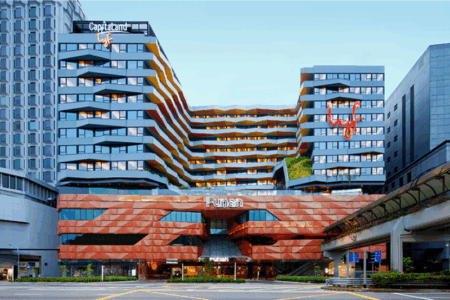
CapitaLand Integrated Commercial Trust (SGX: C38U), or CICT, is another example.
Its distribution per unit rose 6.4% to S$0.1158 in FY2025, helped by newly acquired stakes in ION Orchard and CapitaSpring.
Over time, I would put more focus on income rather than rely only on growth.
What I would not do is chase the highest yield.
A 7% yield may look tempting, but high yields sometimes hide underlying risks such as unsustainable payout ratios, declining business fundamentals or potential dividend cuts.
Instead, look beyond the headline number to check the company’s balance sheet strength, free cash flow generation and earnings stability to ensure the dividend is safe over the long run.
Step 5: Build Your Retirement Assets
Your S$1 million retirement target does not have to sit entirely in your brokerage account.
CPF can form part of the picture too.
Your CPF savings and future CPF LIFE payouts can provide retirement income alongside your investment portfolio.
As your income grows, increase your investment contributions where possible.
You could invest part of your bonuses, direct salary increases towards your portfolio, and automate monthly contributions.
What If Markets Crash Along the Way?
Markets go up and down all the time.
An investor at 40 still has 15 to 25 years before retirement, so a market drop is not a reason to stop investing.
Instead, they stick to their investment plans.
A downturn can also offer a chance to buy quality businesses at more attractive valuations.
Even so, investors should avoid taking more risks than they can handle.
Higher potential returns come with more volatility, so a portfolio should match an investor’s time horizon and risk tolerance.
Get Smart: 40 Isn’t Too Late, But You Need a Plan
Starting at 40 means you have less time.
But you still have 15 to 25 years before retirement.
Reaching S$1 million will take existing capital, regular contributions and sensible investment returns.
You also need to stay invested through market cycles.
Stopping investments when markets fall can mean missing the recovery or eating into your investment returns through opportunity costs and transaction fees.
Avoid making investment decisions based on emotions.
Instead, build a realistic plan, increase your investments and reinvest any payouts when possible.
Then let time do the rest of the work.
Retirement doesn’t happen overnight. It’s built one decision at a time.
We found 6 SGX companies that have paid dividends every year for more than 20 years, through the Global Financial Crisis, COVID-19, and rising interest rates.
If you’re building long-term income for retirement, this free report is a great place to start. Download your copy today.
Follow us on Facebook, Instagram and Telegram for the latest investing news and analyses!
Disclosure: Darien C. does not own shares of any companies mentioned.