Information overload is very real.
It can deter new investors from making their first move.
However, there is no need to load your portfolio with “ideal” stocks or complex strategies.
Read ahead to find six simple steps you can use to build your long-term portfolio.
Step 1: Start With Your Goal
There are many reasons why people choose to invest: for retirement, children’s college funds, a new home, or financial independence.
Knowing why you invest is important since different objectives may require different investment approaches.
Investing is a long-term venture.
The earlier you invest, and the longer you stay invested, the more you can benefit from the effects of compounding.
Although the market can and will fluctuate, investing your money for decades will help ride out the short-term downturns.
Step 2: Build Your Financial Foundation First
Invest only money you won’t need soon.
A drop in asset value is just a temporary paper loss until you sell.
If you are forced to sell during a market crash, you lock in those losses and miss out entirely on the subsequent recovery.
Build an emergency fund before you begin investing.
With an emergency fund, you would not be forced to sell your investments prematurely to cover unexpected emergencies.
Knowing you have liquid cash also helps you to stay the course during market volatility.
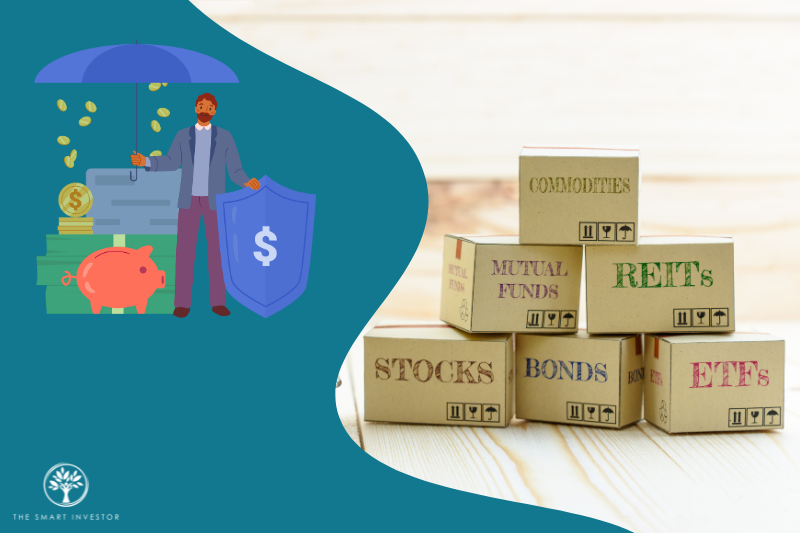
Step 3: Understand the Core Building Blocks
Stocks
When you own stocks of a company, you have partial ownership in that business.
As the business becomes more profitable, its stock value may increase, and shareholders benefit from capital appreciation.
Some companies, such as DBS Group (SGX: D05) and Sheng Siong Group (SGX: OV8), regularly distribute dividends, providing regular income in addition to potential price growth.
REITs
Real Estate Investment Trusts (REITs) like CapitaLand Integrated Commercial Trust (SGX: C38U) and Parkway Life REIT (SGX: C2PU) are companies that own, operate, or manage income-producing real estate such as offices, hospitals, and shopping centres.
They generate income primarily through rent collected from tenants.
As Singapore REITs (S-REITs) are legally mandated to distribute at least 90% of their taxable income to unitholders annually to qualify for tax transparency, they are particularly attractive to income investors.
ETFs
Investors can buy a broad spectrum of assets all in a single purchase through Exchange-Traded Funds (ETFs).
Vanguard Total World Stock ETF (NYSEARCA: VT) contains almost 10,000 holdings within a single fund, while SPDR Straits Times Index ETF (SGX: ES3) tracks the Straits Times Index and contains 30 holdings.
Cash
While cash typically offers lower returns, it provides liquidity.
Funds are readily available for emergencies, short-term needs, or market opportunities, reducing the need to sell during downturns.
Step 4: Focus on Quality Investments
Quality companies often share several key characteristics including:
- Strong balance sheet: Healthy finances, strong cash flow, and manageable debt for future investments
- Consistent profitability: Business can reliably generate earnings regardless of market conditions.
- Competitive advantages: Unique advantages that protect a company from business rivals.
- Capable management: Effective management that can guide a company towards sustainable growth.
Excitement often drives prices far above a company’s true value.
Hype-driven investments may rise quickly, but they can also fall just as fast when expectations are not met.
Successful investors often hold simple portfolios made up of a few high-quality companies or diversified funds.
Holding too many investments can make a portfolio difficult to manage and may reduce the impact of strong-performing assets.
Step 5: Diversify Sensibly
Investing in multiple sectors and geographies can reduce overall portfolio risk.
Technology may thrive during periods of stability, while healthcare is more resilient during economic downturns.
Sector diversification reduces the risk of an entire portfolio being impacted by poor performance in one sector, while country diversification reduces reliance on one country’s economic performance.
A well-rounded portfolio also often includes both income and growth stocks.
Dividend-paying stocks and REITs can provide regular cash flow and stability, and growth stocks can be riskier but could offer greater return potential.
A Sample Beginner Portfolio Framework
A beginner portfolio does not need to be complicated. A simple portfolio framework can consist of:
- Growth component: 50–75% in local and international stocks and ETFs
- Income component: 15–30% in REITs and dividend-paying stocks
- Stability component: 10–20% in cash and bonds
Allocation will vary depending on age, goals, and risk tolerance.
For example, a younger investor can have a higher growth component as they have more time to ride through market fluctuations.
Retirees, on the other hand, might be better suited for a higher income component to give them a stable and recurring passive income.
Step 6: Invest Consistently
By focusing on consistency, investors can reduce the risks associated with market timing and build wealth steadily through disciplined investing habits.
By using dollar-cost averaging (DCA), investors can invest a fixed amount of money at consistent intervals regardless of market conditions, and let compounding do its magic.
Compounding allows earnings to generate additional earnings over time.
When dividends are reinvested, they begin producing their own returns, creating a snowball effect that accelerates portfolio growth.
Remember, financial markets experience daily fluctuations, many of which have little impact on a company’s long-term prospects.
Successful investors ignore short-term market noise and focus on the underlying performance of the business they own.
Common Mistakes New Investors Make
Many new investors delay getting started because they want to wait for the “perfect” time.
In reality, consistently predicting the best time to invest is impossible.
While waiting on the sidelines, investors will miss growth and compounding opportunities.
Another costly mistake is the pursuit of quick profits.
New investors who take excessive risks early in their investing journey may experience setbacks that discourage them from staying invested.
Monitoring a portfolio too frequently can cause investors to become overly focused on short-term fluctuations rather than long-term progress.
This can increase anxiety and lead to emotional decisions such as panic-selling.
Get Smart: The Best Time to Start Is Yesterday
Every successful portfolio started with a first investment.
The earlier you start investing, the more time compounding has to work its magic.
The smartest investors know their investment goals, adjust their portfolio periodically according to their needs, and stay invested for the long-term for maximum capital appreciation.
First-time investors: We’ve finally released our Beginner’s Guide. Read it in an afternoon, follow the principles, pick an investing style and buy your first SGX stocks within the next few hours! Click here to download it for free.
Follow us on Facebook, Instagram and Telegram for the latest investing news and analyses!
Disclosure: Wenting A. does not own any stock mentioned above.