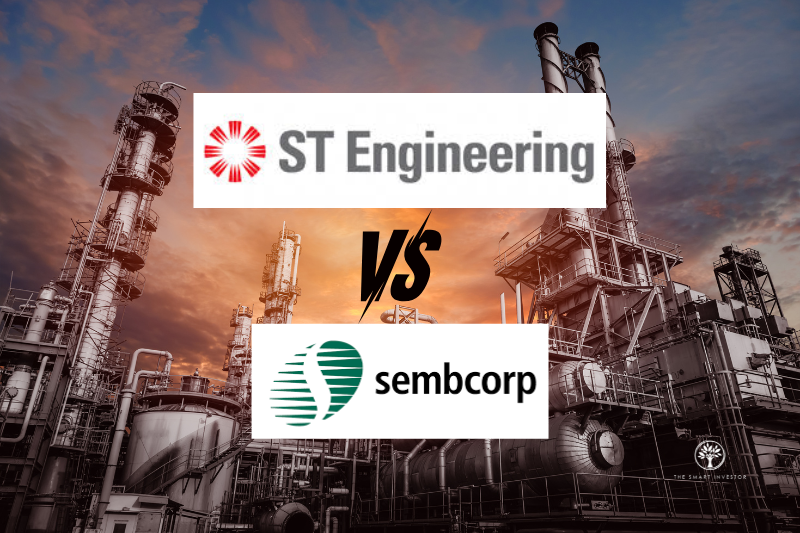
Over the past five years, the quality blue-chip industrial companies Sembcorp Industries (SGX: U96) and ST Engineering (SGX: S63) have both done well for their investors.
The former’s stock price has more than tripled, while the latter’s has more than doubled.
Considering fundamentals and valuation, which stock is a better buy now?
Business Overview: Different Models, Different Strengths
ST Engineering – Steady Compounder
A defence provider for Singapore, ST Engineering, or STE, has three business segments, namely, Commercial Aerospace (CA), Defence & Public Security (DPS), and Urban Solutions & Satcom (USS).
The non-discretionary nature of STE’s defence contracts, alongside essential maintenance, repair, and overhaul (MRO) activities for airlines, allows STE to earn consistent cash flows.
Operating cash flow (OCF) has been positive in each of its last 10 completed financial years and averaged S$943 million, highlighting STE’s resilience in generating cash flows regardless of market conditions.
The company looks set to end 2025 with positive operating cash flow, given its S$761 million in operating cash flow for the first half of the year.
Sembcorp Industries – Renewable Energy Player
As part of its 2023-2028 strategic plan, Sembcorp has been transitioning away from its fossil-fuel heavy past and towards renewable energy.
This is best seen in the company’s rapidly growing renewables energy portfolio, with a gross renewables capacity of 18.9 GW (13.8 GW installed, 5.1 GW under construction) in the first half of 2025, up from 14.4 GW (10.0 GW installed, 4.4 GW under construction) in the first half of 2024.
Sembcorp also completed the divestments of its non-core legacy coal assets in 2024, further amplifying its desire to cement its status as a renewable energy company.
Financial Comparison: Profitability, Cash Flow & Balance Sheet
Now, let us compare both companies in terms of their financials.
ST Engineering
As highlighted earlier, STE generates consistent cash flows because of the essential nature of its CA and DPS business segments.
This allows the company to pay a consistent annual dividend, a streak stretching back to at least 2015.
STE’s gearing is on the higher side, with a debt-to-equity (D/E) ratio of 1.8.
However, the blue-chip heavyweight’s ability to consistently generate solid cash flows makes this slightly higher leverage manageable.
Sembcorp
Sembcorp has a history of consistently producing positive OCF as well, averaging S$879 million over its last 10 completed financial years, highlighting the critical nature of its business as an energy provider.
Similar to STE, Sembcorp has returned these cash flows to shareholders in the form of consistent annual dividends, never missing a payment over the last decade.
Sembcorp has a slightly healthier balance sheet with a D/E ratio of 1.6, aided by proceeds from the sale of its SembEnviro business in March 2025.
Moving forward, the company’s healthy cash flow generation ability should help in keeping its leverage manageable.
Comparison Angle:
Both companies rank similarly in terms of sustainability and consistency of cash flow generation, given the essential nature of their business operations.
However, STE might edge out Sembcorp a little because of the disclosure of its order book, which gives considerable visibility on when revenue/cash flows are expected to be recognised by the company.
STE is slightly more leveraged compared to Sembcorp, but it’s nothing to be overly worried about.
Growth Drivers: Where Will Future Returns Come From?
ST Engineering
STE’s future growth comes partially from the continued recovery we have seen in the aerospace market, which could lead to steady demand for the company’s MRO services.
STE’s order book of contracts provides the company with multi-year visibility in terms of revenue.
The continued trend of increased global defence spending could also result in more/higher-value defence contracts for STE.
The company has an order book of S$32.6 billion as of September 2025, up 21% from S$26.9 billion a year ago.
The USS segment’s international presence adds to STE’s overseas growth potential.
Sembcorp
Looking ahead, Sembcorp’s growth drivers are tied to its aggressive expansion in the renewables space.
Sembcorp plans to have 25 GW of gross renewables capacity installed by 2028.
The company is also pursuing international opportunities, as seen with its renewable capacity construction plans in China, India, and Southeast Asia.
The broader global trend of the energy transition from fossil fuels to renewable energy provides a structural growth tailwind for Sembcorp.
Comparison
STE’s future growth is more stable and defensive in nature, because of the resilient demand from CA and DPS, underpinned by a pipeline of contracts.
Sembcorp offers higher growth prospects with its sustainable energy charge, but it comes with potential higher volatility in operating performance – there was a dip in earnings in the first half of 2025.
Dividend Profile: Which Company Rewards Shareholders More?
Both companies pay consistent annual dividends to shareholders.
However, Sembcorp boasts a higher trailing dividend yield of 4.3%, compared to STE’s 2.5%.
Recently, Sembcorp’s dividends have seen an acceleration in growth.
Its ordinary dividend per share had increased by 187.5% from S$0.08 in 2022 to S$0.23 in 2024, attributable to the increasing profitability experienced over the last few years.
The question for investors is: do you value stable yields?
If so, STE is your horse.
But, if you are looking at growth potential, Sembcorp might be for you.
Valuation: Which Stock Offers Better Value Today?
STE trades at an estimated forward price-to-earnings (P/E) ratio of 30.3, which is rich compared to the five-year average of 18.8.
Although STE’s past execution has been stellar and the company also has decent future growth potential, the rich P/E ratio of 36.4 may mean its future growth has already been priced in.
Sembcorp trades at a lower estimated forward P/E ratio of 10.5; however, this is also above the five-year average of 7.9.
With the potential for relatively stronger growth ahead, alongside its steady ability to produce cash flow, Sembcorp’s current valuation looks rather attractive.
Risk Factors Every Investor Should Note
The main risks for STE include potential cyclicality in the aerospace market, and its ability to execute its contracts and manage its costs.
Sembcorp’s risks lie in project execution, particularly for its markets in China, India, and Southeast Asia.
Tariffs related to renewables, as well as the inherent volatility in energy, could challenge Sembcorp.
Verdict: Which Industrial Powerhouse Offers Better Value Now?
STE is ideal for conservative investors looking for predictable dividends and stable growth.
For investors looking for a slightly faster growth profile with exposure to renewable energy, Sembcorp might be more suitable for you.
Get Smart: Match the Stock to Your Investment Goals
Ultimately, both companies are solid industrial choices.
Whichever you choose to invest in depends on what you are looking for.
STE remains a premier ‘steady compounder’ for those seeking a defensive name that generates reliable income.Or, consider Sembcorp if you are comfortable with higher price volatility in exchange for exposure to its rapidly expanding global renewables portfolio.
What if every stock trade in Singapore puts money in your pocket? One company earns whenever the market moves. Its free cash flow has grown close to 10% a year, and dividends are set to rise 40% over the next three years. Our free 2026 Dividend Playbook reveals this legal monopoly. Download it for free now.
Follow us on Facebook, Instagram and Telegram for the latest investing news and analyses!
Disclosure: Wilson.H does not own shares in any of the companies mentioned.