Mark your calendars!
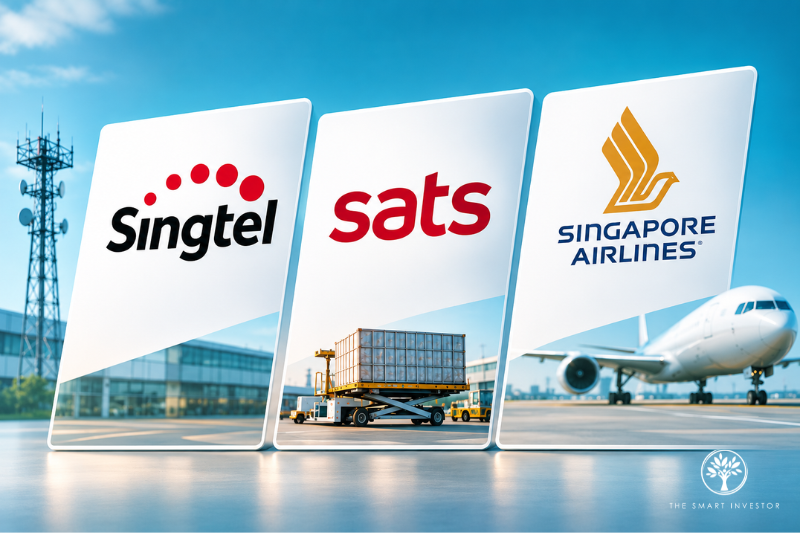
Three of Singapore’s best-known blue chips will report results within three days of each other this month.
Temasek-Linked Blue Chips Reporting
| Company | Ticker | Reporting date | Temasek stake |
|---|---|---|---|
| SATS Ltd. | SGX: S58 | 11 November 2026 | Deemed interest of 40.3% (as of 19 May 2026) |
| Singapore Airlines Limited (SIA) | SGX: C6L | 11 November 2026 | 50.6% (as of 2 June 2026) |
| Singapore Telecommunications Limited (Singtel) | SGX: Z74 | 13 November 2026 | 50.6% (as of 2 June 2026) |
Singapore Telecommunications Limited (SGX: Z74), or Singtel, SATS Ltd. (SGX: S58) and Singapore Airlines Limited (SGX: C6L), or SIA, share a common major shareholder.
That shareholder is Temasek, a global investment company headquartered in Singapore.
It owns 50.6% of Singtel and 50.6% of SIA, both as of 2 June 2026.
It also holds a deemed interest of 40.3% in SATS as of 19 May 2026.
What they don’t share is the same set of pressures.
For context, all three last reported on the first quarter of fiscal 2027 (1QFY2027), which ended on 30 June 2026.
Two of the three felt the strain of Middle East tensions.
Can Singtel keep beating its own guidance?
Singtel got off to a fast start.
Operating profit rose 10% year on year (YoY) to S$462 million in 1QFY2027.
That’s ahead of management’s guidance for low- to mid-single-digit growth for the full year.
Underlying net profit climbed 21% to S$831 million.
So where did the growth come from? Singtel’s growth engines.
IT services arm NCS grew operating profit 29% YoY to S$102 million on better delivery margins.
Optus added 14% to A$152 million on stronger mobile performance.
Back home, Singtel Singapore’s operating profit slipped 2% to S$230 million amid intense price competition.
Revenue grew 5% to S$3.6 billion, though, on a constant-currency basis, it was flat.
In other words, currency movements drove the top-line growth.
On 13 November, check first whether operating profit is still running ahead of guidance.
Then check whether the decline in Singapore has levelled off.
Keep an eye on capital management, too.
Singtel has raised around S$6.8 billion of its S$9 billion asset-recycling target and has used 41% of its S$2 billion buyback.
Up to S$3.3 billion in value realisation dividends is still to come through to FY2030.
Remember, Singtel pays dividends only at the half-year and full-year marks.
Will SATS turn profit growth into cash?
SATS grew its business, but its cash didn’t follow.
Revenue rose 11.3% YoY to S$1.7 billion in 1QFY2027 on new client wins and shifting trade flows.
Net profit increased 6% to S$75.1 million.
Here’s the thing: free cash flow came in at negative S$22.6 million.
Operating cash flow after lease repayment fell to S$23.2 million from S$45.8 million a year ago.
SATS blamed the timing of working capital.
On 11 November, look for signs of a recovery.
Margins are the next thing to watch.
Operating margin narrowed to 8.0% from 8.3% a year ago.
Middle East disruptions to cargo flows and inflationary pressure weighed on margins.
Management has also cautioned that inflationary pressures could add to costs in the coming quarter, and that the Middle East situation is weighing on aviation demand.
SATS carried S$4.2 billion of total debt as at 30 June 2026.
Gross debt to equity held steady at 1.41 times.
It held S$726.0 million in cash, which puts net debt, including leases, at about S$3.5 billion.
SATS declared no dividend in 1Q, the same as a year ago.
Can SIA’s fares keep pace with fuel?
SIA’s 1QFY2027 business update showed record revenue of S$5.7 billion, up 19.3% YoY.
The group still swung to a net loss of S$75.8 million, from a profit of S$186.1 million a year ago.
How does an airline lose money on record revenue? Fuel.
Net fuel expenses rose 78.5%, or S$991 million, as jet fuel prices spiked on the back of the Middle East conflict.
SIA’s share of Air India’s wider losses added to the pressure.
SIA did push back with higher prices.
Passenger yields improved 12% YoY, and cargo yields rose 28.1%.
Management flagged, though, that fare adjustments cannot fully offset higher fuel prices.
So on 11 November, the key question is whether higher yields can narrow the gap.
On the flip side, SIA’s cash flow tells a happier story than its profit; the airline generated about S$810 million of free cash flow.
As at 30 June 2026, it held S$9.1 billion in cash and bank balances against total debt of S$10.7 billion.
SIA pays dividends only at its half-year and full-year results.
If you own the shares for income, watch which one any dividend decision tracks: the profit or the cash.
Get Smart: Check the cash before the profit
SATS grew its profit in 1Q but burned cash.
SIA booked a loss but generated about S$810 million of free cash flow.
Profit and cash don’t always move together.
So when these results land, start with the cash flow statement.
Free cash flow is the lifeblood of dividends, after all.
Then ask yourself whether the profit story and the cash story agree.
If they don’t, find out which one management expects to change.
Retirement doesn’t happen overnight. It’s built one decision at a time.
We found 6 SGX companies that have paid dividends every year for more than 20 years, through the Global Financial Crisis, COVID-19, and rising interest rates.
If you’re building long-term income for retirement, this free report is a great place to start. Download your copy today.
Follow us on Facebook, Instagram, Telegram and YouTube for the latest investing news and analyses!
Disclosure: The Smart Investor does not own shares in any of the companies mentioned.