What happened
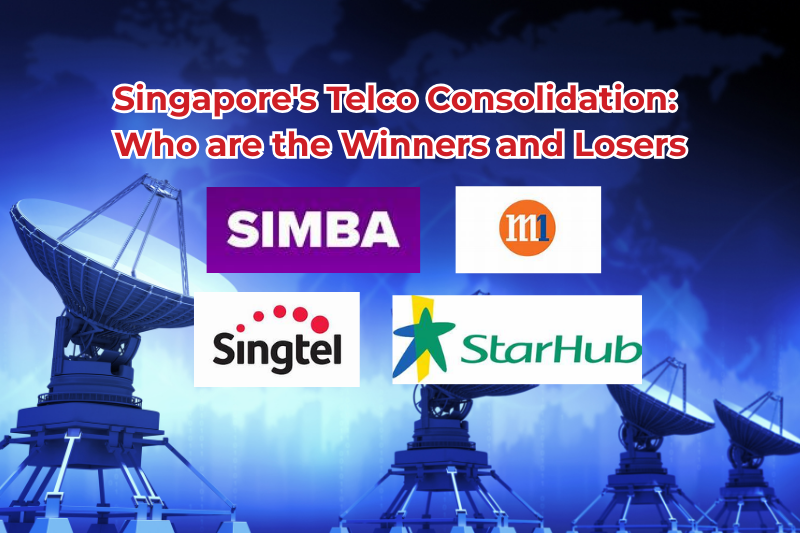
Keppel Ltd (SGX: BN4) surprised the market this week when it announced the sale of telecommunication company (telco) M1 to Simba Telecom Pte Ltd.
The agreed transaction amount was S$1.43 billion, with Keppel receiving close to S$1 billion in cash for its 83.9% stake in M1.
Simba had put forth the most attractive bid among interested parties and is a unit of Tuas Ltd (ASX: TUA), an Australian-based company that owns and operates mobile services and provides telecommunication services in Singapore.
Keppel, however, will book an estimated accounting loss of S$222 million but maintains that this transaction helps crystallise its investment in M1.
The blue-chip asset manager will also continue to retain M1’s ICT (Information and Communication Technology) business.
This transaction should close in a few months, subject to regulatory approval given by the Infocomm Media Development Authority (IMDA).
Just one day later, StarHub Ltd (SGX: CC3) announced the acquisition of the remaining 49.9% stake in MyRepublic that it does not own.
Singapore’s second-largest telco will pay S$105.2 million for the MyRepublic brand in Singapore, along with key operational assets relating to the broadband business.
MyRepublic has assured that it’s business as usual, and StarHub has no immediate plans to restructure the team at MyRepublic or make changes to existing services.
So what?
In just two days, the telco scene has shifted significantly as consolidation between the major players finally took place.
Simba, previously known as TPG Telecom, is Singapore’s fourth fully-licensed mobile operator with full 4G and 5G spectrum rights.
The company launched its services in 2020 and has reached 500,000 subscribers as of April 2022.
According to the Australian Stock Exchange filing, Simba had just a 1.5% market share of the prepaid mobile market and a 0.9% market share in the broadband market.
The company’s market share in the postpaid market was higher at 14.4%, but still lags StarHub’s 22.8% and M1’s 23.9%.
If the acquisition of M1 is approved by IMDA, Simba is targeting to capture 15% of the prepaid mobile market, 38.3% of the postpaid market, and 15.9% of the broadband market.
If successful, it will increase the combined entity’s market share in the prepaid, postpaid, and broadband markets to 16.5%, 52.7%, and 16.8%, respectively.
Singtel (SGX: Z74) will face stronger competition in the postpaid sector as its current market share is close to 39%.
StarHub will similarly face competitive pressure from this telco consolidation, as it has a 22.8% share of the postpaid market and 22.2% share of the prepaid market.
Through the consolidation, both Simba/M1 and StarHub should have a stronger fighting chance in an increasingly crowded telco space.
Mobile virtual network operators (MVNOs) such as Circles.Life and Virgin Mobile were also introduced in 2002 as additional competition.
Such MVNOs lease network capacity from the four telcos and then sell data subscriptions to customers, thereby creating more fragmentation within the market.
Simba/M1 and StarHub will need to aggressively respond to this competition to maintain their market shares.
Now what?
It remains to be seen if IMDA will approve the M1 sale to Simba, but StarHub’s purchase of MyRepublic does not require any approval.
Hence, investors will be watching the sector keenly to see how each player responds and how mobile and broadband pricing plans will change.
With less competition, customers may experience higher charges on existing services that may push them to switch operators.
But with limited choices in the market, these customers may have no choice but to tolerate the higher costs.
Winners and losers
A clear winner from the telco consolidation is Keppel.
The group is monetising its stake in M1 as it transitions towards an asset-light strategy.
The sale will result in S$1 billion in cash proceeds that can be recycled into promising growth opportunities, to lower debt, or to reward shareholders through a special dividend.
Another winner from the consolidation is StarHub.
The purchase of MyRepublic will strengthen the telco’s multi-brand, multi-segment strategy and also for service differentiation and cross-product bundling.
CEO Nikhil Eapen believes that this transaction will allow StarHub to serve customers better and is an acceleration of its transformation to modernise its core business and deliver better value.
It seems Singtel may face stronger competition as a result of this telco consolidation, but Singapore’s largest telco should be well-equipped to handle these challenges.
Get Smart: Still in flux
To be sure, it’s still early days, and the telco space is still in flux.
Simba looks set to become a more powerful player in the telco space, while StarHub is also bulking up on its resources.
Singtel needs to watch its back as its two key competitors may start to target its dominant position.
There will be interesting days ahead as we watch how the sector evolves.
How do rich Singaporeans invest when volatility hits?
They turn to companies with cash, history, and discipline. This free report highlights 5 blue chips that deserve your attention. Get your copy here and see who made the list.
Follow us on Facebook, Instagram and Telegram for the latest investing news and analyses!
Disclosure: Royston Yang does not own shares in any of the companies mentioned.