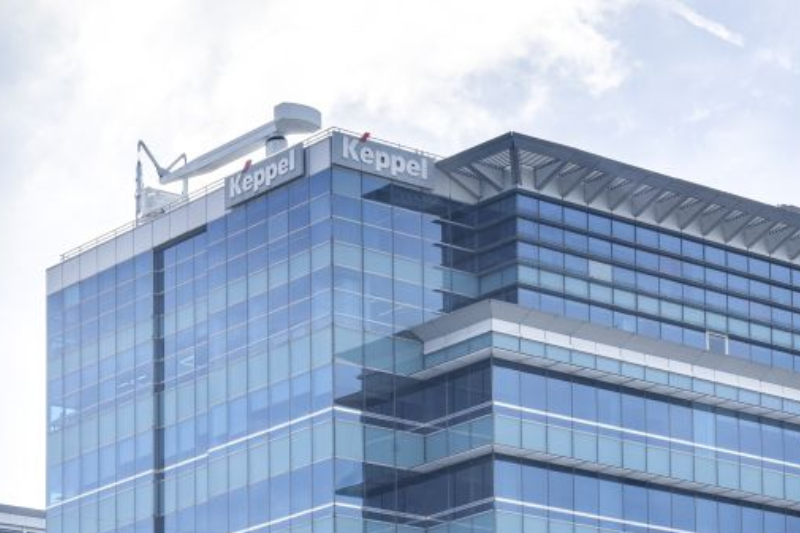
Everyone likes a winner, and Keppel (SGX: BN4) has been on a roll recently.
Last month, its shares hit a high of S$10.34, a level not seen in over a decade.
This uptick didn’t come easy. Keppel has spent the past few years reinventing itself.
The offshore and marine (O&M) business, once its flagship, was jettisoned.
Now, the company is positioned as a global asset manager and operator, riding on megatrends such as the energy transition, digitalisation, and urbanisation.
With Keppel’s stock price up by more than 200% over the past five years, it’s fair for investors to ask whether this growth story can continue.
Look at me now
The old Keppel divided its business into four segments.
Apart from O&M – which accounted for 60% of revenue and 31% of net profit in 2015 – it also had property, infrastructure, and investment arms.
Today, these have been slimmed to three main segments: infrastructure, real estate, and connectivity.
Other assets have been lumped into a category called “non-core portfolio for divestment”, which does exactly what it says on the tin; earlier this year, Keppel sold its stake in telco M1 for S$1 billion.
In the first half of 2025 (1H2025), Keppel’s top-line was S$3.1 billion, 5.2% lower than the same year-ago period.
However, its profit for the period rose by 18.9% to S$373.3 million.
The company sought to highlight its recurring income, which rose 7% year on year (YoY) to S$444 million.
This is a measure that Keppel is focused on growing as part of its transformation from an asset-heavy business into an asset manager and operator that collects fees from the assets it manages.
An increasing stream of recurring income is likely to support a stable or growing dividend, while also allowing Keppel to reinvest and grow its business.
In 1H2025, the asset manager declared an interim dividend of S$0.15 a share, the same as the previous year.
It also announced a S$500 million share buyback programme, which is another way for companies to return capital to shareholders.
The prospect of Keppel’s transformation, along with a progressive, sustainable dividend and increased buybacks, likely helped power the stock to multi-year highs.
As of 3 December 2025, its share price was S$10.28, 58% higher than a year ago, and compared to an all-time high of S$13.38 recorded in October 2007.
Growth Drivers
Keppel bulls are counting on its continued transformation, with growth fuelled by three megatrends.
First, there’s the move from traditional to clean energy (including offshore wind and solar).
Notably, Keppel divested its O&M business to Sembcorp Marine (now known as Seatrium), in order to focus on renewable energy.
Its infrastructure division is currently studying the possibility of importing renewable energy from Indonesia’s Riau Islands, generating power using low or zero-carbon ammonia, and carbon capture and storage.
Second, Keppel can ride on rising demand for data centres, driven by AI and digitalisation.
The company expects strong demand in the Asia Pacific (APAC) region to come from both US and Chinese cloud service providers, and for APAC to be the fastest growing region for data centre demand over the next five years.
Third, Keppel will benefit from increasing urbanisation globally.
For example, within its real estate division, 99% of its residential landbank (by number of units) is in China, Vietnam, Indonesia, and India.
These are all emerging markets where urbanisation rates in 2024 ranged from 37% (in India) to 66% (in China), and so still have a long way to run.
Keppel is counting on both organic and inorganic initiatives to reach its goals.
According to CEO Loh Chin Hua, as an asset manager, Keppel has lifted its funds under management (FUM) from S$55 billion to S$88 billion in 2024 both by growing organically, and also by acquiring European asset manager Aermont Capital.
Macroeconomic uncertainties have not stopped it from doing deals, with recent acquisitions of a data centre in Tokyo and a Singapore-based solar energy platform.
Risks & Challenges
As Keppel sheds its old skin, it has become far less exposed to volatility in oil and gas prices.
However, the O&M business still forms a material part of its operating profit.
For the first half of 2025, its non-core portfolio (which includes the O&M assets) recorded an operating profit of S$127 million, around 20.6% of the total.
In the short-term, the company may still find itself facing headwinds if energy prices decline.
Perhaps more significantly, there are also risks to the renewables and digital infrastructure sectors that Keppel has pivoted to.
Under the Trump administration, US policy towards renewable energy has become decidedly less friendly, which may present headwinds for the sector.
However, CEO Loh has said that the company “remains committed to sustainability”, despite “backsliding seen in some markets”.
Another risk is if – or when – the AI bubble bursts, and the consequences this could have for Keppel’s data centre business.
Economic volatility could also impact growth in its funds under management, where it faces competition from other asset managers trying to raise money for infrastructure and renewable projects.
Some of these, such as Brookfield Asset Management, Macquarie Asset Management, and IFM Investors, are more established and have greater scale.
Finally, execution risks remain as the company embarks on its ambitious transformation plan.
Dealmaking inevitably involves a certain level of risk, although the company claims that the Aermont acquisition has gone well, and that it is planning more M&A going forward.
Conclusion – Get Smart: heed the transformation
Keppel’s transformation from stodgy oil and gas-anchored conglomerate to a diversified, asset-light manager and operator of assets should set it up for a period of growth ahead, although challenges remain.
Investors must now examine its prospects in these new growth areas, especially in renewables and digital infrastructure, to determine the prospects for its share price in the years ahead.
The performance of management will be critical.
This could be the fastest way to jump from a “newbie” investor to a seasoned pro. Our beginner’s guide shows everything you need to know to buy your first stock and beyond. Click here to download it for free today.
Follow us on Facebook, Instagram and Telegram for the latest investing news and analyses!
Disclosure: Silas owns shares in Keppel.