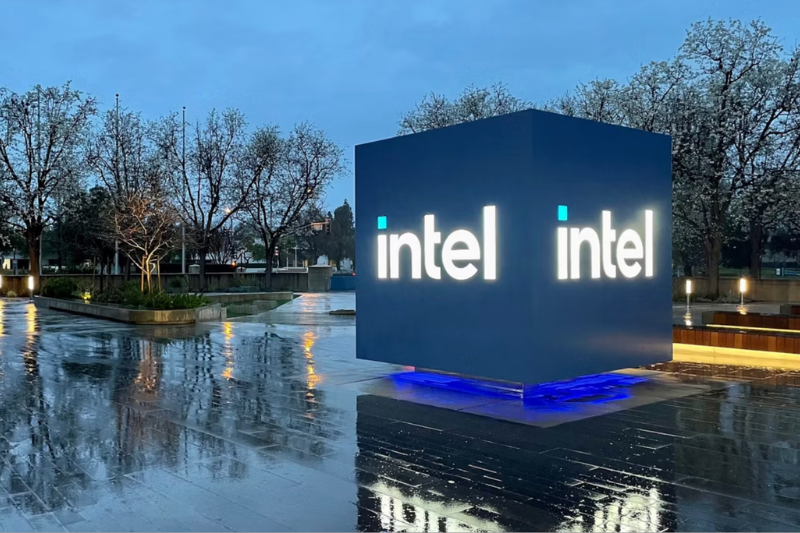
Intel Corporation’s (NASDAQ: INTC) stock price has gone on a meteoric rise after better-than-expected results, igniting renewed interest from investors.
After being perceived as a semiconductor laggard for the last few years, Intel has shrugged off this label with notable manufacturing momentum and high-profile partnerships.
Despite the current success, investors are probably expecting even more from the chipmaker to sustain the turnaround.
Let’s see whether Intel’s comeback story is still unfolding.
What’s Driving Intel’s Recent Rally
The next wave of AI is shifting from foundational models to inference and agentic deployments.
Notably, Intel’s management sees the shift “increasing the need for Intel’s CPUs and wafer and advanced packaging offerings.”
Having also beaten revenue expectations for the sixth consecutive quarter in the first quarter of 2026, investors are sending Intel’s stock price to new highs.
Widely perceived as being behind chip-manufacturing giant Taiwan Semiconductor Manufacturing Company (NYSE: TSM), Intel’s recent high-profile partnership with SpaceX, xAI and Tesla (NASDAQ: TSLA) could potentially uplift its status from a manufacturing-laggard to an indispensable foundry.
Intel’s Turnaround Story: What Has Changed?
Intel’s turnaround is underpinned by its heavy investments in advanced manufacturing, and the introduction of a new engineering-centric and customer-focused paradigm.
These strategic moves have paid off with its 18A process node reportedly exceeding internal expectations in both volume and yield.
Additionally, its newer, under-development 14A node is also observed to perform even better than the 18A node in a comparable stage.
Intel’s Foundry business is also growing beyond internal demand, having opened its fabs to external customers such as its recently spun-off Altera.
By offering its proprietary x86 CPU IP and other leading-edge process technologies and packaging capabilities to external customers, the chipmaker is positioning itself as a capable foundry for taking on the rising and evolving semiconductor needs of the AI wave.
Financials
Intel did well in the first quarter of 2026 (1Q2026), with revenue rising 7.2% year on year (YoY) to US$13.6 billion. AI-driven businesses did the heavy lifting.
Furthermore, when excluding non-operating items, its non-GAAP earnings of US$0.29 per share far exceeded its initial guidance for break-even.
The top-line growth also trickled down to operating cash flow, which climbed 34.8% YoY to US$1.1 billion.
However, Intel’s growth came with massive gross capital expenditure (capex) of US$5 billion, sending its adjusted free cash flow to -US$2 billion (the most important adjustment was cash inflows from partner contributions).
Notably, total debt stood at US$45 billion, far exceeding its cash balance of US$17.2 billion, which resulted in significant net debt of US$27.8 billion.
The takeaway from Intel’s financials is that there’s a story of ongoing recovery, but the dark clouds of heavy capex and leverage linger overhead.
The Bull Case: More Upside Ahead?
Having beaten revenue expectations for six consecutive quarters, as mentioned earlier, investors may reasonably wonder whether they are missing out on Intel’s continued rally if they remain on the sidelines.
After all, the best is yet to be, as Intel rides the massive AI-tailwind, in particular, the transition from training to inference and edge AI, fuelling demand for its x86 CPU franchise and other advanced packaging and manufacturing capabilities.
It helps too, that Intel is receiving strong tax benefits and grants from the US government to spur domestic semiconductor manufacturing.
With this favourable outlook, Intel’s management is expecting growth for Intel Foundry to continue into the first half of 2027.
The Bear Case: Is It Too Late?
Still, successful execution remains key to Intel’s growth story.
Although its 14A process node has produced good results so far in the developmental phase, its production performance remains untested.
Should it underperform in the actual fabrication process, Intel’s massive sunk capex could be proven uneconomical, thus throwing a spanner in its turnaround ambitions.
Moreover, market risk also exists with its stock price breaking new highs – its future growth prospects could possibly already be priced in.
Valuation: Cheap, Fair, or Expensive?
Intel is currently trading at a price-to-forward-earnings (PFE) ratio of approximately 140, way above the 5-year average of about 23, making it overvalued relative to history.
Additionally, it’s also overvalued compared to Advanced Micro Devices (NYSE: AMD) and TSMC, its closest competitors, with a PFE of 63 and 27, respectively.
The verdict?
Intel is likely priced to perfection, with market participants reflecting extreme optimism rather than its true fundamental value.
Get Smart: Ability to Execute Remains Key
A massive stock rally like Intel’s might trigger the fear of missing out (FOMO).
However, maintaining a rational mindset is key to consistent profits in the stock market.
Here’s the thing: Intel’s turnaround story is compelling, but its high capex and debt require some caution.
Instead of chasing the highs blindly, smart investors should ask whether the company can continue to execute well and deliver on its turnaround promises.
Not all AI “winners” will survive this cycle.
But a few companies already have the scale, cash flow, and edge to pull ahead. We highlight what to look for in our FREE volatile market report. Download it here.
Follow us on Facebook, Instagram and Telegram for the latest investing news and analyses!
Disclosure: Larry L. does not own shares of any companies mentioned.