Many investors often dream of earning a passive income from dividends without lifting a finger.
Wouldn’t it be nice to get S$2,000 every month?
Fret not, dividend stocks can get you there.
In this article, let’s look at how five dividend-paying stocks can help you achieve your dream.
Step 1: Understanding the Income Target
So, S$2,000 a month works out to S$24,000 a year.
If your portfolio offers a dividend yield of 5%, you would require a capital investment of S$480,000.
Naturally, if your portfolio offers a higher yield, the capital required will be lower to achieve the same monthly goal.
However, it is important to monitor not only the dividend yield, but if these payouts are sustainable.
Step 2: Why Diversification Still Matters
To have a sustainable dividend portfolio, diversification is important.
Holding five stocks across different industries allows you to avoid sector concentration and helps spread out the timing of your payouts.
For instance, Singapore Exchange Limited (SGX: S68), or SGX, usually pays a dividend in February, May, October and November, while Venture Corporation (SGX: V03) typically pays out in May and September.
By mixing these with other stocks, you can smooth out your cash flow to ensure money hits your account throughout the year.
An ideal portfolio mix consists of real estate investment trusts (REITs) for yield, banks for dividend strength, and defensive companies for stability.
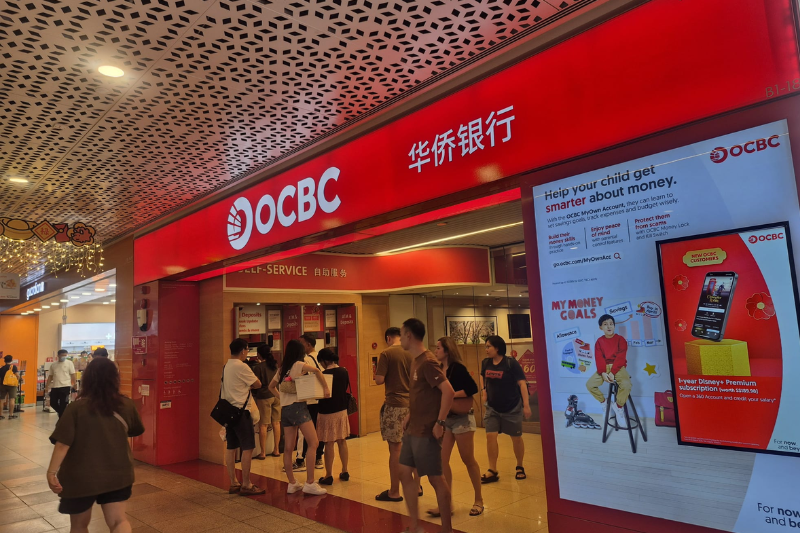
Oversea-Chinese Banking Corporation (SGX: O39), or OCBC – Stable Dividends
Speaking of banks that provide solid dividends, look no further than the oldest bank in Singapore, OCBC.
Currently, the bank offers a trailing dividend yield of 4.7%, and has paid an annual dividend for over two decades.
OCBC’s total payout ratio for the financial year 2025 (FY2025) was decent at 60%.
The bank maintains a solid financial profile.
Non-performing loans remained low at 0.9%, with a Common Equity Tier 1 ratio (CET1) of 15.1%, providing ample headroom for continued dividend payments.
OCBC currently trades at a trailing price-to-book (P/B) of 1.5x, against the 2.3x of DBS Group (SGX: D05) and 1.2x of United Overseas Bank (SGX: U11).
That said, the bank is a cyclical business that is heavily linked to the broader economic cycle.
Singapore Exchange Limited (SGX) – “ERP” Collector
The next company on the list is SGX.
To put into perspective what the group does, imagine driving and having to pay ERP; that’s exactly what this bourse operator does.
Rain or shine, SGX makes money from the activities conducted in Singapore’s financial markets.
This has allowed the group to pay a consistent annual dividend for the past 20 years.
SGX currently has a trailing dividend yield of 2.2%, while having a payout ratio of 61.9%.
The group has a strong balance sheet, with a debt-to-equity ratio of 0.3 times.
Given the recent government initiatives to boost the financial scene in Singapore, the earnings outlook for SGX looks bright.
Parkway Life REIT (SGX: C2PU), or Parkway Life – Healthcare REIT that Delivers, Rain or Shine
Next on the list is Parkway Life, a healthcare REIT with a portfolio of 75 properties across Singapore, Japan, France, and Malaysia, and the epitome of resilient income.
Think about it, rain or shine, you wouldn’t skip out on healthcare services.
Parkway Life has paid an annual consistent dividend since 2007, and currently offers a yield of 3.8%.
The outlook remains bright as a renewed 20 year master lease for its Singapore hospitals is expected to drive rental income up by 24.4% to S$99.2 million in 2026, potentially boosting the distribution per unit (DPU) to S$0.183.
Current gearing for this healthcare REIT remains low at 33.4%, which means the group’s balance sheet is also well-positioned to handle any macroeconomic headwind.
Venture Corporation – Robust Balance Sheet That Supports Dividends
Having no financial debt on its balance sheet supports a company’s dividend payments.
Introducing Venture, a technology company that boasts a strong net cash position of S$1.28 billion as at 31 December 2025.
The pristine balance sheet has allowed the group to pay a recurring annual dividend over the last 12 years.
For the year ending 31 December 2025 (FY2025), the group has declared a total dividend of S$0.80 per share, which includes a special dividend of S$0.05 per share.
Looking ahead, the company is executing on pathways to accelerate growth momentum.
Management noted that demand in the networking, communications, and semiconductor-related equipment domains is underpinned by strong growth in hyperscale data centres.
This cash-rich position provides the necessary foundation for sustainable long-term distributions.
CapitaLand Integrated Commercial Trust (SGX: C38U), or CICT – Blue-Chip REIT
Finally, CICT rounds things off as Singapore’s largest REIT.
This mall and office operator has paid annual dividends since its inception.
CICT’s healthy leverage of 38.6% has supported its consistent dividends.
Over the last year ended 31 December 2025 (FY2025), the group has paid a total DPU of S$0.1158 per share.
This REIT trades at a P/B of 1.1 times, which is higher than the industry average of 0.98 times.
Given the highly diversified nature of the portfolio, earnings should remain resilient moving forward.
The group expects the stable macroeconomic environment in Singapore to anchor its portfolio of assets across office and retail properties.
While geopolitical tensions can reignite inflation fears, the diversified nature of this blue-chip trust helps mitigate these risks.
Get Smart: Income Investing Is a Long-Term Strategy
Having a diversified portfolio of stable dividend stocks does not mean you no longer need to monitor the performance of your companies.
Risks remain in the form of dividend cuts, higher interest rates – which affects REITs in particular, and sector-specific headwinds.
However, with a well-planned strategy, earning a monthly income of S$2,000 is not out of reach.
It simply requires planning and patience to see results over time.
As always, the smartest investors monitor the underlying fundamentals of a business to ensure a track record of paying sustainable dividends.
Imagine receiving steady rent increases for more than two decades. It sounds unusual, but one healthcare REIT already has rental escalations locked in until around 2042. Income visibility like this is hard to find today. We break down how this REIT built such dependable cash flow in our FREE dividend report and how it could strengthen a retirement portfolio. Get the free report here.
Follow us on Facebook, Instagram and Telegram for the latest investing news and analyses!
Disclosure: Wilson.H does not own shares in any of the companies mentioned.