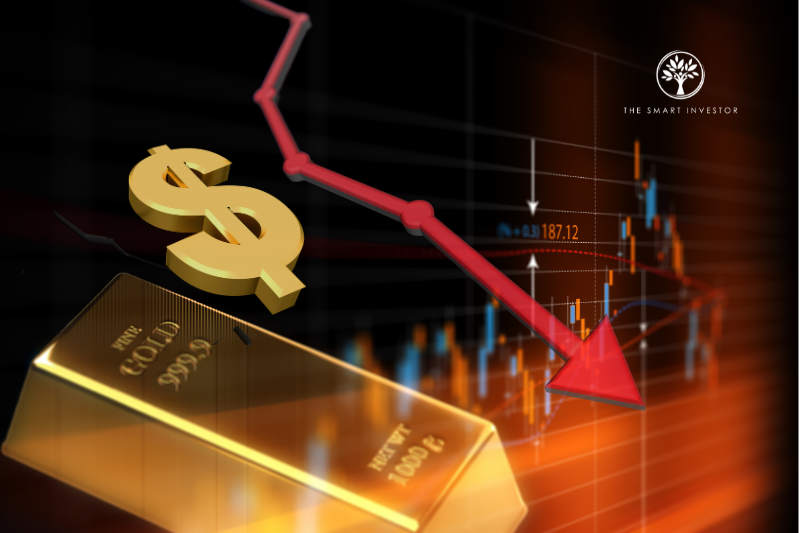
After an impressive five-year run, gold prices surged roughly 200% to reach a record high of US$5,589.38 on 28 January 2026.
Gold is known to thrive during periods of uncertainty as it is a safe-haven asset.
But with prices falling in recent months, many investors now have a nagging question: should they move money into stocks instead?
Why Are Gold Prices Falling?
Gold’s record high in January came at the height of the US–Iran conflict, when safe-haven demand was at its most intense.
As those tensions eased, the premium investors had been paying for protection unwound.
More recently, energy-driven inflation has revived expectations that central banks may need to keep interest rates higher for longer.
That matters for gold because it pays no income – when interest-bearing assets look more attractive, gold competes less well.
Gold vs. Stocks: They Serve Different Roles
Gold is a store of value.
It is an effective hedge against inflation, fiat currency depreciation, and geopolitical turmoil.
However, gold does not generate income and relies solely on price appreciation.
Stocks, on the other hand, represent ownership in businesses, with the potential for capital appreciation if those companies do well.
Some companies also pay dividends to their shareholders, giving those shareholders an additional stream of income.
Gold and stocks are not an either-or option in investing; they have different objectives and work together to enhance a portfolio.
Should Investors Sell Gold to Buy Stocks?
The Case for Stocks
Owning stocks means holding a stake in businesses that generate earnings, pay dividends, and compound wealth over the long run.
Dividend-paying stocks like Singapore Technologies Engineering (SGX: S63) reward shareholders with regular dividends.
Real estate investment trusts (REITs), such as CapitaLand Integrated Commercial Trust (SGX: C38U), or CICT, do the same for unitholders through distributions.
As Singapore’s largest listed REIT, CICT serves as a steady anchor in an investor’s portfolio, especially because Singapore REITs must distribute at least 90% of their taxable income to unitholders to qualify for tax transparency.
The REIT delivered reliable, recurring rental income, with gross revenue of S$426.7 million, rising 8.0% year on year (YoY), and net property income (NPI) increasing 7.9% to S$314.4 million for 1Q2026.
For FY2025, CICT achieved a healthy distribution per unit (DPU) of S$0.1158, 6.4% higher YoY.
Historically, equities have outpaced gold over long-term horizons.
The Case for Keeping Some Gold
Gold provides protection during a financial crisis, especially when fiat currencies face pressure.
Beyond its role as a hedge during turbulent times, gold offers excellent portfolio diversification as a physical precious metal, having a low correlation with other asset classes, such as equities.
The Danger of Chasing Performance
Investors often buy after strong rallies, when prices are already high.
Buying at elevated prices means paying a premium, significantly lowering your potential upside.
Emotional investing can also lead to poor long-term outcomes when investors panic-sell during price drops.
Instead of chasing high performance, focus on asset allocation.
Rebalance periodically and evaluate business fundamentals rather than reacting to short-term noise.
How Long-Term Investors Should Think
Long-term investors should prioritise time in the market over timing the market.
Asking the right questions is important.
Ask yourself why you are investing – is it for income, for growth, or for wealth preservation?
Rather than asking, “Should I own gold or stocks?”, the correct question should be, “How much gold and how many stocks do I need to achieve my financial goals?”
Maintain a disciplined long-term strategy, adjusting your holdings only when necessary to keep them aligned with your personal risk tolerance and financial goals.
When Stocks May Offer Better Long-Term Value
Stocks might offer better long-term value because equities can generate earnings and provide dividends, while gold’s returns depend entirely on price appreciation.
When the economy is growing and corporate earnings are increasing, stocks have tended to outperform gold.
On top of capital appreciation when stock prices rise, dividend yields also offer added value over the long term for stock investors.
Singapore’s largest bank, DBS, delivered record total income of S$5.95 billion in 1Q2026, up 1% YoY.
The bank has been steadily paying out since 2001, declaring a total dividend of S$0.81 for 1Q2026 (which includes a S$0.15 capital return dividend), an 8% YoY increase.
You can compound wealth over decades when you own quality companies, because they possess wide economic moats and strong balance sheets, generating high returns on capital consistently.
Common Mistakes Investors Make
A common folly is concentrating only on gold or stocks, which would expose investors to unnecessary risks.
Diversification across different asset classes helps reduce dependence on any single market.
Selling one asset entirely because it has recently underperformed is a costly mistake.
Markets move, and an asset that lags today may recover as conditions change.
By selling without evaluating the underlying business, investors might lock in permanent losses.
Trying to perfectly time the gold or stock markets is a lofty goal that even professionals struggle with.
Instead, stay invested for the long term with strategies like dollar-cost averaging (DCA) to grow your wealth and let compounding do its job.
Get Smart: Don’t Replace One Asset With Another Without a Plan
Falling gold prices do not automatically mean it’s time to sell.
Likewise, rising stock prices do not guarantee better future returns.
Gold and equities serve different purposes in a diversified portfolio.
The smartest investors know that they should focus on building a balanced portfolio of quality assets that can grow wealth, generate income, and ride out different market cycles over time.
If the market falls further, will you be ready… or fully invested?
This is where most investors get it wrong. Our FREE report shows how to stay prepared for what comes next. Get it free here.
Follow us on Facebook, Instagram and Telegram for the latest investing news and analyses!
Disclosure: Wenting A. does not own any stocks mentioned.