The earnings season for the first quarter of 2024 (1Q 2024) is almost over.
Singapore’s three big banks have handed in their report cards in an environment of “higher-for-longer” interest rates.
DBS Group (SGX: D05) was the first to report and announce a stellar set of results with net profit hitting a new record.
United Overseas Bank (SGX: U11), or UOB, was next but delivered a subdued performance for 1Q 2024.
OCBC Ltd (SGX: O39) was the last of the trio to announce its earnings and it, too, saw its net profit hit a new record.
If you are looking for one of the banks to invest in, you are in luck.
We place the three side by side to determine which is the best bank you should purchase.
Financials
Source: Banks’ Earnings Reports
First off, we look at each bank’s financial performance.
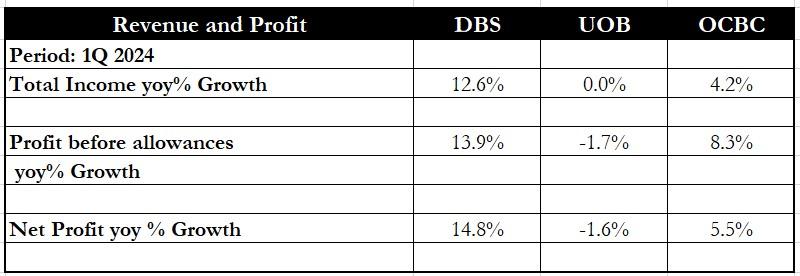
There was a wide spread across the trio with DBS leading the pack with a 12.6% year on year increase in total income.
DBS saw its net interest income rise 8% year on year while its fee and commission income hit a new high of S$1 billion for the quarter.
UOB, on the other hand, saw its total income remain flat year on year as its net interest income fell 2% year on year while fee income rose 5% year on year.
For net profit, DBS is the clear winner with a near-15% year on year rise to S$2.95 billion as expenses rose less than total income.
OCBC came in second place with a decent performance – its total income rose 8% year on year on the back of a 4% year-on-year increase in net interest income.
OCBC managed to improve its net profit for 1Q 2024 by 5% year on year to nearly S$2 billion.
Winner: DBS
Loan book and net interest margin (NIM)
Source: Banks’ Earnings Reports
Next, we examine each bank’s loan book and net interest margin (NIM).
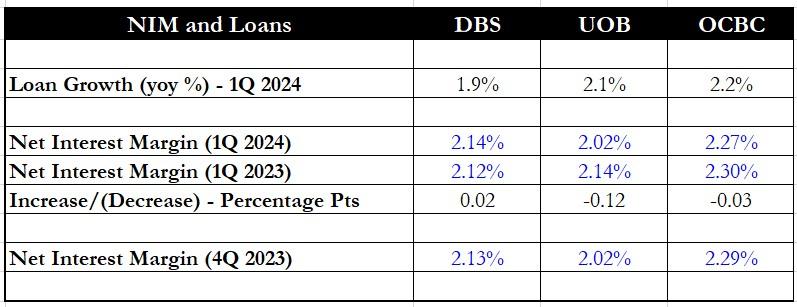
The three banks all reported a year-on-year rise in their loan books with the average rise being around 2%.
For NIM, OCBC has the highest among the trio at 2.27% for 1Q 2024.
However, investors should note that OCBC’s NIM had dipped by 0.03 percentage points from 2.3% a year ago.
Its 1Q 2024 NIM was also lower than the previous quarter’s 2.29%.
DBS, on the other hand, reported a slight year-on-year and quarter-on-quarter increase for its NIM, which came in at 2.14% for 1Q 2024.
UOB saw the largest year-on-year NIM decline among the three banks with a 0.12 percentage point drop.
OCBC still emerges as the winner as its NIM is the highest while remaining fairly stable year on year.
Winner: OCBC
Cost-to-income ratio (CIR)
Source: Banks’ Earnings Reports
The next metric to look at is each bank’s cost-to-income ratio (CIR).
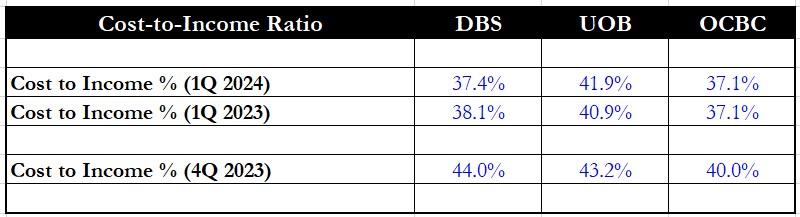
The CIR is the ratio of the bank’s total expenses to its total income and a lower ratio signifies that a bank has its expenses well-controlled.
OCBC is once again the winner here with the lowest CIR among the three banks for 1Q 2024.
However, credit should be given to DBS for improving its CIR both year-on-year and quarter-on-quarter.
While UOB also saw an improvement in its CIR, it was the only bank with its CIR consistently above 40%.
Winner: OCBC
Non-performing loans (NPL) ratio
Source: Banks’ Earnings Reports
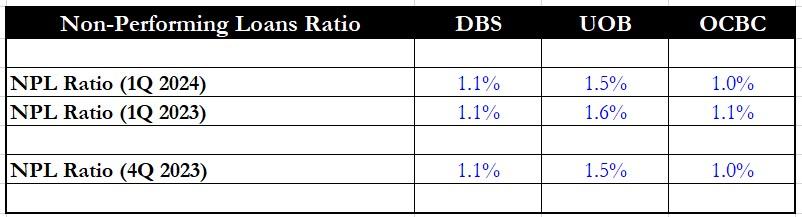
Moving on to the non-performing loans (NPL) ratio, OCBC once again is the winner with the lowest NPL ratio.
As a reminder, the NPL ratio measures the credit quality of a bank’s loan book.
Hence, a lower NPL ratio will imply that a bank’s loan book has a lower level of problematic borrowers.
Winner: OCBC
Return on equity (ROE)
Source: Banks’ Earnings Reports
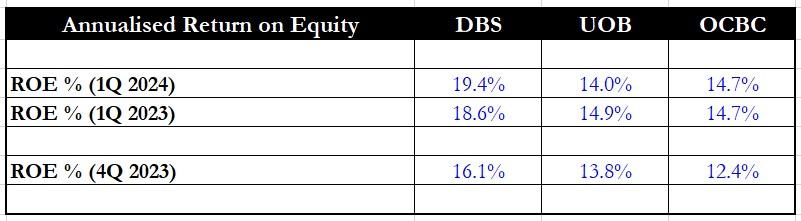
A bank’s return on equity measures the amount of profit generated per dollar of capital, so a higher ROE is a signal that a bank is more profitable with less capital.
On this front, DBS is the clear winner with its ROE hitting an all-time high of 19.4% for 1Q 2024.
DBS also saw a sharp increase of 3.2 percentage points for its ROE from the previous quarter (4Q 2023).
OCBC also saw a 2.3 percentage point ROE improvement while UOB’s improvement came in at just 0.2 percentage points over the same period.
Winner: DBS
Valuation
Source: Banks’ Earnings Reports
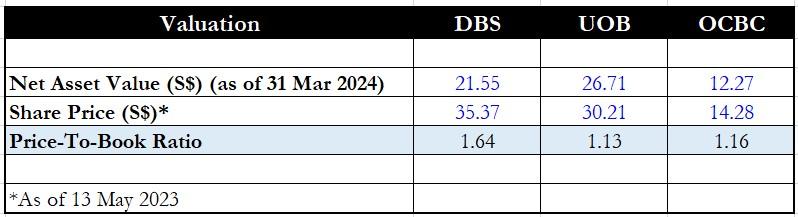
When it comes to valuation, DBS is the most expensive bank of the three with a price-to-book (P/B) ratio of 1.64 times.
UOB and OCBC are both valued at 1.13 times and 1.16 times P/B, respectively, making them much more affordable compared to Singapore’s largest bank.
Winner: UOB
Get Smart: A tough choice
A clear decision is not easy in this case as both OCBC and DBS score points on different attributes.
While OCBC has the highest NIM and the lowest CIR and NPL ratio, DBS scores points in raising its net profit and knocking the ball out of the park with the highest ROE.
Investors need to decide which metrics are more important in their decision-making process.
Another factor to consider is that DBS pays out a quarterly dividend while the other two banks only pay dividends every six months.
For 1Q 2024, DBS declared an interim dividend of S$0.54 per share, a 42% increase over the prior year’s S$0.38.
Attention: Investors aiming for both growth and peace of mind. We’ve pinpointed 5 SGX stocks known for consistent dividends. If you want to build a retirement portfolio, but don’t want the stress of stock watching, this report is for you. Click HERE to download now.
Follow us on Facebook and Telegram for the latest investing news and analyses!
Disclosure: Royston Yang owns shares of DBS Group.