Things are looking up for our local banks.
Last year, Singapore’s central bank, the Monetary Authority of Singapore (MAS), called on the trio of local banks to moderate their dividend payments in light of the pandemic.
DBS Group (SGX: D05), OCBC Ltd (SGX: O39) and United Overseas Bank Ltd (SGX: U11), or UOB, promptly complied, slashing their 2020 dividends to 60% of what was paid out in 2019.
Fortunately, economic conditions have improved since then.
After assessing the banks’ capital requirements and ongoing risks, MAS decided to lift the dividend restrictions, allowing the banks to restore their dividend payments.
All three banks also posted encouraging earnings for their fiscal 2021 second quarter (2Q2021).
Let’s take a look at the banks’ metrics to see which makes the most attractive investment candidate.
Revenue and profits
Source: Banks’ earnings reports, author’s compilation
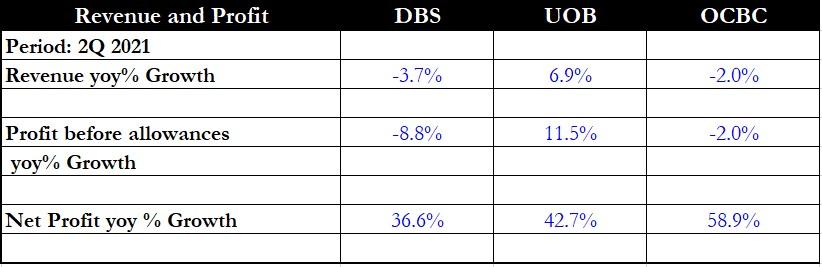
For the quarter, UOB was the only one of the three banks to post a year on year increase in revenue.
It was also the sole lender to report a jump in net interest income, up 8.4% year on year.
Yet another strong point about UOB was its 33.7% year on year increase in non-interest income.
These two factors resulted in an 11.5% year on year growth in profit before allowances.
OCBC may have posted the best year on year profit growth, but for this match-up, UOB comes out tops for being able to post year on year increases in all three attributes in the table above.
Winner: UOB
Allowances
Source: Banks’ earnings reports, author’s compilation
A major focus for investors during the pandemic-induced downturn was the credit quality of the banks’ loan books.
Last year, the three banks were compelled to make pre-emptive provisions to buffer against potential bad loans amid the circuit breaker.
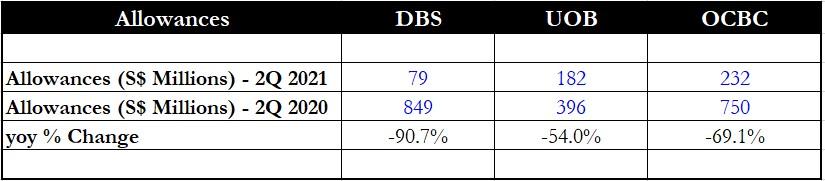
A year later, these allowances have come down drastically due to the more sanguine outlook.
DBS is the only bank thus far to have written back some of its general allowances, resulting in a nearly 91% year on year fall in allowances.
The other two banks have taken a cautious approach and have not written back any allowances for now.
Winner: DBS
Net interest margin and loan book
Source: Banks’ earnings reports, author’s compilation
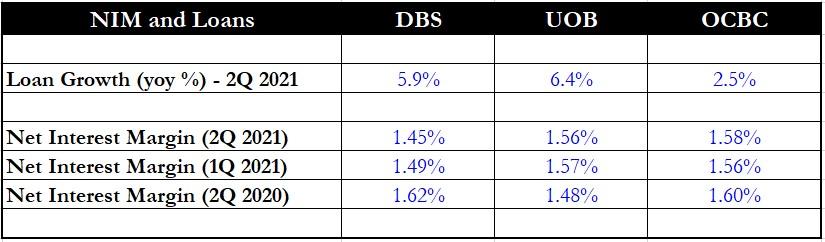
All three banks reported a year on year increase in their loan books, reflecting a healthy appetite for borrowing despite the challenging conditions.
However, of the three, UOB recorded the highest year on year growth at 6.4%.
Turning to net interest margin (NIM), OCBC currently sports the highest NIM among all the three banks as of 2Q2021.
DBS displayed the weakest performance as NIM had fallen by 0.04 percentage points from the previous quarter and 0.17 compared to the prior year’s second quarter (2Q2020).
OCBC’s NIM has remained relatively stable, with just a 0.02 percentage point drop quarter on quarter and a 0.02 fall from 2Q2020.
UOB, on the other hand, stands out as the winner as NIM has rebounded strongly by 0.08 percentage points from 2Q2020, which further reinforces why the bank recorded year on year growth in net interest income.
Winner: UOB
Cost to income ratio

Source: Banks’ earnings reports, author’s compilation
UOB is also the only bank among the three to reduce its cost to income ratio year on year, down from 46% a year ago to 43.7%.
Although DBS has the lowest cost to income ratio among the trio, it has seen a fairly large jump from the 39.8% booked in 2Q2020, part of which can be attributed to expenses relating to the acquisition of Lakshmi Vilas Bank in India.
Winner: UOB
Valuation
Source: Banks’ earnings reports, author’s compilation
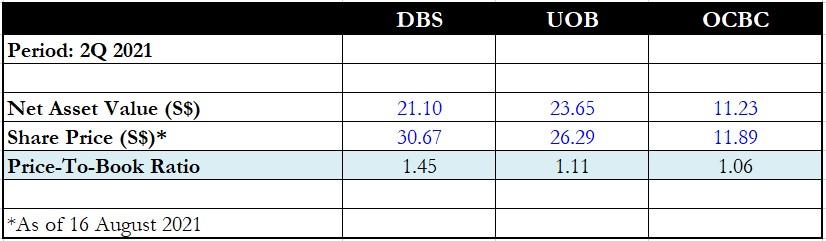
When it comes to valuation, DBS is the most expensive among the three banks in terms of price-to-book ratio, standing at 1.45 times.
UOB and OCBC are trading at fairly close multiples of around 1.1 times each, but OCBC wins by a nose for this round with a price-to-book ratio of just 1.06 times.
Winner: OCBC
Dividend yield
Source: Banks’ earnings reports, author’s compilation
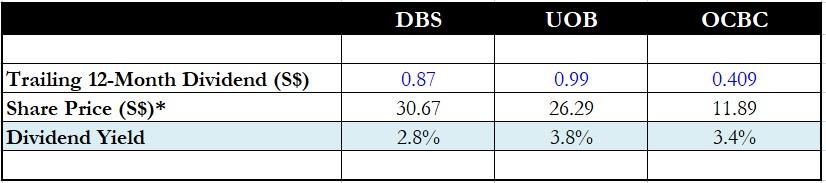
Finally, we look at the trailing 12-month dividend yield for each bank.
UOB has the highest trailing dividend yield of 3.8% and is also the only bank among the three to raise its interim dividend above what was paid out in 2019.
The bank had declared a S$0.60 interim dividend for 2Q2021, higher than the S$0.55 paid out in the second quarter of 2019.
Winner: UOB
Get Smart: A clear winner
UOB ticks off many positives for this quarter — a stronger loan book, improving NIM, increases in both revenue and net profit, and an attractive dividend yield.
In general, we are seeing a much healthier performance from Singapore’s banks for 2021 thus far.
To be sure, investors may need a few more quarters of observation to fully ascertain if this momentum can be sustained.
If you want more stock ideas, start looking out for these 5 unique traits in the stock market. Companies with these traits can possibly pay you dividends for life. Discover what these traits are in your FREE special report “Dividend Stocks That Can Pay You For Life”. Click here to download now.
Follow us on Facebook and Telegram for the latest investing news and analyses!
Disclaimer: Royston Yang owns shares of DBS Group.