The trio of local banks have been a big beneficiary of surging interest rates as the US Federal Reserve began its aggressive rate hikes in March 2022.
Back then, no one thought that over the next year, the central bank would embark on one of its most aggressive interest-rate increases in history to combat inflation.
United Overseas Bank Ltd (SGX: U11), or UOB, was the first to hand in its report card, where it announced a record net profit of S$1.6 billion.
Next, DBS Group (SGX: D05) turned in a similarly-stellar earnings report for fiscal 2023’s first quarter (1Q 2023) with a historical net profit of S$2.57 billion.
Not to be outdone, OCBC Ltd (SGX: O39) followed up with its record net profit of S$1.88 billion, being the last of the three banks to report its results.
With all three blue-chip banks reporting impressive sets of earnings, it can be tough to decide on which bank to add to your buy watchlist.
We sized up all three banks to review their latest numbers and determine which qualifies as the best investment idea.
Financials
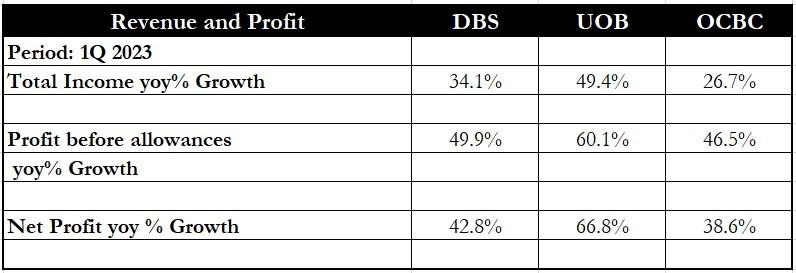
Looking at the financials angle, all three banks posted higher total income as their results were strongly boosted by a surge in net interest income.
Profit before allowances also surged in all three cases as the rise in expenses was dwarfed by the sharp jump in total income.
The result? A strong year on year net profit growth for all three banks allowed them to record historic levels of net profit.
Looking at the percentage increases, UOB is the winner in this round as total income, profit before allowance, and net profit all increased at the fastest pace among the trio.
This outstanding performance may also be tied to its recent acquisition of Citigroup’s (NYSE: C) consumer banking division which is now being slowly integrated into the group’s results.
Winner: UOB
NIMs and loan growth
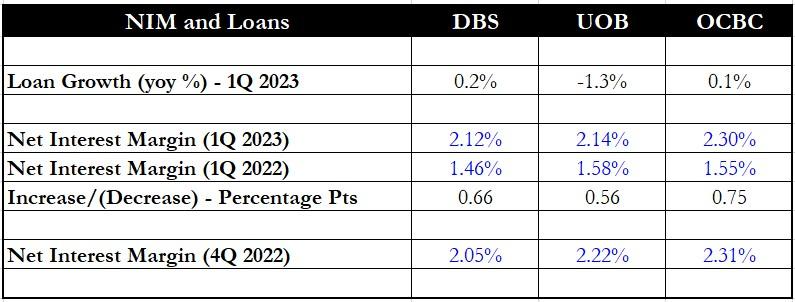
Moving on to the net interest margin (NIM), the surge in interest rates has helped to lift all three banks’ NIM to above 2%, levels that have not been seen in a while.
Although DBS Group has the lowest NIM of the three, it was the only bank to have displayed quarter-on-quarter growth in NIM, going from 2.05% to 2.12%.
The other two banks saw NIM dip slightly. UOB’s NIM fell by 0.08 percentage points to 2.14% from 4Q 2022 while OCBC’s slid just 0.01 percentage points to 2.3%.
This slight dip suggests that NIMs may have peaked for both UOB and OCBC, while there may still be some NIM upside for DBS Group.
For loan growth, all three banks displayed relatively flat loan growth but DBS Group takes the cake here with a 0.2% year on year increase in its loan book.
Winner: DBS Group
Cost-to-income ratio
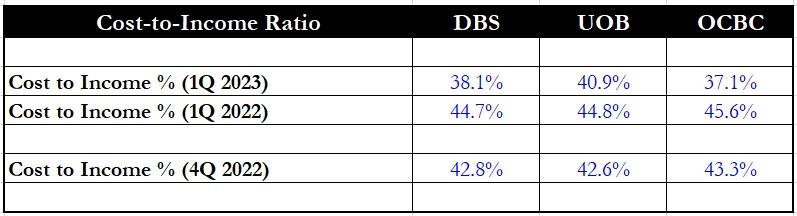
The cost-to-income ratio measures how efficiently a bank is run by comparing its expenses base to its total income.
OCBC has shown an amazing ability to reduce its cost base with its cost-to-income ratio jumping from 43.3% in 4Q 2022 to 37.1%, making it the lowest among the three.
It was also the largest improvement among the trio on a year on year basis as OCBC’s cost-to-income ratio stood at 45.6% in 1Q 2022.
Winner: OCBC
Return on equity
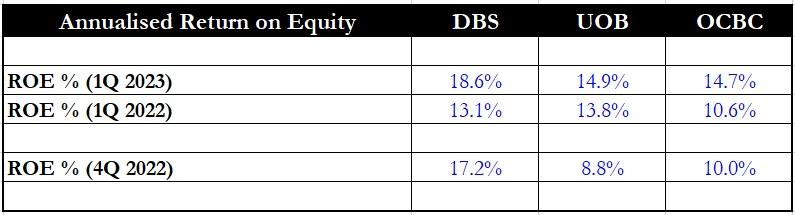
Next, we look at the important return on equity (ROE) metric that measures the profitability of each bank relative to its equity base.
DBS easily takes the trophy here with an ROE of 18.6%, with UOB and OCBC coming in relatively close to each other at 14.9% and 14.7%, respectively.
It should be noted that DBS’s ROE was already the highest in the prior quarter (4Q 2022) at 17.2%), but it has continued to maintain its lead as we head into 1Q 2023.
Winner: DBS Group
Non-performing loans (NPL) ratio
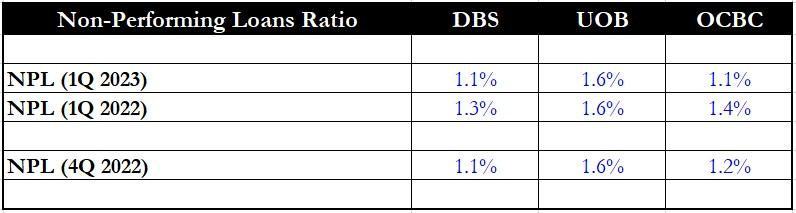
As higher interest rates tend to dampen consumer spending and raise the probability of bad loans, we took a look at each bank’s non-performing loans (NPL) ratio.
DBS also comes up as the winner here with a consistently low NPL ratio of 1.1% which is down from the prior year’s 1.3%.
OCBC also fared well by reducing its NPL ratio to be on par with DBS Group, but its prior 4Q 2022’s NPL ratio was slightly higher than DBS at 1.2%.
Winner: DBS Group
Valuation
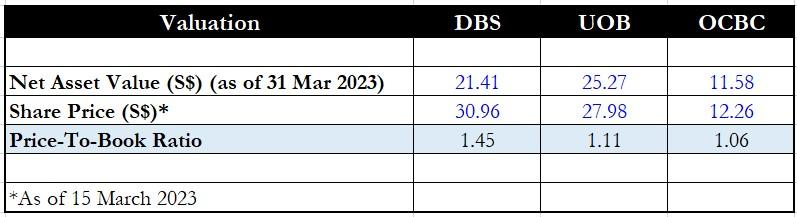
An analysis of the three banks would not be complete without a look at their valuations.
Based on the price-to-book (P/B) for each bank, OCBC once again emerges as the cheapest of the trio at just 1.06 P/B.
DBS is, as usual, the most expensive once again at 1.45 P/B while UOB is sandwiched in the middle with a 1.11 P/B.
Winner: OCBC
Get Smart: Other considerations
It seems DBS has won this round with three attributes coming up tops, compared with two for OCBC and one for UOB.
Of course, investors need to consider other factors too when evaluating all three lenders.
For instance, DBS Group also pays out a quarterly dividend of S$0.42 per share.
Income-seeking investors could view this aspect favourably when considering which bank to buy as Singapore’s largest bank is the only bank to dole out quarterly dividends.
Our beginner’s guide to investing is finally here! Many investors took years to understand the principles inside, but you can have it all in one afternoon. If you have just started investing, download our free guide today so you can catch up quickly. Click here to download now.
Follow us on Facebook and Telegram for the latest investing news and analyses!
Disclosure: Royston Yang owns shares of DBS Group.