As we move through February 2026, the Singapore REIT (S-REIT) sector remains a cornerstone for income-seeking investors.
However, the narrative is shifting.
No longer is it just about surviving high interest rates; it is now about which managers are successfully “recycling” capital and pivoting their portfolios to meet new structural challenges.
We examine three heavyweights in the retail and commercial space and what you need to know about your dividends.
CapitaLand Integrated Commercial Trust (SGX: C38U) [CICT]
CICT posted a 2025 distribution per unit (DPU) of S$0.1158, a 6.4% year-on-year (YoY) increase.
The second half of 2025 (2H2025) was particularly strong, with a DPU of S$0.0596, up 9.4% YoY.
That’s not all.
CICT is already making its next moves in capital recycling.
The REIT announced the sale of Bukit Panjang Plaza for S$428 million, a 165% premium to its 2007 purchase price and 10% above its latest valuation.
The sale proceeds will be redeployed into the Hougang Central mixed-use development site, where CICT will develop the commercial component comprising approximately 300,000 square feet of net lettable area.
With a total development cost of around S$1.1 billion and a target yield on cost exceeding 5%, this represents a meaningful upgrade in portfolio quality, although income contribution is only expected between 2030 and 2031.
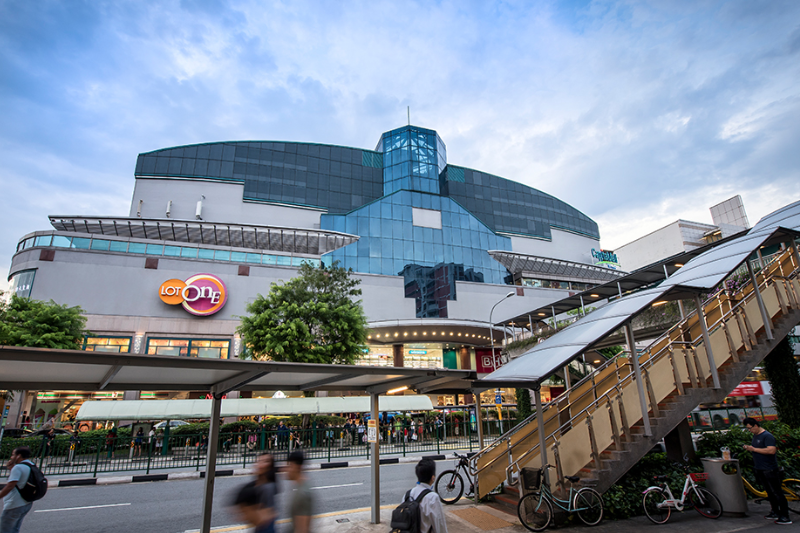
In addition to the development pipeline, the REIT has lined up three asset enhancement initiatives (AEIs): Lot One Shoppers’ Mall (S$37 million) and Tampines Mall (S$24 million) and a newly announced S$25 million AEI at Capital Tower set to commence in 3Q2026.
In sum, there is much to like about CICT’s latest update.
At S$2.42, CICT units offer a 4.8% distribution yield.
Frasers Centrepoint Trust (SGX: J69U) [FCT]
By now, you would have heard about the Johor Bahru-Singapore Rapid Transit System (RTS) link, which is expected to commence operations by the end of 2026, reducing the travel time across the causeway.
There is little doubt that it will have an impact.
But how much?
At its recent annual general meeting (AGM), management addressed the issue directly, revealing that independent studies estimate retail sales leakage could rise from the current 3% to 4% to approximately 5% by 2032.
The Case for Concern
FCT’s two largest revenue contributors, namely Causeway Point and Northpoint City, are located in the north and sit squarely in the firing line.
How significant is the threat?
Here’s some context: for the fiscal year ended 30 September 2025 (FY2025), Causeway Point accounted for around a quarter of the REIT’s gross revenue and net property income (NPI).
Over the same period, Northpoint City contributed 22% of the REIT’s gross revenue and 21% of its NPI.
Given what’s at stake, unitholders are understandably nervous.
How the REIT management is responding
Management is transforming Causeway Point into a “regional mall” by pivoting the tenant mix toward resilience.
This involves reducing exposure to mass-market categories vulnerable to cross-border competition and increasing the presence of essential services, enrichment centres, and international fashion.
By strategically bringing popular Malaysian brands like Oriental Kopi and Zus Coffee into the mall, FCT aims to differentiate its offering, ensuring it competes on convenience and lifestyle rather than just price.
The Structural Tailwinds
The northern region is anchored by powerful secular trends, including the projected addition of over 50,000 residential units and 100,000 jobs via the Woodlands Regional Centre.
With the North-South Corridor set to improve connectivity to the city, the local population is expected to grow by over 25% in the next 15 years, providing a growing captive audience for FCT’s flagship assets.
Operational Performance Remains Solid
Operationally, the REIT remains robust, with committed occupancy hitting a near-perfect 99.9% after backfilling vacant cinema spaces.
The Northpoint City South Wing acquisition continues to be DPU-accretive, while the balance sheet has strengthened with a lower cost of debt at 3.5% and over 80% hedged to fixed rates.
At S$2.27, FCT offers a 5.3% trailing yield, aligning closely with its historical average.
Mapletree Pan Asia Commercial Trust (SGX: N2IU) [MPACT]
For the second straight quarter, MPACT delivered a YoY DPU increase.
But make no mistake – this is rate relief rather than revenue growth.
Gross revenue and NPI both declined.
But finance expenses fell even more (10.2% YoY), pulling DPU up 2.5% YoY to S$0.0205 for the third quarter of the fiscal year ending 31 March 2026 (3QFY2026).
In other words, this improvement came entirely from lower borrowing costs.
Meanwhile, the underlying portfolio continues to shrink.
VivoCity fires on all cylinders
Thankfully, the portfolio’s crown jewel is delivering its strongest performance yet, accelerated by the completion of the Basement 2 asset enhancement initiative in late August 2025.
For 3QFY2026, VivoCity saw a 10.1% surge in NPI and a 6.3% jump in shopper traffic, while tenant sales grew 4.4% and rental reversions held firm at a double-digit 14.7%.
Alongside Mapletree Business City, these core Singapore assets now contribute 57% of total portfolio NPI – a figure set to rise as the REIT continues to divest non-core assets like Festival Walk Tower.
Festival Walk: foot traffic up, spending down
Festival Walk’s retail mall continues to struggle.
Shopper traffic improved 4.5% YoY, a notable turnaround from last year’s decline, but tenant sales fell 2.9%, and rental reversion widened to negative 10.5% from negative 7.2% a year ago.
The divergence tells the story: Hong Kong residents are visiting, but they are not buying — likely spending their dollars across the border in Shenzhen instead.
A new concern: portfolio occupancy
A metric worth flagging is portfolio occupancy, which slipped to 88.1%, down from 90.0% a year ago.
The decline reflects ongoing challenges in Japan (Makuhari at 73.1%) and China (83.6%).
Between Festival Walk, China properties and Japan properties, these markets contribute more than a third of NPI and continue to weigh on its top line and bottom line.
At S$1.44, the REIT offers the highest yield among the trio at 5.9%.
Get Smart: Quality Over Yield?
The divergence among these three REITs highlights a crucial lesson: not all distributions are created the same.
While CICT plays the long game by sacrificing immediate yield for high-quality developments, FCT is proving that its “moat” lies in being an essential part of the daily commuter’s habit – a strategy that looks robust even with the RTS link on the horizon.
Meanwhile, MPACT remains a tale of two portfolios; its Singapore crown jewels are powerhouse performers, but the recovery of its North Asian assets is still the missing piece of the puzzle.
Imagine receiving steady rent increases for more than two decades. It sounds unusual, but one healthcare REIT already has rental escalations locked in until around 2042. Income visibility like this is hard to find today. We break down how this REIT built such dependable cash flow in our FREE dividend report and how it could strengthen a retirement portfolio. Get the free report here.
Follow us on Facebook, Instagram and Telegram for the latest investing news and analyses!
Disclosure: Chin Hui Leong owns shares of CICT, FCT and MPACT.