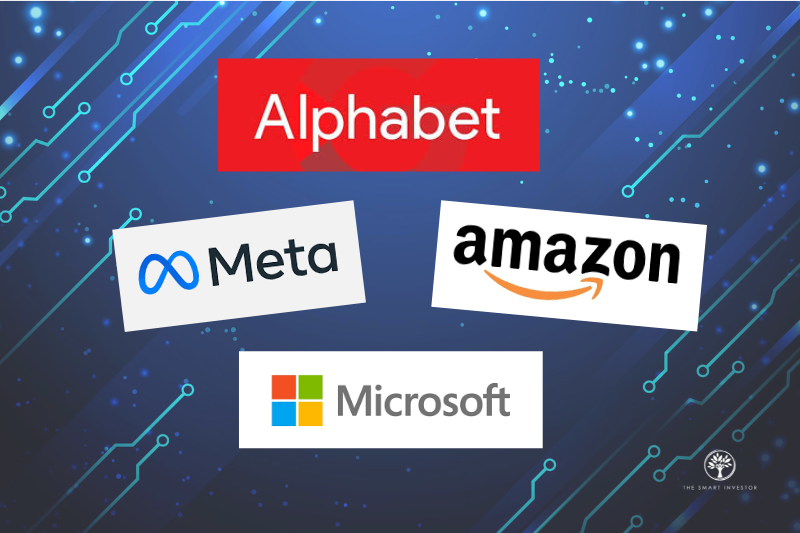
Four of the world’s largest companies will release their latest quarterly results on the same day – 29 April 2026.
Alphabet (NASDAQ: GOOGL), Microsoft (NASDAQ: MSFT), Meta Platforms (NASDAQ: META), and Amazon (NASDAQ: AMZN) each wrapped up 2025 with bold capital expenditure (capex) commitments totalling well over half a trillion US dollars for 2026 alone.
The upcoming earnings release will give investors their first quarterly read on whether the revenue and margins are keeping pace with the spending.
Here’s what we’re watching at each.
Alphabet: Can Three Engines Keep Firing?
Alphabet heads into the release with the clearest tailwind.
In 2025’s fourth quarter (4Q2025), Google Search revenue rose 17% year on year (YoY) to over US$63 billion – the fastest quarterly growth since 2022.
Google Cloud went one better, with revenue surging 48% to US$17.7 billion, its quickest pace in three years.
Cloud operating margins nearly doubled from 17.5% to 30.1% over the same period, while the Cloud backlog more than doubled YoY to US$240 billion.
The question now is whether all three engines – Search, Cloud, and the subscriptions segment that grew 17% – can sustain momentum through 1Q2026.
Investors should also listen for pacing updates on the US$175 to US$185 billion capex target for 2026, a figure that exceeds Alphabet’s 2025 operating cash flow (OCF).
Meta Platforms: The Steepest Capex Step-up
Meta’s 4Q2025 revenue rose 24% YoY to US$59.9 billion, taking full-year sales past the US$200 billion mark.
The advertising flywheel keeps turning.
Ad impressions grew 18% while average price per ad climbed 6%.
AI-generated video ad tools now command a US$10 billion annual run-rate, with quarter-on-quarter growth running at nearly three times the pace of overall ad revenue.
But the social media giant’s 2026 capex guidance of US$115 to US$135 billion represents a 67% to 97% jump from 2025’s US$69 billion – the steepest proportional step-up among the four.
For 1Q2026, we’ll be watching whether ad pricing and impressions can both keep climbing, and whether WhatsApp’s paid messaging business – already at a US$2 billion run-rate – extends its momentum.
Any commentary on Reality Labs losses, which management expects to peak near 2025’s US$19 billion level, would also be instructive.
Microsoft: The Real Test Is Non-OpenAI Backlog
Microsoft’s commercial remaining performance obligation (RPO) surged 110% YoY to US$625 billion at the end of 4Q2025.
Around 45% of that figure is tied to OpenAI, a concentration that naturally raises questions.
But strip OpenAI out, and the remaining backlog of roughly US$350 billion still grew 28% YoY – a telling indicator of underlying enterprise demand.
Microsoft 365 (M265) Copilot seat additions climbed over 160% YoY in the most recent quarter, reaching 15 million paid seats.
Here’s the nuance to watch.
CFO Amy Hood flagged that Azure’s growth would have exceeded 40% in the first half of fiscal year 2025 had all incoming GPU capacity been allocated there.
Microsoft instead diverted supply to first-party products like M365 Copilot.
For 1Q2026, Azure’s reported growth rate, the non-OpenAI RPO trajectory, and Copilot seat momentum will matter more than the headline figure.
Amazon: How Deep Does the Free Cash Flow Trough Go?
Amazon Web Services (AWS) delivered its fastest growth in 13 quarters in 4Q2025, with revenue up 24% to US$35.6 billion.
Advertising services rose 22% excluding foreign exchange to US$21.3 billion, and the underlying operating income – stripping out around US$2.4 billion in one-off charges – would have been US$27.4 billion rather than the reported US$25 billion.
But free cash flow (FCF) is the pressure point.
Trailing-12-month FCF compressed sharply to US$11.2 billion from US$38.2 billion the prior year, weighed down by a US$50.7 billion YoY jump in property and equipment spending.
CEO Andy Jassy has committed to roughly US$200 billion in capex for 2026.
For 1Q2026, the read-outs to track are AWS’s growth rate (can it hold above 24%?), the depth of the FCF trough, and whether advertising and same-day delivery volumes continue to support North America segment margins.
Get Smart: One Report, Four Different Questions
On 29 April, the market will be asking the same overarching question – are the returns from massive AI capex starting to show up in the numbers? – but the specific answer differs for each name.
For Alphabet, the question is whether Cloud’s 48% growth is sustainable.
For Meta, whether ad pricing power can justify a near doubling of capex.
For Microsoft, whether the non-OpenAI backlog can stand on its own.
For Amazon, how deep the FCF trough goes before AI investments start paying back.
Fellow investors should focus less on the headline numbers and more on these specific proof points.
Not all AI “winners” will survive this cycle.
But a few companies already have the scale, cash flow, and edge to pull ahead. We highlight what to look for in our FREE volatile market report. Download it here.
Follow us on Facebook, Instagram and Telegram for the latest investing news and analyses!
Disclosure: The Smart Investor owns shares of Alphabet, Meta and Microsoft.