Welcome to this week’s edition of top stock market highlights.
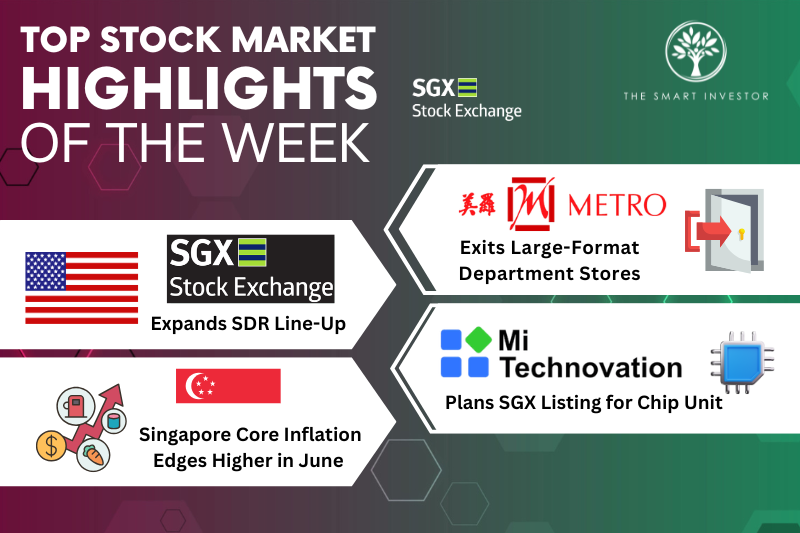
This week brought a mix of corporate transformation, market infrastructure news and fresh economic data.
A long-standing Singapore retailer is stepping away from the format that made its name.
Meanwhile, the local exchange has opened a new door to US-listed growth names, and a Malaysian semiconductor player is eyeing an SGX listing.
Also, June’s inflation print showed price pressures creeping upwards.
Here is what investors should take note of.
Retailer Exits Large-Format Department Stores
Metro Holdings (SGX: M01) will stop operating its department stores at Paragon and Causeway Point when the current leases expire, as it intends to progressively move away from traditional large-format department stores.
In a bourse filing on Monday, 20 July 2026, Metro said the shift follows a strategic review of its retail operations as it seeks to better align with evolving consumer preferences, shopping habits and market trends.
The two outlets are Metro’s last remaining large-format department stores in Singapore.
The group is instead exploring smaller-format stores, multi-specialty outlets, curated shopping experiences and pop-up initiatives, and said it is in discussions with current and other landlords on rolling out new multi-concept stores.
The company is still assessing the financial implications and cannot yet quantify the full earnings impact, though the board does not expect a material effect on consolidated net tangible assets or earnings per share for the financial year ending 31 March 2027.
Shares of Metro closed at S$0.46 on Monday.
It will continue pursuing opportunities through Grand Brands Asia, its brand management joint venture.
SDR Suite Expands to US-Listed Counters
Singapore Exchange (SGX: S68), or SGX, has expanded its Singapore Depository Receipts (SDR) suite with three US-listed counters — Grab (SGX: UGBD), Sea (SGX: UGGD) and SpaceX (SGX: UXSD) – which commenced trading on Wednesday, 22 July 2026 at market open.
The timing reflects strong momentum in the product.
Average daily turnover has more than tripled year on year, driven by record retail participation, while total assets under management have crossed S$280 million, up 153% year on year (YoY), with retail investors holding more than 80% of total holdings.
With these additions, SGX now offers 38 SDRs across four markets: Thailand, Hong Kong, Indonesia and the United States.
The appeal is largely practical.
The US SDRs let investors trade these names in Singapore dollars during local market hours, removing foreign currency conversion friction.
SGX’s Vice President of Securities Trading Bernice Tan, noted that average daily turnover across the existing SDR ecosystem has tripled to S$13 million.
Notably, this marks the first time retail investors here can gain listed exposure to SpaceX.
Chip Materials Arm Heads For An SGX Listing
Bursa-listed Mi Technovation (KLSE: MI) is planning to list its semiconductor materials business on the SGX, as the artificial intelligence boom continues to drive investment across the global chip supply chain.
The business earmarked for listing, Mi Material, manufactures solder balls used in advanced semiconductor packaging.
Executive director and group CEO Oh Kuang Eng said Singapore scored the highest points among the markets considered, citing access to talent, transparency and the quality of researchers, alongside the Republic’s geopolitical stability and proximity to its planned Senai plant in the Johor-Singapore Special Economic Zone.
The group acquired a 99% stake in Taiwan-based Accurus Scientific in 2021 for RM271 million (US$66.3 million) and plans to place it under Mi Material this year.
The listing lands amid a fierce local chip rally.
As at 22 July 2026, AEM Holdings (SGX: AWX) is up 425% year to date, UMS Integration (SGX: 558) 122.7%, and Frencken Group (SGX: E28) 97.1%.
Mi Technovation’s own Bursa-listed shares have gained 97.6%.
Oh believes the upcycle has further to run, though he cautioned that what semiconductor experts see is not necessarily what capital markets see.
Mi Technovation currently employs around 20 staff here and expects to hire about 40 researchers when its Singapore R&D facility opens later this year.
Singapore’s Inflation — Core and Headline Prices Tick Higher in June
Singapore’s price pressures firmed last month.
Core inflation rose to 1.6% year on year in June, up from 1.4% in May, according to a joint statement from the Monetary Authority of Singapore (MAS) and the Ministry of Trade and Industry released on 23 July 2026.
The increase was driven by higher inflation for food, services, and retail and other goods, with core consumer prices up 0.1% on a month-on-month basis.
Headline inflation rose to 1.9% YoY in June from 1.8% in May, lifted by higher accommodation inflation alongside the increase in core inflation.
Core inflation excludes accommodation and private transport costs, and is the central bank’s preferred gauge of domestically driven price pressures.
Both readings remain within MAS’s forecast range of 1.5% to 2.5% for both headline and core inflation in 2026, a range raised from 1% to 2% after the central bank returned to policy tightening in April — its first such move since 2022 — amid inflationary pressures from the Middle East conflict.
Imagine owning businesses that continued paying shareholders even when markets were falling. That’s the appeal of dividend investing done well. Our FREE report reveals 6 SGX companies that paid dividends every single year for two decades, through the Global Financial Crisis, COVID-19, and 2022’s rate shock. Start building the kind of income stream that could fund a more comfortable retirement. Get your free report here.
Follow us on Facebook, Instagram and Telegram for the latest investing news and analyses!