A new kebab store opened near my home last week.
At least, that’s what I think the owner is selling.
It’s a mess, to put it mildly.
The store design is all over the place.
The menu is a haphazard concoction of biryani, pasta, fries, and kebabs – all mashed together.
Its Instagram page doesn’t even match the store’s name.
Oh, and the store has been moving around Singapore, swinging from Pasir Ris to Yishun to Holland Village.
Everything I could see told me this store had no business being successful.
And yet, everything I couldn’t see told a different story.
A loyal following.
Customers willing to chase this store across the island.
The taste is, apparently, worth the trouble.
So much so that its kebabs got a rare praise from a MasterChef Singapore judge.
This little experience reminded me of something important in investing …
… when it comes to businesses, what you see is only half the picture.
You have to dig a little further to see the more important half.
Reaching for my Visa in Malaysia
I experienced this firsthand last week.
While on vacation in Malaysia, I found myself using the Touch ‘n Go app in many places.
Restaurants, and convenience stores – the e-wallet was accepted almost everywhere I went.
But then I checked into my hotel.
Touch ‘n Go? Sorry, no.
At the AEON supermarket self-checkout? The option is not always available.
In both cases, I had to turn to my trusty credit or debit card.
Now, these exclusions may seem trivial.
But they reveal something important that most investors don’t see.
In a world bursting with digital wallets, QR codes, and buy-now-pay-later (BNPL) options, you’d think the old credit card networks are yesterday’s news.
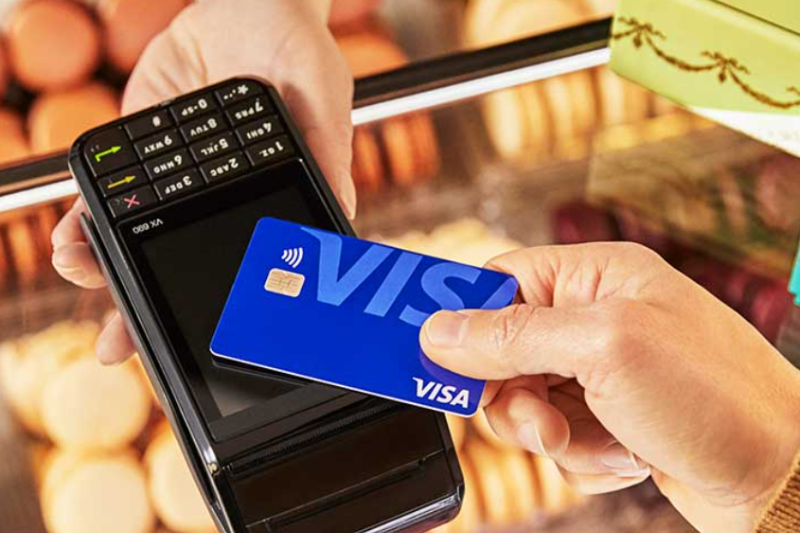
And yet, there I was – standing at the hotel reception with no choice but to reach for my Visa (NYSE: V) card.
Here’s what most people see when they look at Visa: a credit card company.
Here’s what they don’t see: the invisible rails that the world’s payments run on.
A “mature” company?
When most people look at Visa, they see a mature business.
Billions of cardholders.
Accepted in over 200 countries.
The logo stamped on practically every wallet in the world.
The cynics aren’t wrong – some parts of the business are maturing.
Visa already holds about 25% market share in consumer payment volume.
At that scale, how much more can it really grow?
Here’s where it gets interesting.
Despite that sizable 25% share, Visa is still growing its consumer payment volume at over twice the market rate.
How?
For one, there’s cash conversion.
Some people still haven’t moved from swiping to tapping.
And once they tap, they tend to spend about 15% more.
Then there are premium card schemes that Visa designs for banks to target highly affluent customers – the people who are regulars in business class.
This cohort spends around 30 times more than the average cardholder.
And that’s just the tip of the iceberg.
The moat you can’t see
Now, you might be wondering: with so many fintechs, digital wallets, and real-time payment systems out there, won’t they eat Visa’s lunch?
Here’s what I find fascinating.
Look at virtually every fintech today.
They all offer a debit or credit card.
Nubank (NYSE: NU) in Latin America?
Started with credit cards.
A short hop away is MercadoLibre (NASDAQ: MELI).
And what is the Latin American fintech’s latest growth channel? Credit cards.
How about Trust Bank in Singapore?
What was their first product? Credit cards.
Remember when DBS Group (SGX: D05) acquired Citibank Taiwan in 2023?
What did the bank put at the centre of its announcement? The number of credit card holders.
Even Wise (LSE: WISE)— the fintech built to disrupt traditional payment fees – offers a Visa debit card.
In short, Visa’s supposed competitors are becoming its customers.
Why? Because what it built is incredibly hard to replicate.
The origins of Visa’s network can be traced back to 1968, when the late Dee Hock got the competing banks into a room, convinced them to share information with one another, and created a set of principles that everyone agreed to follow.
Incredibly, this network has lasted almost 60 years.
And here’s something remarkable: Visa’s network runs at 99.9999% uptime.
What does that mean?
The network limits its downtime to roughly 31.5 seconds a year.
Think about it for a moment: when was the last time you used your Visa and it didn’t work?
That reliability is trust.
And trust, when money is flying around the digital world, is not something you can copy overnight.
Where the hidden growth lies
With that kind of trust as a foundation, Visa’s next moves make perfect sense.
The first is money movement.
Business-to-business transfers alone represent a massive opportunity that’s growing far faster than its core consumer payments market.
The second is value-added services.
Visa holds some of the most valuable information in the world — confirmation of an actual purchase.
Google might get a consumer to click through to your website, but may not know if you actually bought something.
Visa does.
The company has identified 65 million potential small and medium-sized business customers for these services, with an addressable market of an estimated US$520 billion.
Together, new flows and value-added services already make up roughly 30% of Visa’s business – and growing.
Oh, and one more thing. Visa grew its revenue by 17% in its latest quarter.
That doesn’t sound mature to me.
Get Smart: Look beyond what you can see
Back to that messy food store near my house.
If I had judged it by what I could see – the chaotic menu, the random Instagram name, the lack of a permanent address – I would have written it off completely.
But the things I couldn’t see …
… the taste, the consistency, the loyalty it inspires – those turned out to be far more important.
The same goes for Visa.
What you can see is a credit card logo on your wallet.
What you can’t see is a nearly 60-year-old network with 99.9999% uptime, two fast-growing business segments most investors overlook, and a network so valuable that even its competitors are becoming its customers.
As investors, we’re naturally drawn to what we can measure, what we can see, and what we can compare.
But some of the most important qualities of a business, whether it’s trust, loyalty, network effects, don’t show up neatly in a spreadsheet.
The next time you assess a company, ask yourself: what am I not seeing?
The answer might be worth more than everything you can.
For the full discussion, check out my conversation with Michelle Martin on Money FM 89.3 on 17 June 2025.
Wish you could overhear how experienced investors think? That’s what Get Smart feels like. Reading calm, thoughtful commentary from people who study the markets closely and care about growing wealth sensibly. Click here to subscribe to our weekly newsletter for free now!
Follow us on Facebook, Instagram and Telegram for the latest investing news and analyses!
Disclosure: Chin Hui Leong owns shares of Alphabet, DBS Group, MercadoLibre, and Visa.