Singapore’s Straits Times Index (SGX: ^STI) has had a year worth celebrating.
The SPDR STI ETF (SGX: ES3), which tracks the benchmark, returned 16.3% year to date (as of 8 July 2026).
Most investors would take that gladly.
Here’s the twist: three STI components out of the 30 left it well behind.
Singapore Exchange (SGX: S68) delivered a total return of 43.3% over the same stretch.
Oversea-Chinese Banking Corporation (SGX: O39) returned 36.2%.
Singapore Technologies Engineering (SGX: S63) came in at 33.7%.
Each has easily doubled the index’s returns.
A rising tide lifts an index.
It does not, on its own, explain why three names pulled this far ahead.
The businesses did that.
The broad benchmark only partly captures what these businesses achieved, and the market appears to have rewarded that concentration.
Why did SGX outrun the field?
SGX runs Singapore’s only stock market.
When trading activity picks up, the toll-taker collects.
That is close to what happened.
For the first half of its fiscal year, ended 31 December 2025, net revenue rose 7.6% year on year (YoY) to S$695.4 million.
The Equities – Cash division led the way, climbing 16.2% to S$223.9 million as securities daily average traded value jumped 19.5%.
Fixed income, currencies and commodities added 12.5% to reach S$178.9 million on heavier volumes.
Investors may have read the headline profit with more care.
Net profit attributable to shareholders was almost flat, up 0.8% to S$342.7 million, held back by lower non-operating gains and a S$15.0 million goodwill impairment tied to Scientific Beta.
Strip those out and adjusted net profit rose 11.6% to S$357.1 million.
The operating engine ran harder than the reported figure let on.
For dividend investors the signal was clearer still.
Free cash flow is the lifeblood of dividends, and SGX generated S$363.7 million in net cash from operations for the half.
Total dividends came to S$0.2175, up from S$0.180 a year earlier.
Management has committed to raising the quarterly dividend by 0.25 cents each year through to the end of FY2028.
A revenue tailwind paired with a committed, rising payout is the kind of combination the market tends to reward.
Is ST Engineering’s strength built to last?
ST Engineering sells into defence, aerospace and urban systems across more than 100 countries.
Two of those markets are running hot.
Group revenue climbed 11% YoY to S$3.3 billion in the first quarter of 2026.
Excluding LeeBoy, divested last September, rebased revenue grew 15%.
All three segments contributed.
Defence and public security rose 13% on a rebased basis to S$1.4 billion on strong international contract wins.
Commercial aerospace jumped 15% to S$1.3 billion, led by engine maintenance and nacelle work.
Urban solutions and satcom surged 18% to S$525 million, with satcom alone growing more than 30%.
The order book is what may have caught the market’s eye.
ST Engineering booked S$4.8 billion in new contracts during the quarter and closed March with an order book of S$34.5 billion, of which S$8.0 billion is due for delivery across the rest of the year.
That is a long runway of committed work.
A note of caution belongs here.
First-quarter updates are business snapshots, and the group does not disclose profit or cash flow figures at this stage.
Management said net profit growth outpaced rebased revenue growth, though the numbers behind that claim will only arrive with the half-year results.
The revenue picture is strong.
The full earnings picture is not yet on the table.
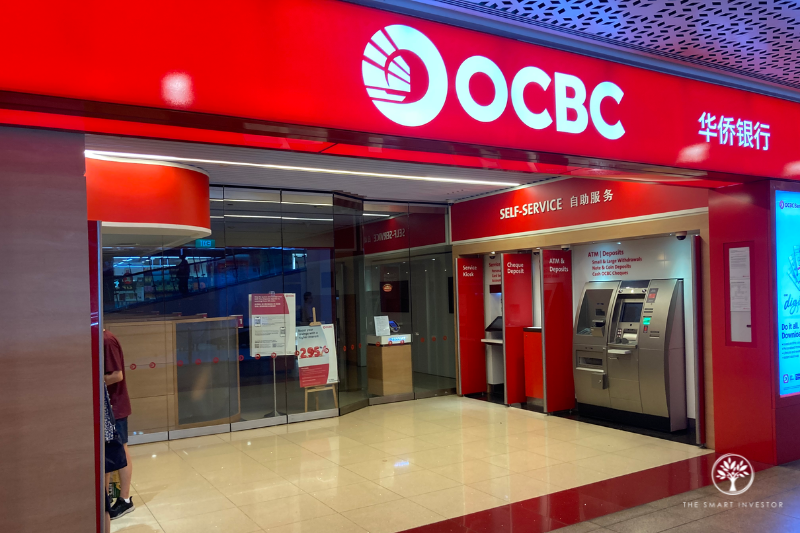
Can OCBC keep growing without rate support?
OCBC posted record income this year, and it did so while the rate backdrop turned against it.
That tension explains a lot about the stock.
Total income reached a new high of S$3.8 billion in the first quarter of 2026, up 5% YoY.
The story sat in the mix.
Net interest income fell 5% to S$2.2 billion as benchmark rates eased across the Singapore dollar, Hong Kong dollar and US dollar.
Net interest margin compressed 28 basis points to 1.76%.
Lower rates squeeze what a bank earns on its loans, and OCBC felt it.
The bank leaned on the other side of its business.
Non-interest income surged 23% to S$1.6 billion and made up more than 40% of the total.
Net fee income rose 24% to S$675 million, driven by a 34% rise in wealth management fees.
Insurance income leapt 34% to S$409 million.
Loan growth of 9% on a constant currency basis, to S$347 billion, cushioned the margin squeeze, and asset quality held firm with the non-performing loan ratio steady at 0.9% for an eighth straight quarter.
Net profit attributable to shareholders rose 5% to S$2 billion.
The market appears to have concluded that OCBC can grow through a falling-rate cycle by pivoting toward fees, wealth and insurance rather than leaning on interest income.
A bank that keeps earning as rates fall is a rarer thing than one that thrives when they rise.
Get Smart: One Index, Three Engines
The STI carried these three names higher.
It also carried plenty of others that did far less.
The gap between a 16.3% index return and returns in the mid-30s to low-40s came down to concentrated exposure to the right shift at the right time: a trading and listings revival at SGX, a defence and aerospace upcycle at ST Engineering, a wealth-and-fee pivot at OCBC.
An index hands you all of it, the leaders and the laggards together.
Picking the engines is harder, and it carries more risk when a single thesis stumbles.
The reward this year went to investors who held the businesses doing the pulling rather than the average of everything around them.
You’ve probably shopped at their malls, banked with them, or bought their products this month. These 6 SGX companies have paid dividends for 20 straight years, GFC and COVID included. Our FREE report shows you which ones, and what has kept their dividends going for 20 years and more. Grab your copy here.
Follow us on Facebook, Instagram and Telegram for the latest investing news and analyses!
Disclosure: The Smart Investor owns shares of SGX and OCBC.