A cash return feels like a win.
If you live off your portfolio, though, the useful question is not how big this year’s cheque is.
It is whether the same cheque turns up next year.
Three SGX-listed companies are handing cash back to shareholders in their latest financial year.
Each is doing it a different way.
One is paying an ordinary dividend and clearing out surplus capital on top.
One is running a multi-year programme of special dividends and buybacks.
One has topped up its ordinary dividend with a one-off special.
Tell those mechanisms apart, and you can see which income you can retire on and which is a one-time bonus.
Free cash flow (FCF) is the lifeblood of dividends.
So the test for each stock is the same.
Does the cash coming in cover what goes out to shareholders?
Here they are, from steadiest to most nuanced.
Credit Bureau Asia (SGX: TCU)
Credit Bureau Asia (CBA) supplies credit and risk information to banks, financial institutions and government bodies across Southeast Asia.
It runs credit bureaus in Singapore, Cambodia and Myanmar.
It also sells commercial risk and business information through a partnership with Dun & Bradstreet.
For the year ended 31 December 2025, revenue edged up 0.7% year on year (YoY) to S$60.1 million.
Profit attributable to owners slipped 4.4% to S$10.7 million.
Lower interest income, a softer contribution from the Cambodia joint venture and higher staff costs all weighed on the result.
The recurring dividend still went up.
A final dividend of S$0.022 brought the full-year payout to S$0.042, against S$0.040 a year ago.
FCF came in at S$27.2 million, well above what the company pays out.
The business carries no borrowings and, at group level, held S$71.1 million in liquid assets at year-end, made up of S$46.5 million in cash and S$24.7 million in treasury bills and money market funds.
That is the income a retiree can count on year to year.
Then there is the one-off.
The company has proposed a capital reduction, returning S$0.09 in cash for every share held, about S$20.7 million across the register.
There is a catch worth knowing.
This distribution is drawn from the company’s own cash, which it puts at around S$28.8 million at year-end.
After the S$0.09 payout and the final dividend, it expects to hold roughly S$3 million.
Management calls that sufficient, and against FY2025 running costs of about S$460,000, it has room.
But it says plainly that this is surplus being cleared out once, not a stream that repeats.
So read CBA in two parts.
A steady, cash-backed ordinary dividend you can plan around.
And a large one-time capital return that lands once, and should not be mistaken for recurring income.
Valuetronics (SGX: BN2)
Valuetronics is an electronics manufacturing services provider that handles design through to production for consumer and industrial customers out of China and Vietnam.
The payout move here is the biggest of the three.
Valuetronics declared a total FY2026 dividend of HK$0.38, up 41% on the year.
It raised its dividend policy too, to a target of 50% to 70% of net profit, up from 30% to 50%.
Management also plans to return around HK$300 million in surplus cash across FY2027 and FY2028 through special dividends and share buybacks, with about HK$146 million earmarked for FY2027.
That generosity sits against a weaker profit line.
Net profit fell 33.1% YoY to HK$111.4 million, dragged down by a HK$48.4 million net loss on its Trio AI investment and a higher tax bill.
Strip out Trio AI and adjusted net profit was HK$159.9 million.
The cash tells a healthier story.
FCF swung to a positive HK$178.4 million from negative HK$20.1 million a year ago.
Capital spending dropped sharply once the prior year’s GPU and AI-hardware outlay rolled off.
The group ended the year with HK$1.21 billion in cash and no borrowings.
So the income here rests on two things.
A large cash pile, and a stated intent to hand it back.
Neither rests on rising profit, and management has flagged a fluid environment of US tariffs and supply-chain uncertainty.
The capital return is real.
But treat the special dividends and buybacks as a planned drawdown of surplus cash across the next two years, not a permanent lift to the ordinary payout.
Old Chang Kee (SGX: 5ML)
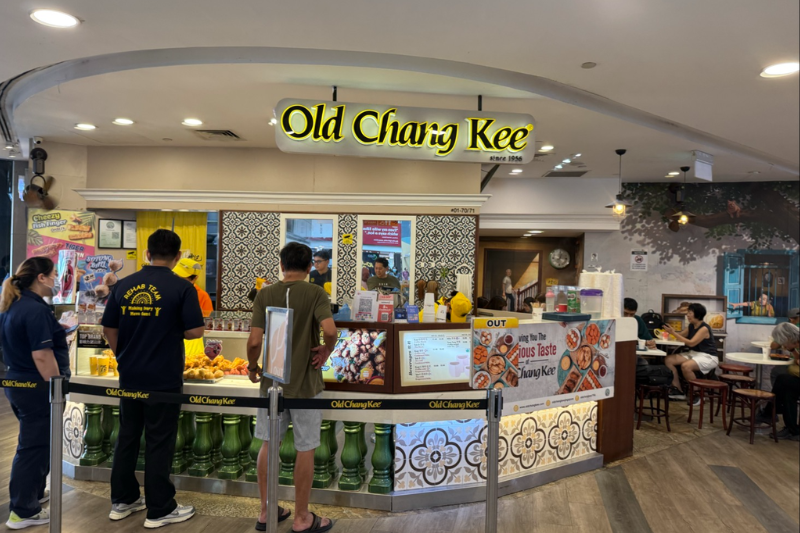
Old Chang Kee, the curry puff maker, sells its snacks through retail outlets at high-traffic spots and through delivery, catering and business supply.
Its total payout rose too, to S$0.03 per share from S$0.02 a year ago.
The make-up matters.
Of that S$0.03, only S$0.02 is the recurring dividend, a S$0.01 interim and a S$0.01 proposed final.
The remaining S$0.01 is a one-off special dividend.
That distinction matters because the recurring business is under pressure.
For the fiscal year ended 31 March 2026, revenue edged up 1.5% to S$103.5 million.
Net profit fell 15.8% to S$9.6 million, weighed down by higher staff costs, more depreciation and lower interest income.
The cash position holds up.
FCF was a positive S$21.0 million, down from S$23.2 million.
The company holds S$61.6 million in cash and deposits against just S$1.4 million of debt.
Inflation and manpower shortages remain the headwinds management is steering against.
For a retiree, the conclusion is straightforward.
The ordinary dividend this year is S$0.02.
The special S$0.01 is a welcome bonus.
Don’t bank it as income that repeats.
Get Smart: A cash return is not the same as an income stream
Look at what these three have in common.
All are returning cash into a softer profit environment.
None is doing it on the back of booming earnings.
They are doing it on free cash flow and balance-sheet strength, which is the right way round.
But the shape of each return is different, and that is what a retiree has to read carefully.
Credit Bureau Asia is paying a steady ordinary dividend and clearing out surplus capital once.
Valuetronics is committing to a two-year programme of special dividends and buybacks from a large cash pile.
Old Chang Kee has added a single special dividend on top of its ordinary payout.
Only one part of each is the recurring income you can plan a retirement around.
The rest is a bonus, and bonuses do not repeat on schedule.
So ask the harder questions every time.
Where does the cash come from?
Is it profit, or is it surplus being cleared out?
Is the recurring payout covered, or stretched?
Answer those, and the size of this year’s cheque becomes the least interesting thing about it.
S$5 billion in government backing. S$1.1 billion already deployed. Singapore’s small-cap market is about to explode, and most people are completely clueless. Our FREE report gives you the inside track on 5 companies positioned to benefit. Download now before the crowd catches on.
Follow us on Facebook, Instagram and Telegram for the latest investing news and analyses!
Disclosure: Calvina L. does not own shares of any companies mentioned.