Generating regular passive income is usually one of the primary objectives for most dividend investors.
In Singapore, the two popular income-producing sources are blue-chip stocks and real estate investment trusts (REITs).
Instead of competing with each other, they can be used to complement each other.
Understanding the Difference Between Blue Chips and REITs
What are blue-chip stocks?
Blue chips are typically well-established firms with a long operating history, strong reputations and consistent financial performance.
These companies are widely associated with reliable dividends, operational stability, and long-term wealth appreciation.
They have strong market positions and consistent profitability, like Southeast Asia’s biggest bank, DBS Group (SGX: D05), and aerospace and defence giant, ST Engineering (SGX: S63).
What are REITs?
REITs are companies that own, operate, or finance income-generating real estate.
Strong REITs like CapitaLand Integrated Commercial Trust (SGX: C38U) (CICT) and Parkway Life REIT (SGX: C2PU) own high-quality assets, keep prudent balance sheets, and grow distributions through different market environments.
Singapore REITs are required to pay out at least 90% of their taxable income to unitholders to qualify for tax transparency, making them appealing to income investors.
What Blue-Chip Stocks Bring to an Income Portfolio
Blue chips are corporations characterised by strong cash balances and reasonable debt positions.
These stocks can survive difficult economic conditions, pay dividends, and operate efficiently under any market conditions.
With time, blue-chip stocks can also raise their dividends alongside rising profits.
DBS paid dividends of S$3.06 per share for FY2025 against S$0.54 a share in FY2015 – an impressive fivefold increase in dividend payments.
This allows investors to steadily increase their investment income and keep up with the rising cost of living.
Blue chips also bring opportunities for capital appreciation since the price of blue-chip stocks tends to rise with improved financial performance.
What REITs Bring to an Income Portfolio
By investing in REITs, you gain access to physical, income-generating assets.
This adds a unique layer of diversification as real estate often behaves differently from traditional stocks and bonds.
As rental payments are paid on a monthly basis or through long-term lease contracts, REITs have fairly predictable cash flows, allowing them to make distributions on a consistent basis.
The high starting yields provided by REITs come as a result of legal requirements that require them to pay out at least 90% of their taxable income.
For example, CICT currently offers about 5% yield, compared to ST Engineering, which offers a 2.2% yield.
Why They Work Better Together
REITs and blue-chip stocks complement each other by balancing current income with future income growth.
REITs typically provide higher current yields, while blue-chip stocks deliver steady dividend growth as corporate earnings rise over time.
REITs and blue chips also generate income differently, and these diversified income streams may respond differently to economic conditions.
Combining them can make a portfolio more resilient.
A Hypothetical Passive Income Portfolio
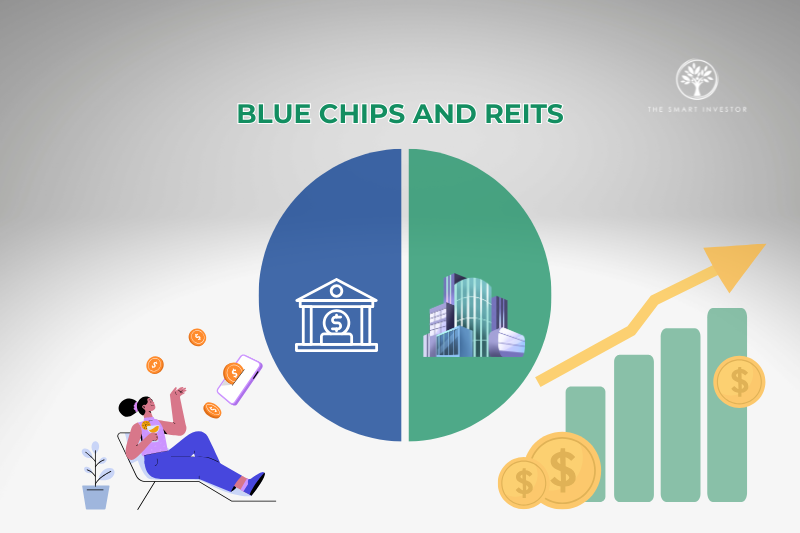
A portfolio split between blue-chip stocks and REITs can provide a balanced mix of income, stability, and growth:
- 50% blue-chip stocks: DBS Group, ST Engineering, and Singapore Airlines (SGX: C6L)
- 50% REITs: CICT, Parkway Life, and Mapletree Logistics Trust (SGX: M44U)
Blue chip dividends and REITs’ distributions generate portfolio income from two complementary sources.
Together, they can create a steady stream of income that supports cash flow needs while reducing reliance on a single asset class.
Over the long term, this allocation can also support wealth creation through both income growth and capital appreciation.
A 50/50 portfolio can offer investors both reliable income today and meaningful portfolio growth in the future.
What Investors Should Watch
Interest rates: Changes to interest rates affect asset classes differently. Rising interest rates can pressure REIT valuations because higher borrowing costs reduce profitability, while banks typically benefit from higher rates as they improve lending margins.
Distribution sustainability: Sustainable payouts supported by healthy financial fundamentals are generally more reliable than unusually high distributions with weak underlying cash generation.
Economic conditions: Broader economic conditions such as recessions, inflation, and growth cycles can impact REITs and blue-chip stocks differently. Inflation can benefit certain REITs if landlords can raise rents, while strong economic growth may support corporate earnings and dividend expansion.
Common Mistakes Income Investors Make
One of the most common mistakes income investors make is focusing only on the highest-yielding investments.
A very high yield can sometimes signal financial distress or unsustainable payouts rather than genuine opportunity.
Yield should always be evaluated alongside business quality, cash flow strength, and growth potential.
In addition, concentrating solely on only REITs or blue chips would expose investors to unnecessary risks.
Diversification across multiple asset classes helps reduce dependence on any single source of income.
Finally, focusing exclusively on current income can cause investors to miss opportunities for long-term wealth creation.
Investors who balance present income with future growth are often better positioned to preserve purchasing power and build lasting wealth.
Which Investors May Benefit Most?
Retirees often benefit from a blended portfolio because it can provide consistent and diversified income streams.
This combination can support regular withdrawals while reducing dependence on selling assets during unfavourable market conditions.
On the other hand, younger investors benefit significantly from reinvesting dividends and distributions rather than spending them.
Over long time horizons, this compounding effect can substantially increase portfolio value, especially when combined with dividend growth and long-term capital appreciation.
Investors who want a balance between stability, income, and growth may find a combination of REITs and blue-chip stocks particularly attractive.
Get Smart: Don’t Choose Between Blue Chips and REITs
Both REITs and blue-chip stocks have their own strengths and weaknesses.
A balanced portfolio consisting of both asset classes creates a more diversified and resilient passive income portfolio.
The smartest investors do not find that single perfect asset but instead build a portfolio that generates income through any market condition.
This new 10-minute read could change how you invest this year. Inside:
5 SG dividend-paying blue chips that have quietly powered through past downturns, and could reward you handsomely in the next.
Grab the free report now. It might be the most profitable thing you read today.
Disclosure: Wenting A. does not own any stocks mentioned.