Most REIT investors focus on yields, occupancy rates, and interest costs.
But there is another force quietly impacting distributions: currency movements.
As the Singapore dollar (SGD) strengthens, overseas rental income can shrink once translated back into local currency, creating a subtle drag on distributions.
This article explores how Singapore’s currency policy affects REIT payouts, and which REITs face the most exposure.
Why the Singapore Dollar Matters for REIT Investors
The Monetary Authority of Singapore (MAS) manages monetary policy differently from most major central banks.
Instead of relying mainly on domestic interest rates, MAS manages monetary policy by targeting the exchange rate of the Singapore dollar against a basket of currencies of its major trading partners.
That stronger currency helps tame imported inflation.
However, it can simultaneously dilute overseas earnings for Singapore-listed REITs holding international assets when those foreign cash flows are converted back into SGD.
How Currency Movements Affect REITs
Many Singapore REITs (S-REITs) earn rental income in foreign currencies such as the Australian dollar (AUD), the Euro (EUR), or Japanese yen (JPY).
When the Singapore dollar appreciates, those overseas earnings lose value upon conversion, even if the underlying properties maintain robust operational performance.
Lower translated income can reduce total distributable cash flow, putting pressure on distribution per unit (DPU) growth.
In prolonged periods of local currency strength, foreign exchange headwinds can offset positive operational milestones such as positive rental reversions or higher portfolio occupancy.
Which REITs Are Most Exposed?
REITs With Large Overseas Portfolios
Naturally, REITs with larger overseas exposure run into more foreign exchange risks.
Therefore, investors should look beyond revenue, but also pay attention to hedging ratios, the mix of debt currencies, and what management says about currency movements.
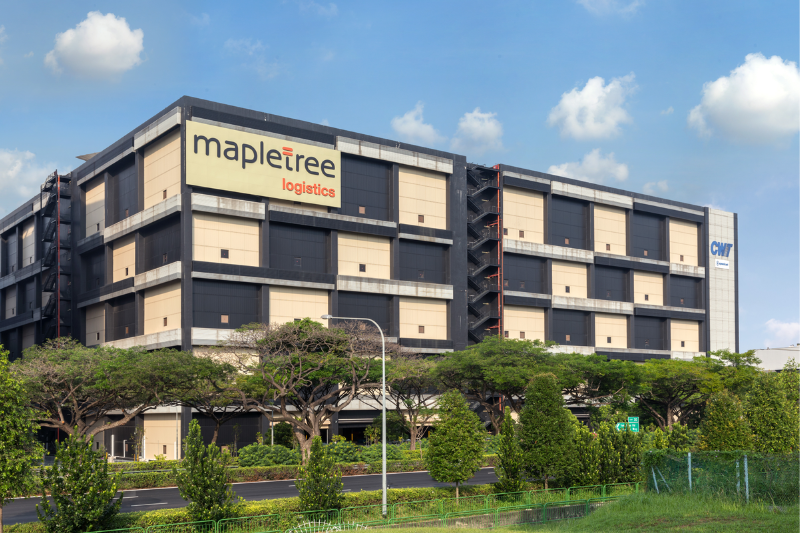
Mapletree Logistics Trust (SGX: M44U), or MLT, is one of the more globally diversified REITs on the Singapore Exchange (SGX).
In its most recent quarterly filing (4QFY2025/2026), aggregate leverage stood at 40.6%, with around 83% of total debt locked into fixed interest rates.
The REIT also uses natural hedging by matching borrowing currencies aligned with asset locations.
Additionally, approximately 75% of its income stream for the next 12 months is hedged back into SGD.
Despite these defensive measures, MLT’s distribution history illustrates the persistent pressure of currency translation over time.
Annual DPU declined from S$0.09003 in FY2023/24 to S$0.08053 in FY2024/2025, before easing further to S$0.07262 in FY2025/2026.
While higher interest costs and softer regional logistics demand contributed to the decline, foreign exchange translation from a resilient Singapore dollar remained a significant headwind.
REITs With Purely Domestic Focus
Conversely, Frasers Centrepoint Trust (SGX: J69U) minimizes foreign exchange risk, thanks to a portfolio that’s almost entirely based in Singapore.
As of 31 March 2026, all of its retail assets – including Causeway Point, Northpoint City (North Wing), and Tampines 1 – operate within Singapore.
That’s why nearly all the REIT’s rental income is collected in SGD, effectively insulating the REIT from currency translation volatility.
FCT reported an aggregate leverage ratio of 40% in the latest financial update (1HFY2026), with 66% of its borrowings protected by fixed interest rates.
This structural defense has supported a highly resilient DPU profile despite macroeconomic shifts.
FCT’s distributions have tracked within a tight five-year range of S$0.12042 to S$0.12227, finishing at S$0.12113 in FY2025.
How REIT Managers Handle Currency Risk
S-REIT managers generally rely on two primary toolkits to defend distributions against exchange rate volatility: forward currency hedging and natural hedging.
Currency hedging involves locking in exchange rates for anticipated overseas rental income via derivative contracts to smooth out short-term quarterly fluctuations.
Natural hedging works by borrowing in the same currency as their overseas assets.
This ensures that if the asset value or rental income drops in SGD terms, the corresponding debt obligations decline in value as well, protecting the balance sheet.
However, hedging comes with structural limitations. Derivative contracts carry transactional costs that can weigh on net returns over time, and typically only cover income on a rolling short-to-medium-term basis.
As a result, prolonged strength in the Singapore dollar can still affect distributable income and DPU despite these safeguards.
Why Currency Risk Matters More Today
Currency risk has become increasingly important for REIT investors.
Singapore relies on a strong Singapore dollar to help control inflation, but that strength cuts both ways.
For investors and companies, overseas earnings lose value when converted back to SGD.
Concurrently, the S-REIT sector’s multi-year push into international markets to chase scale and higher yields means that portfolios are inherently more sensitive to currency swings than they were a decade ago.
As geographical diversification increases, exchange rate movements play a bigger and more direct role in shaping distributable income and DPU.
Ignoring currency risk is no longer an option.
Does a Stronger SGD Always Mean Bad News?
A stronger Singapore dollar does not necessarily mean bad news for overseas-focused REITs.
Overseas diversification can still provide stronger growth opportunities, access to larger markets, and potentially higher yields.
Over the long run, asset quality, localized demand drivers, and proactive operational management often matter more than short-term currency swings.
Get Smart: Don’t Let Currency Risk Hide in Plain Sight
Many investors tend to ignore currency risk when looking at REITs.
When the Singapore dollar strengthens, overseas portfolios face an uphill battle to grow their DPU in SGD terms.
But the better-managed REITs fight back.
Chasing the highest yields isn’t the answer.
The real win comes from building a balanced portfolio that blends resilient domestic retail or commercial assets with well-hedged, high-growth international exposure – ensuring a steady, reliable stream of distributions over the long haul.
Imagine receiving steady rent increases for more than two decades. It sounds unusual, but one healthcare REIT already has rental escalations locked in until around 2042. Income visibility like this is hard to find today. We break down how this REIT built such dependable cash flow in our FREE dividend report and how it could strengthen a retirement portfolio. Get the free report here.
Follow us on Facebook, Instagram and Telegram for the latest investing news and analyses!
Disclosure: Joseph G. does not own shares of any companies mentioned.