Think about the products and services you use every day.
The bread on your breakfast table, the curry puff you grab at the MRT station, the dental check-up you schedule every six months.
These everyday essentials are more than just line items on your monthly budget; they are the engines driving several established companies listed right here on the Singapore Exchange (SGX: S68).
For the income-focused investor, the appeal of these “boring” businesses is clear.
We use them regardless of whether the Straits Times Index (SGX: ^STI) is up or down.
However, the real challenge is determining whether these familiar household names can actually deliver a reliable stream of passive income.
To find the answer, we have to look past the brand and dive into the balance sheet.
When profits face pressure – as they recently have for the three companies below – it is the cash reserve, not the marketing budget, that ensures your dividend cheque remains in the mail.
QAF Limited (SGX: Q01)
If you have ever bought a loaf of Gardenia bread, you are already a customer of QAF Limited.
The group is a dominant force in the regional bakery scene, manufacturing and distributing a massive array of confectionery products across Singapore, Australia, the Philippines, and Malaysia.
The first half of 2025 (1H2025) was a test of resilience for the bakery giant.
QAF reported revenue of S$306.1 million, a slight 1% dip year on year (YoY) as shoppers tightened their belts.
On the surface, the profit figures looked alarming; profit attributable to owners tumbled 69% to S$3.9 million.
This sharp drop was largely fueled by a perfect storm of non-cash setbacks, including S$3.0 million in foreign currency losses and a S$1.9 million impairment on its Malaysian joint venture.
Yet, for dividend seekers, the underlying health of the business told a more optimistic story.
Free cash flow actually grew by 13% to S$11.5 million, thanks to disciplined capital spending.
Even more comforting is QAF’s fortress balance sheet.
The company holds a massive net cash position of S$162.4 million, with S$188.6 million in the bank against a tiny S$6.9 million in debt.
This cash hoard represents nearly 29% of the company’s S$552 million market capitalisation.
With an unchanged interim dividend of S$0.01 and a trailing yield of 4.9% at a S$1.02 share price, QAF is effectively using its deep pockets to protect shareholders while waiting for consumer sentiment to recover.
Old Chang Kee (SGX: 5ML)
Old Chang Kee, or OCK, is a Singaporean institution.
From its humble beginnings as a single stall, it has grown into a high-margin retail machine famous for its signature Curry’O.
For the six months ended 30 September 2025 (1HFY2025), OCK managed to edge its revenue up by 0.2% to S$51.9 million.
However, the bottom line felt the pinch of rising costs, with net profit declining 19.3% to S$5.0 million and free cash flow dropping 20% to S$8.8 million.
The squeeze is a classic tale of modern Singaporean business: higher raw material costs and rising wages.
Gross margins narrowed slightly to 69.3%, while selling expenses climbed 4% as the company absorbed the impact of the Progressive Wage Model and the costs of opening new outlets.
Despite these headwinds, OCK remains an incredibly cash-rich entity.
As of late 2025, the group held S$57.3 million in cash against just S$1.0 million in debt.
For a company valued at roughly S$136 million, having 41% of your market value sitting in cold, hard cash provides a significant margin of safety.
Management maintained its interim dividend at S$0.01 per share.
While the trailing yield is a more modest 1.7% at a share price of S$1.17, the massive cash cushion suggests that OCK is well-equipped to navigate a structurally higher-cost environment without compromising its payout.
Q&M Dental Group (SGX: QC7)
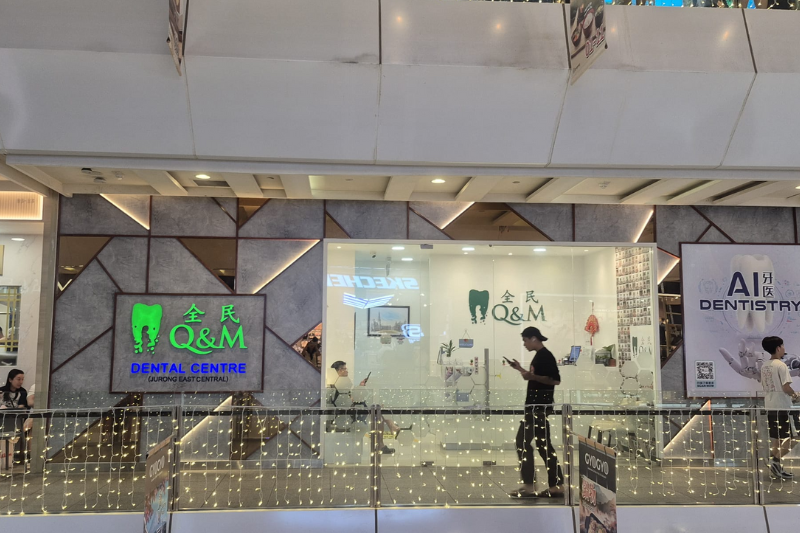
As the largest listed dental healthcare provider in Singapore, Q&M Dental oversees a sprawling network of 152 dental outlets across Singapore, Malaysia, and China.
Its 1H2025 results were somewhat complicated by accounting manoeuvres.
Reported profit fell 60% to S$3.9 million, but this was primarily due to a one-off S$4.4 million accounting loss triggered by reclassifying its subsidiaries.
When we look at the core operations, the business is actually growing.
Underlying profit rose 5% to S$8.3 million, supported by a steady climb in dental revenue.
Unlike its peers in the food industry, Q&M is in an aggressive expansion phase.
The group recently issued S$130 million in notes to fund acquisitions across China and the Johor-Singapore Special Economic Zone.
This move has shifted the balance sheet to a net debt position of S$78.5 million.
Currently, Q&M offers a trailing dividend yield of approximately 2.0% based on its S$0.54 share price and a first interim dividend of S$0.004.
Because the company is leaning on leverage to fuel its M&A strategy, the sustainability of its dividend is more closely tied to the successful integration of these new clinics.
It is a classic “growth-meets-income” play where the payout depends on management’s ability to turn new debt into fresh earnings.
Get Smart: The balance sheet is your dividend safety net
These three companies prove that even when the economic weather gets choppy, the businesses that provide our daily essentials often have the stamina to keep paying their investors.
However, there is a clear distinction in how they protect those payouts.
QAF and Old Chang Kee provide a masterclass in balance sheet strength.
Their massive net cash positions act as a shock absorber, allowing them to maintain dividends even when net profits fluctuate.
Q&M Dental, conversely, is trading some of that safety for growth potential, relying on its expansion strategy to keep the cash flowing.
For dividend investors, the lesson is clear.
Free cash flow is the lifeblood of dividends, but net cash is the safety net.
When you look at the companies behind your grocery list, always ask if they have the financial stamina to keep paying you when the market takes a bite out of their margins.
What if you could collect a steady income from Singapore companies for decades to come? We found one in a near-duopoly with 70%+ market share that’s practically printing money. Our FREE small-cap report uncovers this “hidden monopoly” advantage (plus 4 other dividend powerhouses) that will keep paying no matter what the market does. Click here to grab your copy now.
Follow us on Facebook, Instagram and Telegram for the latest investing news and analyses!
Disclosure: Calvina Lee does not own any of the stocks mentioned. Chin Hui Leong contributed to the article and does not own any of the stocks mentioned.